
32-Bit Architecture: A Technical History of Computing Evolution
The evolution of computer architecture is often defined by the width of the data it can process. At the heart of this evolution is the 32-bit architecture, a design standard that allows a processor to handle 32-bit integers and address a vast range of memory. While modern computing has largely moved toward 64-bit systems, the journey of 32-bit design reveals the ingenious ways engineers overcame the physical and financial constraints of early hardware.
The Dawn of Stored-Program Computing
The origins of 32-bit architecture date back to 1948 with the Manchester Baby. As the first stored-program electronic computer—meaning it could store its instructions in electronic memory rather than being physically rewired—it utilized a 32-bit architecture. However, it was primarily a proof of concept with very limited practical capacity.
The Manchester Baby featured only 32 32-bit words of RAM (Random Access Memory) stored on a Williams tube. Interestingly, its mathematical capabilities were minimal; it lacked a dedicated addition operation and relied solely on subtraction.
Overcoming Early Hardware Constraints
Between the 1960s and the 1980s, the components required for 32-bit systems—such as digital circuits, wiring, and memory—were prohibitively expensive. To make these machines commercially viable, manufacturers introduced various compromises to reduce costs without abandoning the 32-bit logic.
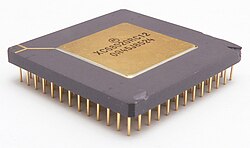
Many early processors maintained 32-bit registers and instructions to manipulate 32-bit quantities, but utilized narrower internal components. For instance, the IBM System/360 Model 30 operated with an 8-bit ALU (Arithmetic Logic Unit), 8-bit internal data paths, and an 8-bit path to memory. Similarly, the original Motorola 68000 featured a 16-bit data ALU and a 16-bit external data bus, leading some to describe it as a 16/32-bit design.
Advancements in Bus Width and Memory Access
As technology matured, 32-bit designs evolved to support external bus widths that exceeded 32 bits, enhancing performance and memory capacity. The Pentium Pro is a prime example; while it remains a 32-bit processor in terms of its registers and instructions, it employs a 36-bit external address bus. This allows the system to access more than 4 GB of memory.
Furthermore, the Pentium Pro utilizes a 64-bit external data bus to enable more efficient prefetching of data and instructions. A similar approach was taken with the PowerPC 604, which combines a 32-bit architecture with a 64-bit external data bus for increased throughput.
Key Facts
- First Implementation: The Manchester Baby (1948) was the first stored-program computer to use a 32-bit architecture.
- Cost-Cutting Measures: Early 32-bit CPUs often used narrower ALUs (8-bit or 16-bit) to reduce expensive wiring and circuitry.
- Hybrid Designs: The Motorola 68000 is a notable "16/32-bit" design due to its 32-bit registers paired with a 16-bit external data bus.
- Memory Expansion: The Pentium Pro used a 36-bit address bus to bypass the standard 4 GB memory limit of 32-bit systems.
- Data Efficiency: Later 32-bit processors, like the PowerPC 604, adopted 64-bit external data buses for better performance.
| Processor/System | Architecture | ALU/Internal Path | External Bus/Memory Feature |
|---|---|---|---|
| Manchester Baby | 32-bit | Subtraction only | 32 words of RAM (Williams tube) |
| IBM System/360 Model 30 | 32-bit | 8-bit | 8-bit memory path |
| Motorola 68000 | 32-bit | 16-bit | 16-bit external data bus |
| Pentium Pro | 32-bit | 32-bit | 36-bit address / 64-bit data bus |
| PowerPC 604 | 32-bit | 32-bit | 64-bit external data bus |
Frequently Asked Questions
What defines a processor as "32-bit"?
A processor is generally considered 32-bit if it has 32-bit registers and uses instructions designed to manipulate 32-bit quantities of data.
Why did some early 32-bit processors have 8-bit or 16-bit ALUs?
During the 1960s through the 1980s, memory, wiring, and digital circuits were very expensive. Using narrower ALUs and data paths was a cost-saving compromise that allowed manufacturers to keep the 32-bit instruction set while reducing hardware costs.
How did the Pentium Pro access more than 4 GB of RAM?
While it remained a 32-bit processor internally, the Pentium Pro utilized a 36-bit external address bus, which expanded the amount of memory the CPU could physically address beyond the 4 GB limit.
What was unique about the Manchester Baby's memory?
The Manchester Baby used a Williams tube for its RAM, which could only hold 32 words of 32-bit data.
What is the difference between a data bus and an address bus?
A data bus carries the actual data being processed (such as the 64-bit bus in the PowerPC 604), while an address bus specifies the location in memory where that data is stored (such as the 36-bit bus in the Pentium Pro).