
4th Millennium BC: The Dawn of Complex Civilizations
The 4th millennium BC represents one of the most transformative eras in human history. This period marks the transition from the Neolithic (the New Stone Age, characterized by the advent of farming) to the Chalcolithic (the Copper Age), eventually paving the way for the Bronze Age. Across the globe, human societies shifted from small agricultural villages to complex urban centers, inventing writing, metallurgy, and monumental architecture.
Key Facts
- Writing: Proto-cuneiform emerged in Mesopotamia, leading to the first unequivocal Sumerian documents by the 31st century BC.
- Innovation: The potter's wheel, sailboat, and wheeled carts were developed during the Uruk period.
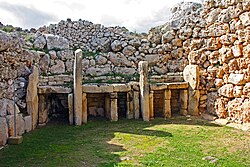
- Architecture: The Ġgantija temples in Malta stand as the world's oldest extant unburied free-standing structures.
- Migration: The Yamnaya culture of the Pontic-Caspian steppe is linked to the spread of Proto-Indo-European languages.
- Agriculture: Maize domestication appeared in the Valley of Tehuacán (Mexico) around 3600 BC.
Mesopotamia and the Near East
In the Near East, the Uruk period (4100–3100 BC) saw the rise of Sumerian hegemony. This era introduced Proto-cuneiform—an early form of writing—alongside base-60 mathematics, astronomy, and complex hydrology. The Sumerians engineered dams and canals and utilized the inclined plane and lever for stone sculptures.
By 3500 BC, Sumerians were utilizing wheeled carts and bronze tools. The city of Ur became a center of power with the construction of the tomb of Mes-Kalam-Dug, while the temple of Inanna was erected at Eridu.
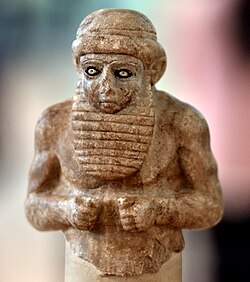
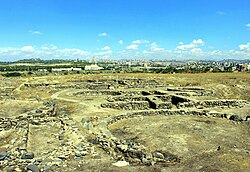
Further east, the Persian plateau saw Susa become a major center for pottery production around 4000 BC, and the Proto-Elamite script emerged by 3200 BC. In the Caucasus, the Maykop culture (3700–3000 BC) is considered a primary candidate for the origin of bronze production.
Ancient Egypt and the Levant
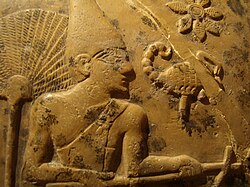
Along the Nile, the Naqada culture flourished between 4000 and 3000 BC. The first hieroglyphs appeared around 3500 BC on labels found in a ruler's tomb at Abydos. This era saw the development of mastabas—bench-like tombs that served as the predecessors to the pyramids.
By 3100 BC, the Narmer Palette signaled the transition toward the Early Dynastic period. Egyptians of this time utilized sails on the Nile and played musical instruments including harps, flutes, lyres, and double clarinets.
European Developments and Megaliths
Europe experienced a diverse array of cultural shifts. In the Pontic-Caspian steppe, the Yamnaya (or Kurgan) culture (3500–2300 BC) emerged. This group is believed to be the locus of the Proto-Indo-Europeans and the origin of the Proto-Indo-European language.
![Bronze Age spread of Yamnaya steppe pastoralist ancestry into two subcontinents—Europe and South Asia—from c. 3300 to 1500 BC.[5]](/images/f8/91/f89120c8cf82f4b6d1114e796dc35c313bbfa46a7933150e68ff5bc2bba0d93c.jpg)
In the Mediterranean, Malta became a hub of monumental construction. The Ġgantija temple complex (3600 BC) and the Mnajdra solar temple provided early examples of religious architecture featuring stone benches and tables.
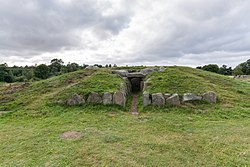
Northern Europe saw the rise of the Funnelbeaker culture (4000–2700 BC). Notable achievements include the Newgrange solar observatory in Ireland and the early phases of Stonehenge in England, which began as a circular earth bank and ditch around 3100 BC.
Global Transitions: Asia, Africa, and the Americas
In the Indus Valley, the Bronze Age began around 3300 BC in Harappa, introducing advanced drainage and sewage disposal systems. Meanwhile, Neolithic Chinese cultures like the Yangshao and Longshan produced silk, pottery, and domesticated pigs and dogs.
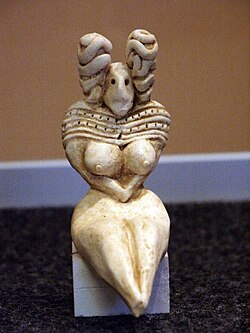
In the Americas, the Norte Chico civilization began in Northern Peru, and the first pottery in the New World appeared in Colombia at Puerto Hormiga around 3000 BC. In Sub-Saharan Africa, the desiccation of the Sahara around 3500 BC forced herders into the Nile Valley and eastern Africa, potentially triggering the dispersal of the Niger-Congo linguistic phylum.
Summary of 4th Millennium BC Milestones
| Region | Key Culture/Civilization | Major Achievement | Approx. Date |
|---|---|---|---|
| Mesopotamia | Sumerian (Uruk) | Proto-cuneiform & Wheel | 4100–3100 BC |
| Egypt | Naqada | Hieroglyphs & Mastabas | 4000–3000 BC |
| Malta | Megalithic | Ġgantija Temples | 3600 BC |
| Steppes | Yamnaya | Proto-Indo-European origin | 3500–2300 BC |
| Indus Valley | Harappan | Bronze Age & Sewage systems | 3300 BC |
Frequently Asked Questions
What was the Uruk period?
The Uruk period (4100–3100 BC) was a phase in Mesopotamia characterized by the rise of Sumerian hegemony, the development of the first cities, and the invention of proto-writing and the potter's wheel.
Who were the Yamnaya people?
The Yamnaya were a culture of the Pontic-Caspian steppe (3500–2300 BC) believed to be the ancestors of Proto-Indo-European speakers, contributing significantly to the genetic and linguistic makeup of Europe and South Asia.
What are the oldest free-standing structures in the world?
The Ġgantija temples in Malta, constructed around 3600 BC, are the world's oldest extant unburied free-standing structures.
When did writing first appear in Egypt?
The first Egyptian hieroglyphs appeared around 3500 BC, discovered on labels within a ruler's tomb at Abydos.
What was the significance of the Funnelbeaker culture?
The Funnelbeaker culture (4000–2700 BC) was a Neolithic culture in Scandinavia and Northern Europe known for its distinct pottery and the construction of passage graves.