
Abscopal Effect: How Localized Cancer Treatment Triggers Systemic Responses
In the fight against metastatic cancer, the goal is typically to address every site of disease within the body. However, a fascinating phenomenon known as the abscopal effect suggests that treating a single tumor site can sometimes lead to the shrinkage of other, untreated tumors located elsewhere in the organism.
First coined in 1953 by Robin H. Mole, the term is derived from the Latin words 'ab' (away from) and 'scopus' (target). It describes a scenario where ionizing radiation—or other localized therapies—produces a therapeutic effect at a distance from the actual irradiated volume.
Key Facts
- Definition: The shrinkage of untreated tumors occurring concurrently with the treatment of a localized tumor.
- Origin: The term was proposed by Robin H. Mole in 1953.
- Mechanism: Modern research indicates the effect is mediated by the adaptive immune system.
- Treatment Types: While originally linked to radiation, it can occur with electroporation and intra-tumoral injections.
- Exclusions: Systemic treatments, such as chemotherapy, do not produce an abscopal effect because they circulate through the bloodstream.
The Evolution of the Abscopal Hypothesis
For many years, the abscopal effect was primarily associated with localized radiation therapy. Over time, the definition expanded to include other targeted interventions, such as electroporation (using electrical pulses to increase cell membrane permeability) and the direct intra-tumoral injection of therapeutics. The defining characteristic of an abscopal response is that the treatment remains strictly local, yet the resulting benefit is systemic.
For decades, the biological drivers behind this phenomenon remained a mystery. It was not until 2004 that researchers postulated that the immune system was the primary mediator of these "off-target" anti-tumor effects.
The Role of the Immune System
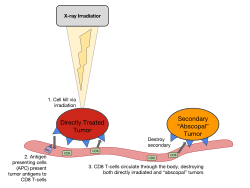
The current scientific understanding suggests that local radiation causes tumor cell death, which then acts similarly to a vaccine. This process allows the adaptive immune system to recognize tumor antigens and launch a systemic attack against cancer cells throughout the body. This hypothesis has been supported by various animal models involving colorectal, mammary, and melanoma tumors.
Clinical Evidence and Modern Applications
Clinical studies have provided evidence of these effects in humans. For example, randomized trials involving women treated with lumpectomy for breast cancer combined with targeted intraoperative radiotherapy showed a reduction in mortality from non-breast-cancer causes compared to those receiving only whole breast radiotherapy.
While reports of the abscopal effect were extremely rare during the 20th century, the advent of immune checkpoint blocking antibodies—such as ipilimumab and pembrolizumab—has changed the landscape. These drugs help the immune system overcome the "brakes" put in place by cancer cells, significantly increasing the number of patients who exhibit an abscopal response, particularly those with lymphoma or metastatic melanoma.
| Treatment Type | Scope of Action | Abscopal Potential | Reasoning |
|---|---|---|---|
| Ionizing Radiation | Localized | Yes | Triggers systemic immune recognition. |
| Electroporation | Localized | Yes | Local treatment with systemic effects. |
| Intra-tumoral Injection | Localized | Yes | Local delivery triggering systemic response. |
| Chemotherapy | Systemic | No | Circulates through the bloodstream. |
Frequently Asked Questions
What exactly is the abscopal effect?
The abscopal effect is a phenomenon where treating a localized tumor results in the shrinkage of other untreated tumors located elsewhere in the body.
Can chemotherapy cause an abscopal effect?
No. Because chemotherapeutic agents circulate through the bloodstream to reach all parts of the body, they are systemic treatments and therefore cannot produce an abscopal response, which requires a local treatment to trigger a systemic effect.
How does the immune system trigger this effect?
Local treatment (like radiation) causes tumor cell death, which allows the adaptive immune system to recognize the cancer. This recognition enables the immune system to attack tumors at distant sites, acting much like a vaccine.
Which modern drugs have increased the frequency of this effect?
Immune checkpoint blocking antibodies, specifically ipilimumab and pembrolizumab, have greatly increased the number of patients responding abscopally, especially in cases of metastatic melanoma and lymphoma.
Who first named the abscopal effect?
The term was proposed by Robin H. Mole in 1953, using the Latin roots 'ab' (away from) and 'scopus' (target).