
Academic Fencing: The Evolution of the German Mensur
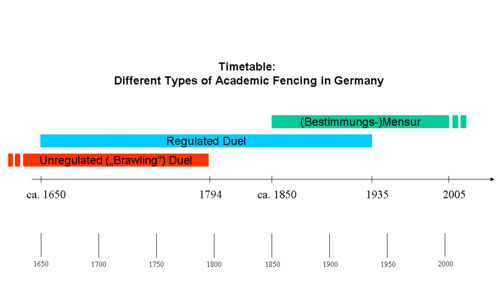
The tradition of academic fencing in Germany is a complex legacy that evolved from lethal street brawls into a highly regulated system of personality training. Rooted in the social distinctions of the early modern period, this practice allowed students to separate themselves from the general population through unique dress, songs, and the ritualized use of weaponry.
Initially, the practice was influenced by the European nobility. Starting in Spain at the end of the 15th century, the rapier (a slender, thrusting sword) became standard attire for noblemen. This trend migrated to the Holy Roman Empire, where students adopted the weapon. During the 16th and 17th centuries—a period marked by the brutality of the Reformation wars and the Thirty Years' War (1618–1648)—student life was perilous, and spontaneous fights in the streets were common.
The Transition to Regulated Dueling
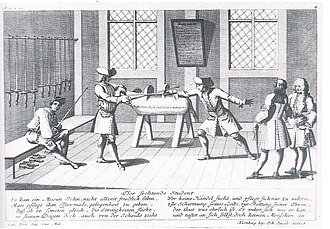
To move away from chaotic violence, students introduced the "regulated" duel in the 17th century. Unlike spontaneous encounters, known as rencontre (French for "meeting"), these bouts followed a strict code called the comment (French for "how").
These regulated events introduced several formal roles to ensure order and safety:
- Kartellträger: The official responsible for arranging the time and location.
- Second: A representative who protected the fighter's interests and provided physical security.
- Referee: An official who made decisions during the bout.
- Doctor: A medical professional present to treat injuries.
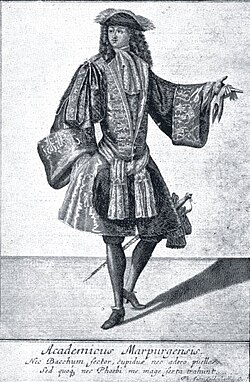
As fashions shifted after the French Revolution at the end of the 18th century, wearing weapons in public became forbidden. While this reduced spontaneous fighting, the regulated duel persisted in secret.
Weaponry and Technical Evolution
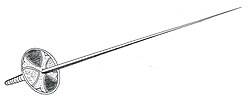
The tools of academic fencing evolved alongside the techniques. In the mid-18th century, the foil was developed in France as a training tool. By blunting the point with a "blossom" (fleuret), fencers could practice elegant thrusts safely. However, some students removed these protections to use the sharp foil in duels, leading to the creation of the Pariser (Parisian smallsword) for the Stoßmensur (thrusting mensur).

The Pariser was dangerous; many students suffered from Lungenfuchser, a condition where the lungs were pierced, making breathing difficult. This danger sparked a counter-movement in the 1760s at Göttingen, where the Göttinger Hieber was invented. This was the predecessor to the Korbschläger, a weapon designed for cut fencing rather than thrusting. Similarly, the Glockenschläger was developed in eastern German universities.
Regional Preferences and the Academic Sabre
During the early 19th century, thrust and cut fencing coexisted. Thrust fencing remained popular in cities like Jena, Erlangen, Würzburg, and the predecessor towns of LMU Munich. The final recorded thrust Mensur occurred in Würzburg in 1860. For duels against non-students, such as military officers, students used the academic sabre, a heavy, curved blade derived from military designs.
From Honor to Personality Training
Until the mid-19th century, all academic fencing was tied to honor; a bout required a formal insult. These were generally less lethal than pistol duels, typically ending once a contestant received a wound at least one inch long that produced a drop of blood. Some students fought 10 to 30 such bouts. Fritz Bacmeister holds a 19th-century record with approximately 100 bouts between 1860 and 1866, while Alexander Kliesch recorded 70 in the 20th and 21st centuries.
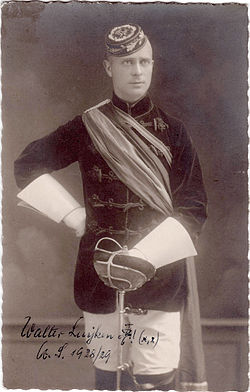
Over time, the purpose shifted from settling disputes to personality training. The goal was to demonstrate fairness and composure under pressure. To ensure all members of student corporations could participate, a formal, non-offensive challenge was adopted: calling an opponent a dummer Junge ("stupid boy").
By 1850, this evolved into the Bestimmungsmensur. In this system, the Consenior (vice-chairman) of the corporation arranged bouts between opponents of equal skill and physical capability. This structured approach remains the concept of the modern Mensur.
| Weapon | Type | Primary Use/Origin | Key Characteristic |
|---|---|---|---|
| Rapier | Thrust | Early Modern Nobility | Slender blade, noble attire |
| Pariser | Thrust | Stoßmensur | Derived from French foil |
| Korbschläger | Cut | Modern Mensur | Descended from Göttinger Hieber |
| Glockenschläger | Cut | East German Universities | Alternative cut weapon |
| Academic Sabre | Cut | Duels with non-students | Heavy, curved blade |
Key Facts
- Origin: Started with the rapier in 15th-century Spain and spread to German students.
- Evolution: Transitioned from spontaneous street fights (rencontre) to regulated bouts (comment).
- Weapon Shift: Moved from dangerous thrusting weapons (Pariser) to cutting weapons (Korbschläger).
- Modern Concept: The Bestimmungsmensur matches opponents by skill level for personality development.
- Record: Fritz Bacmeister fought an estimated 100 bouts between 1860 and 1866.
Frequently Asked Questions
What is the difference between a rencontre and a comment?
A rencontre was a spontaneous, unregulated combat, whereas a comment was a duel conducted according to strict, pre-arranged regulations.
What was a Lungenfuchser?
A Lungenfuchser occurred when a student's lung was pierced during thrust fencing, a dangerous injury that made breathing difficult or impossible.
How did the Bestimmungsmensur change the nature of the duel?
Instead of fighting due to a personal insult, the Bestimmungsmensur allowed officials (Conseniors) to pair opponents of equal ability, turning the event into a test of character and skill.
What was the purpose of the phrase "dummer Junge"?
It served as a formal, standardized insult that acted as a challenge to fence without actually causing a genuine infringement of honor.
When did thrust fencing largely disappear from German universities?
While it varied by region, the last recorded thrust Mensur took place in Würzburg in 1860.