
Al Oerter: The Legendary Four-Time Olympic Discus Champion
In the history of track and field, few athletes possess the resilience and consistency of Al Oerter. A powerhouse of the discus throw, Oerter didn't just win; he dominated the Olympic stage across four different decades, overcoming severe injuries and age to cement his place as one of the greatest athletes of all time.
Early Life and Natural Talent
Born in 1936 in Astoria, Queens, New York City, and raised in New Hyde Park, Oerter's journey into athletics began with a serendipitous moment at age 15. After a discus landed at his feet, he threw it back past a crowd of experienced throwers, revealing a raw, natural talent for the sport. This early aptitude led him to Sewanhaka High School and eventually to the University of Kansas in 1954 on a scholarship.
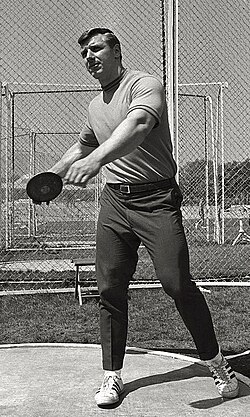
Standing nearly 6 ft 4 in (193 cm) and weighing 280 pounds (130 kg), Oerter possessed the ideal physical build for a thrower. While competing for Kansas, he established himself as a collegiate force, winning the NCAA discus championship in 1957 and successfully defending that title in 1958.
The Path to Olympic Glory
Oerter's Olympic journey began at the 1956 Summer Olympics in Melbourne. Despite not being the favorite, he delivered a career-best throw of 184 feet 10 inches (56.34 m), securing the gold medal by more than 5 inches (130 mm).
His career nearly ended prematurely in 1957 when a near-fatal automobile accident left him fighting for his life. However, his recovery was a testament to his determination. By the 1960 Summer Olympics in Rome, Oerter returned as a slight favorite. In a dramatic showdown with teammate and world record holder Rink Babka, Oerter unleashed a throw of 194 feet 2 inches (59.18 m) in the fifth round, setting a new Olympic record and claiming his second gold.
Overcoming Adversity and Breaking Records
By the early 1960s, Oerter had become a global icon in the sport. In 1962, he made history as the first person to break the 200-foot barrier in the discus, setting his first world record.
The 1964 Tokyo Games presented his greatest physical challenge. Oerter entered the competition hampered by a neck injury that required a brace and torn cartilage in his ribs. Despite competing in immense pain—and being unable to take his final throw due to the severity of his rib injury—he set a new Olympic standard to win his third consecutive gold medal.
Oerter's historic run culminated at the 1968 Mexico City Olympics. At 32 years old, he was again the underdog, with teammate Jay Silvester favored to win. Oerter responded with a massive throw of 64.78 metres (212.5 ft) on his third attempt. This victory made him the first track and field athlete to win gold medals in four consecutive Olympic Games, a feat later matched by Carl Lewis, Michael Phelps, and Katie Ledecky.
Later Years and Legacy
After retiring in 1968, Oerter briefly explored a comeback in 1976. Under medical supervision, he used anabolic steroids to increase muscle mass, but he soon discontinued the treatment after it negatively affected his blood pressure and failed to improve his performance. This experience led him to become a vocal critic of drug use in sports, urging athletes to prioritize training and technique over chemical enhancements.
Even in his 40s, Oerter's strength remained formidable. In 1980, while attempting to qualify for the American team, he set his overall personal record of 69.46 metres (227.9 ft) at age 43. This improvement was attributed to his work with Dr. Gideon Ariel, a former Israeli Olympic shot putter specializing in biomechanics (the study of the mechanical laws relating to the movement or structure of living organisms). Through this scientific approach, Oerter threw 27 feet farther than his best gold-medal performance.
Oerter's contributions to the Olympic movement continued long after his competitive days. He carried the Olympic flag for the 1984 Summer Olympics and the Olympic flame into the stadium for the 1996 Games.
Key Facts
- Olympic Record: First track and field athlete to win four consecutive gold medals (1956, 1960, 1964, 1968).
- Milestone: First athlete to throw the discus over 200 feet (achieved in 1962).
- Personal Best: 69.46 metres (227.9 ft), achieved at age 43 in 1980.
- Physical Stature: 6 ft 4 in (193 cm) and 280 lbs (130 kg).
- Resilience: Won the 1964 gold medal while wearing a neck brace and suffering from torn rib cartilage.
| Year | Location | Winning Distance | Notable Achievement |
|---|---|---|---|
| 1956 | Melbourne | 184 ft 10 in (56.34 m) | First Olympic Gold |
| 1960 | Rome | 194 ft 2 in (59.18 m) | Olympic Record |
| 1964 | Tokyo | Olympic Standard | Won despite severe rib/neck injuries |
| 1968 | Mexico City | 212.5 ft (64.78 m) | First 4-consecutive gold in track & field |
Frequently Asked Questions
How many Olympic gold medals did Al Oerter win?
Al Oerter won four gold medals in the discus throw, achieving this feat in four consecutive Olympic Games from 1956 to 1968.
What was Al Oerter's most significant world record?
In 1962, Oerter became the first person in history to throw the discus beyond the 200-foot mark.
Did Al Oerter ever use performance-enhancing drugs?
Oerter took anabolic steroids under medical supervision in 1976 during a comeback attempt. However, he stopped because of blood pressure issues and lack of results, and he subsequently advised other athletes to avoid such drugs.
How did biomechanics help Oerter in his later years?
By working with Dr. Gideon Ariel, Oerter applied biomechanical services to his technique, allowing him to set his lifetime personal record of 69.46 metres at the age of 43.
What other athletes matched Oerter's record of four consecutive golds?
His achievement was later equaled by American athletes Carl Lewis (1996), Michael Phelps (2016), and Katie Ledecky (2024).