
Amapá Demographics, Culture, and Society
Amapá is a region of Brazil characterized by a unique blend of ethnic diversity, rapid urban growth, and a deep connection to the Amazonian landscape. From its highly urbanized centers to its demarcated indigenous territories, the state presents a complex social fabric shaped by its geography and history.
Key Facts
- Total Population: 733,759 residents (2022 Census).
- Urbanization: 93.7% of the population lives in urban areas, primarily in Macapá and Santana.
- Ethnic Majority: 65.3% of the population identifies as Pardo (multiracial).
- Language: Portuguese is official, with French taught in schools and Lanc-Patuá spoken locally.
- Religion: Roman Catholicism is the predominant faith at 64%.
Population Growth and Demographics
Amapá has experienced significant population expansion over the last several decades. In 1950, the population stood at 37,477, growing steadily to reach 733,759 by 2022. This growth has been accompanied by a high rate of urbanization, with the vast majority of residents concentrated in the cities of Macapá and Santana. The current population density is approximately 5.1 people per square kilometer.
| Year | Population | Growth Percentage |
|---|---|---|
| 1950 | 37,477 | — |
| 1960 | 68,889 | +83.8% |
| 1970 | 116,480 | +69.1% |
| 1980 | 180,078 | +54.6% |
| 1991 | 288,690 | +60.3% |
| 2000 | 477,032 | +65.2% |
| 2010 | 669,526 | +40.4% |
| 2022 | 733,759 | +9.6% |
The ethnic composition of the state is diverse. According to the 2022 census, the majority of the population identifies as Pardo (multiracial) at 65.3%, followed by White Brazilians (21.4%), Black Brazilians (11.8%), and Indigenous people (1.4%). Asians and undeclared individuals make up the remaining 0.1%.
Socioeconomic Conditions and Religion
Economic challenges persist in the region. Data from the Fundação Getulio Vargas (FGV) indicates that 36.56% of the population lives in poverty, surviving on approximately R$79 per month, a figure the foundation considers below a decent standard of living.
Spirituality plays a central role in the community. As of the 2010 census, 64% of residents are Roman Catholics, 28% are Evangelicals (Protestants), and 6% identify as non-religious. Other faiths account for 2% of the population. The Catholic presence is organized under the Diocese of Macapá, established in 1949, which consists of 27 parishes.
Municipalities and Urban Centers
Amapá is divided into 16 municipalities. The distribution of the population is heavily skewed toward the south, where the largest urban centers are located.
- Macapá: The largest city with 407,023 residents.
- Santana: The second largest with 102,860 residents.
- Laranjal do Jari: A significant hub with 40,819 residents.
Other municipalities include Oiapoque, Mazagão, and Porto Grande, with smaller populations found in areas like Pracuúba and Itaubal.
Indigenous Heritage and Territories
The indigenous population of Amapá is primarily located in the north near the Oiapoque River and in the east within the Wayampi Indigenous Territory. All indigenous territories in the state have been officially demarcated.
The tribes currently residing in Amapá include the Galibi do Oiapoque, the Karipuna do Amapá, the Palikur, the Wayampi, and the Galibi Marworno.
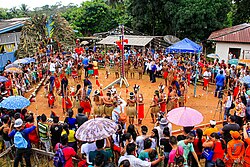
Historically, the Amazon River region supported a large pre-Columbian Amerindian population. However, Portuguese monarchy policies of warfare and the Cabanagem Revolt of the 1830s led to the eventual dispersal of these indigenous groups along the Amazon.
Education and Language
Portuguese is the official national language and the primary medium of instruction in schools. Due to the state's proximity to French Guiana, French is taught as a second language in every school. Additionally, a Creole language known as Lanc-Patuá is spoken by some residents.
Higher Education Institutions
The state hosts several key institutions for higher learning and technical training:
- Universidade Federal do Amapá (Unifap)
- Universidade Estadual do Amapá (UEAP)
- Instituto Federal de Educação, Ciência e Tecnologia do Amapá (IFAP)
- Centro de Ensino Superior do Amapá (Ceap)
- Instituto de Ensino Superior do Amapá (Iesap)
- Instituto Macapaense de Ensino Superior (IMMES)
- Faculdade Seama
Frequently Asked Questions
What is the most common ethnicity in Amapá?
The most common ethnicity is Pardo (multiracial), representing 65.3% of the population according to the 2022 census.
Which cities are the most populated in the state?
Macapá is the largest city, followed by Santana and Laranjal do Jari.
What languages are spoken in Amapá?
Portuguese is the official language, French is taught in schools due to the proximity to French Guiana, and some residents speak a Creole language called Lanc-Patuá.
Which indigenous tribes live in Amapá?
The tribes residing in the state include the Galibi do Oiapoque, Karipuna do Amapá, Palikur, Wayampi, and Galibi Marworno.
What is the religious makeup of the region?
According to 2010 data, 64% of the population is Roman Catholic, 28% is Evangelical, and 6% does not profess a religion.