
Anabasis of Arrian: A Chronological Account of Alexander the Great
The Anabasis is a seminal historical work that provides a detailed, chronological narrative of the reign of Alexander the Great of Macedon, spanning from 336 to 323 BC. Written by Arrian of Nicomedia, the text focuses heavily on military strategy and the expansion of the Macedonian Empire. Following a brief preface regarding his sources, Arrian organizes the life and conquests of Alexander into seven comprehensive books.
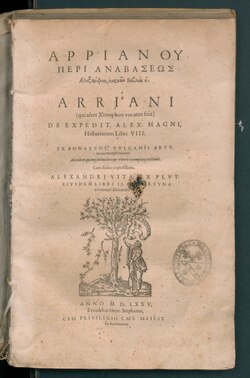
Key Facts
- Author: Arrian of Nicomedia.
- Subject: The reign of Alexander the Great (336–323 BC).
- Structure: Seven books following a broadly chronological sequence.
- Primary Focus: Military operations, sieges, and the administration of conquered territories.
- Scope: Covers the journey from Macedon through Asia Minor, Egypt, Persia, and into India.

The Early Conquests and the Fall of Persia
Establishing Control in Asia Minor
The first book details the early years of Alexander's reign (336–334 BC). Key events include the sack of Thebes in 335 BC and the pivotal Battle of the Granicus in the summer of 334 BC. Arrian also documents the strategic siege and capture of Miletus and the subsequent destruction of Halicarnassus.
The Road to Egypt
Book 2 focuses on three major military operations: the campaign and Battle of Issus in 333 BC, followed by the grueling sieges of Tyre and Gaza in 332 BC. This section also recounts the defeat of King Darius of Persia, the treatment of the Persian royal family, and the legendary trial of the Gordian Knot.
The narrative continues in Book 3 with Alexander's arrival in Egypt, highlighted by his visit to the oracle of Zeus-Ammon at Siwah in the winter of 332/331 BC. This is followed by the decisive Battle of Gaugamela in 331 BC, which led to the final defeat of Darius III. The latter part of the book tracks the pursuit of Darius through northern Iran, the revolt of the pretender Bessus, and the executions of Philotas and Parmenion between 331 and 329 BC.
Eastern Campaigns and Internal Strife
The Sogdian and Punjab Campaigns
Book 4 describes the long Sogdian campaign (329–327 BC) against Bessus, Spitamenes, and Oxyartes, as well as the initial stages of the Punjab campaigns (327–326 BC). Notably, Arrian pauses the chronology to address controversies surrounding Alexander's character, including the killing of Cleitus, the proskynesis (the Persian custom of bowing or prostrating before a monarch) affair, the conspiracy of the pages, and the death of Callisthenes.
The Indian Expedition
The Indian campaign is detailed across Books 5 and 6. Book 5 covers the arrival at Nysa and the major battle against King Porus at the Hydaspes river. It concludes with the army's decision at the Hyphasis river to cease their eastward advance into India.
Book 6 chronicles the return journey down the Indus to the Indian Ocean (326–325 BC). Arrian notes the increasing brutality of the Macedonian forces toward local inhabitants, specifically at the Malli town. The narrative then follows the perilous crossing of the Gedrosian Desert (325–324 BC), during which Alexander suffered a severe injury that caused great concern among his troops before his eventual recovery.
The Final Year and Legacy
The seventh and final book recounts the events leading to Alexander's death (324–323 BC). Key events include the Susa marriages, the Opis mutiny, and the death of his close companion Hephaestion. Arrian notes various omens and predictions that foreshadowed Alexander's demise. The work concludes with speculation regarding the cause of Alexander's death, questioning whether it was the result of poisoning or other causes.
Summary of the Anabasis
| Book | Primary Timeframe | Key Events & Locations |
|---|---|---|
| Book 1 | 336–334 BC | Sack of Thebes, Battle of Granicus, Miletus, Halicarnassus |
| Book 2 | 333–332 BC | Battle of Issus, Sieges of Tyre and Gaza, Gordian Knot |
| Book 3 | 332–329 BC | Oracle of Zeus-Ammon, Battle of Gaugamela, Pursuit of Darius |
| Book 4 | 329–326 BC | Sogdian campaign, Punjab campaigns, Internal court controversies |
| Book 5 | 326 BC | Battle of the Hydaspes, Decision at the Hyphasis |
| Book 6 | 326–324 BC | Indus River journey, Malli town, Gedrosian Desert crossing |
| Book 7 | 324–323 BC | Susa marriages, Opis mutiny, Death of Hephaestion and Alexander |
Frequently Asked Questions
What is the primary focus of the Anabasis?
The Anabasis focuses on the military achievements and chronological reign of Alexander the Great, detailing his conquests from Macedon to India.
How does Arrian handle the controversies surrounding Alexander's character?
In Book 4, Arrian departs from the chronological sequence to group several notorious stories—such as the killing of Cleitus and the proskynesis affair—into a single apologetic digression.
Where did Alexander's army decide to stop their advance into India?
The army decided not to push further into India at the Hyphasis river, as detailed in Book 5.
What happened during the crossing of the Gedrosian Desert?
The crossing (325–324 BC) was marked by extreme hardship and a worrying injury suffered by Alexander, which caused significant distress among his soldiers.
Does the Anabasis provide a definitive cause for Alexander's death?
No, the work concludes with speculation, discussing whether Alexander died of natural causes or was poisoned.