
arXiv: The Open-Access Powerhouse of Scientific Preprints
In the traditional world of academic publishing, the journey from a discovery to a published paper can take months or even years due to the rigorous process of peer review. arXiv (pronounced "archive," where the 'X' represents the Greek letter chi ⟨χ⟩) revolutionized this timeline. As an independent, open-access repository, arXiv allows researchers to share e-prints—electronic preprints and postprints—with the global scientific community almost instantaneously.
Covering critical fields such as physics, mathematics, computer science, astronomy, quantitative biology, statistics, mathematical finance, and economics, arXiv has become an essential pillar of modern research. In many STEM disciplines, it is now standard practice to self-archive a paper on arXiv before it ever reaches a formal journal.
![A screenshot of the arXiv taken in 1994,[9] using the browser NCSA Mosaic. At the time, HTML forms were a new technology.](/images/70/77/7077252cdf6ed4308b2d540f732809042e36c0ba7f7e0183a08ae724f717a73f.png)
Key Facts
- Founded: August 14, 1991, by Paul Ginsparg.
- Purpose: An open-access repository for non-peer-reviewed scientific e-prints.
- Scale: Surpassed 2 million articles by the end of 2021; currently receives approximately 24,000 submissions per month (as of November 2024).
- Status: Transitioned to an independent nonprofit organization on July 1, 2026.
- Impact: Recognized by Nature in 2021 as one of the "10 computer codes that transformed science."
The Evolution of arXiv
The birth of arXiv was driven by a practical problem: the limitations of email. Around 1990, researcher Joanne Cohn began emailing physics preprints as TeX files—a compact format that allowed scientific notation to be transmitted easily and rendered on the recipient's computer. However, the volume of papers soon overwhelmed email mailboxes.
Recognizing the need for a centralized system, Paul Ginsparg created a repository mailbox at the Los Alamos National Laboratory (LANL) in August 1991. The system evolved rapidly, adding FTP access in 1991, Gopher in 1992, and finally the World Wide Web in 1993. Originally known as the LANL preprint archive (with the domain xxx.lanl.gov), the service eventually moved to Cornell University in 2001, adopting the name arxiv.org.
![arXiv's yearly submission rate growth over 30 years since its beginning with topics labeled by the standard abbreviations used on arxiv.org[10]](/images/f1/73/f1735a4027e25b18a9803fc7a8e5bb716aaf2df59463110af4bd62706950d2fc.webp)
Funding and Governance
For years, arXiv was managed by the Cornell University Library. To ensure sustainability, Cornell implemented a membership model in 2010, where institutions provide annual voluntary contributions based on their download usage. These fees, ranging from $1,000 to $4,400 across four tiers, helped support an annual budget that was approximately $826,000 between 2013 and 2017. To further diversify funding, arXiv officially separated from Cornell University to become an independent nonprofit on July 1, 2026.
How arXiv Works: Moderation and Access
Unlike traditional journals, arXiv does not use peer review. Instead, it employs a moderation process to ensure that submissions are relevant to the specified disciplines. To maintain quality, an endorsement system was introduced in 2004. In certain categories, new authors must be endorsed by an established arXiv author to verify that the work is appropriate for the subject area, though authors from recognized academic institutions often receive automatic endorsement.
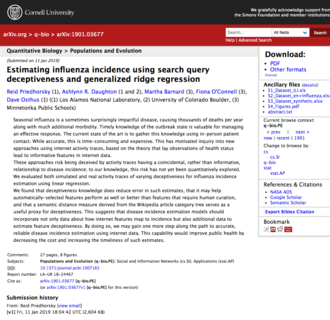
Every paper is assigned a uniquely specific identifier (such as YYMM.NNNNN) to ensure easy tracking and citation. In January 2022, arXiv began collaborating with DataCite to assign Digital Object Identifiers (DOIs) to its articles, further integrating e-prints into the formal scholarly record.
Addressing AI and Quality Control
The rise of AI-generated content has presented new challenges. In November 2025, arXiv announced it would no longer accept computer science review articles or position papers unless they had been vetted by an academic journal or conference. This move was designed to combat the surge of AI-generated research that did not meet the necessary standards of rigor.
Impact on Scientific Discovery
arXiv has fundamentally changed how science is communicated, acting as a catalyst for the open access movement. While most authors eventually submit their work to peer-reviewed journals, some of the most influential work has remained exclusively on arXiv. A notable example is Grigori Perelman’s 2002 proof of the Poincaré conjecture; Perelman chose to upload his work to arXiv and forgo traditional journal publication, yet his work was recognized with the Fields Medal and Clay Mathematics Millennium Prizes (both of which he refused).
Despite its success, the platform is not without controversy. Some critics argue the endorsement system restricts scientific inquiry, and others have noted a lack of transparency in the screening process. Additionally, approximately 14,000 preprints have been withdrawn, primarily due to crucial errors.
| Feature | Details |
|---|---|
| Founder | Paul Ginsparg |
| Launch Date | August 14, 1991 |
| Primary Fields | Physics, Math, CS, Astronomy, Biology, Stats, Economics |
| Review Process | Moderated (Not Peer-Reviewed) |
| Identifier Format | YYMM.NNNNN (e.g., 1507.00123) |
| Legal Status | Independent Nonprofit (since 2026) |
Frequently Asked Questions
Is arXiv the same as archive.org?
No. arXiv is a specialized repository for scientific preprints in STEM fields, whereas archive.org (The Internet Archive) is a general-purpose digital library of websites, books, and other media.
Are papers on arXiv peer-reviewed?
No, arXiv papers are not peer-reviewed. They undergo a moderation process to ensure they are relevant to the field, but they have not been formally vetted by independent experts before posting.
What is an "e-print"?
An e-print is an electronic version of a scientific paper. It can be a preprint (a version of a paper before it has been peer-reviewed) or a postprint (the version of a paper after peer review, if the publisher allows it to be archived).
How does the endorsement system work?
To prevent irrelevant content, some arXiv categories require new authors to be "endorsed" by an existing, established author. The endorser does not review the paper for scientific accuracy but confirms that the work is appropriate for that specific subject area.
Why are some papers withdrawn from arXiv?
Papers are typically withdrawn due to the discovery of crucial errors or because the preprint has been subsumed by another publication. As of December 2024, approximately 14,000 preprints have been withdrawn.