
Autobiography History: From Classical Apologia to Modern Autofiction
The act of recording one's own life is more than a simple exercise in memory; it is a literary evolution that reflects changing views on truth, morality, and the individual. From the rigid self-justifications of antiquity to the experimental "autotheory" of the 21st century, the autobiography has transformed from a tool of defense into a medium of artistic and psychological exploration.
The Classical Period: Apologia, Oration, and Confession
In antiquity, works we would now call autobiographies were typically termed apologia. Rather than providing a comprehensive documentation of a life, an apologia served as a self-justification. For example, the historian Flavius Josephus began his Josephi Vita (c. 99) with self-praise and a justification of his role as a Jewish rebel commander in Galilee.
Other classical forms included the literary oration. The rhetor Libanius (c. 314–394) framed his Oration I (begun in 374) as a private literary work intended for reading in solitude rather than public delivery.
A pivotal shift occurred with Augustine of Hippo (354–430), who titled his work Confessions. Arguably the first Western autobiography, it served as a model for Christian writers throughout the Middle Ages. Augustine detailed his youth's hedonism, his time with the anti-sex Manichaeism movement, and his eventual return to Christianity via Skepticism and the New Academy movement. His theological view—that while sex is good, virginity is better (comparing them to silver and gold, respectively)—deeply influenced Western theology.
This confessional spirit continued into the 12th century with Peter Abelard's Historia Calamitatum, another landmark document of its era.
Early Autobiographies and the Renaissance
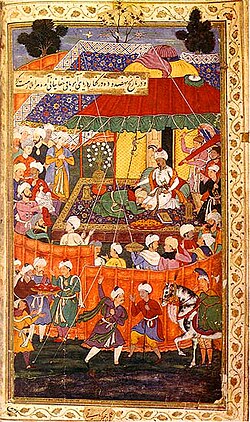
As the genre expanded globally and linguistically, new voices emerged. In the 15th century, Spanish noblewoman Leonor López de Córdoba wrote her Memorias, potentially the first autobiography in Castilian. In South Asia, Zāhir ud-Dīn Mohammad Bābur, founder of the Mughal dynasty, kept a journal between 1493 and 1529 known as the Bāburnāma (Book of Babur).
The Renaissance brought a new standard for life writing. Benvenuto Cellini (1500–1571), a sculptor and goldsmith, wrote his Vita (Life) between 1556 and 1558. Cellini argued that anyone with great achievements should write their own story, but cautioned that no one should attempt such a task before the age of forty. This "Cellinian" standard persisted for nearly three hundred years.
Other significant works of this era include:
- De vita propria (1574): Written by the Italian polymath Gerolamo Cardano.
- Ardhakathānaka (The Half Story): Composed in Braj Bhasa (an early Hindi dialect) by Banarasidas, a Shrimal Jain businessman. It chronicles his journey from an unruly youth to religious realization.
- The Book of Margery Kempe (1438): The earliest known English autobiography, detailing the religious mysticism and pilgrimages of Kempe.
The Evolution of English Life Writing
While Margery Kempe wrote early on, Captain John Smith's 1630 autobiography is possibly the first publicly available English autobiography. Though initially dismissed as "tall tales," a 1964 biography by Philip Barbour later validated many of Smith's accounts. Other 17th-century contributions include works by Lord Herbert of Cherbury (1643) and John Bunyan's Grace Abounding to the Chief of Sinners (1666).
The 18th and 19th Centuries: Romanticism and Celebrity
The rise of Romanticism shifted the focus toward the individual's internal emotional landscape. Jean-Jacques Rousseau's Confessions initiated a trend of intimate, self-critical, and sometimes racy autobiographies. This influence is evident in Stendhal's The Life of Henry Brulard and Memoirs of an Egotist, as well as William Hazlitt's Liber Amoris (1823), which examined the author's love life.
Parallel to this emotional shift was the rise of the public figure. Increased literacy and cheaper printing created a market for celebrity memoirs. It became expected for public figures—including Charles Dickens, Anthony Trollope, John Stuart Mill, and P.T. Barnum—to publish their lives. These works began to emphasize childhood and upbringing, diverging from Cellini's focus on late-life achievement.
Modern Trends: The 20th and 21st Centuries
The modern era has seen the rise of the "scandalous memoir," often written by ghostwriters under pseudonyms to satisfy a public appetite for titillation. Today, this trend continues with professional athletes and media celebrities. Some, like Naomi Campbell, have admitted to not reading their own ghostwritten accounts, while others, such as James Frey in A Million Little Pieces, have been exposed for fictionalizing significant details.
Despite this, the genre remains a powerful literary tool. Albert Facey's A Fortunate Life (1979) is an Australian classic, and works like Angela’s Ashes and The Color of Water have spurred a surge in memoir writing in the United States.
Contemporary writers are further pushing the boundaries of the genre:
- Autotheory: A blend of autobiography and critical theory, exemplified by Maggie Nelson's The Argonauts.
- Autofiction: A genre where the claim for truth overlaps with fictional elements, though the work still purports to be autobiographical.
Key Facts
- Apologia: The classical term for autobiography, focusing on self-justification rather than documentation.
- Augustine's Confessions: One of the first Western autobiographies and a primary model for Christian life writing.
- Cellini's Rule: The Renaissance belief that one should not write an autobiography until after the age of forty.
- Firsts: Margery Kempe wrote the earliest known English autobiography (1438); Jarena Lee was the first African American woman to have a published biography in the US.
- Modern Variants: The genre now includes autofiction (blending fact and fiction) and autotheory (blending life story and critical theory).
| Author | Work | Period/Era | Key Characteristic |
|---|---|---|---|
| Augustine of Hippo | Confessions | Classical/Early Christian | Confessional and theological model |
| Zāhir ud-Dīn Mohammad Bābur | Bāburnāma | 15th-16th Century | Journal of the Mughal founder |
| Benvenuto Cellini | Vita | Renaissance | Emphasis on achievement and maturity |
| Jean-Jacques Rousseau | Confessions | 18th Century | Intimate, emotional, and Romantic |
| Maggie Nelson | The Argonauts | Contemporary | Autotheory (Life + Critical Theory) |
Frequently Asked Questions
What is the difference between an apologia and a modern autobiography?
An apologia is primarily a work of self-justification, intended to defend the author's actions or character, whereas modern autobiographies typically aim for a broader documentation of the author's life and personal growth.
Who wrote the first known autobiography in English?
The earliest known autobiography written in English is the Book of Margery Kempe, written in 1438, which focuses on her experiences as a Christian mystic.
What is "autofiction"?
Autofiction is a literary genre where the narrative purports to be autobiographical but intentionally overlaps the claim for truth with fictional elements.
How did the Romantic era change autobiography?
Romanticism shifted the genre away from public achievement and toward the internal world, emphasizing the subject's emotions, intimacy, and the influence of childhood and upbringing.
What is the "Cellinian" approach to writing a life story?
Named after Benvenuto Cellini, this approach suggests that an individual should only write their autobiography after they have achieved great things and reached the age of forty.