
Availability Engineering: Metrics, Models, and System Design
In systems engineering, availability is the probability that a system will be in an operable and committable state at the start of a mission when called for at a random time. At its most fundamental level, availability is the ratio of a system's expected uptime to the total observation window, which includes both uptime and downtime.
Key Facts
- Availability is generally defined as uptime divided by total time (uptime plus downtime).
- Series configurations always result in lower overall availability than the availability of any single individual component.
- Parallel configurations can exponentially increase system availability through redundancy.
- Inherent Availability focuses on design and corrective maintenance, excluding logistics and administrative delays.
- Operational Availability provides a realistic view by including logistics, waiting times, and all maintenance types.
Mathematical Representations of Availability
Availability (A) can be expressed through several mathematical lenses depending on whether one is looking at expected values, time-to-failure metrics, or probability functions.
Basic Ratios and Time Metrics
The simplest representation is the ratio of expected uptime to the total time (C):
A = E[uptime] / (E[uptime] + E[downtime]) = E[uptime] / C
Another common equation utilizes Mean Time To Failure (MTTF)—the average time a non-repairable system operates before failing—and Mean Time To Repair (MTTR)—the average time required to restore a system to operation. This is also expressed using Mean Time Between Failure (MTBF):
A = MTTF / (MTTF + MTTR) = MTTF / MTBF
Probability and Steady-State Availability
If we define a status function X(t) where the system functions (1) or is under maintenance (0) at time t, availability A(t) is the probability that X(t) = 1.
To find the average availability over a specific interval (c), the integral of A(t) is used. When this interval extends to infinity, it is referred to as limiting (or steady-state) availability:
A∞ = limc→∞ (1/c) ∫0c A(t) dt
Series vs. Parallel Components
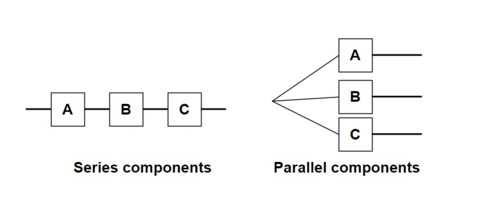
The architecture of a system significantly impacts its total availability. Components are typically arranged in either series or parallel configurations.
Series Components
In a series configuration, every component must function for the system to work. The total availability is the product of the availability of each component (A, B, and C):
Availabilityseries = (Availability A) × (Availability B) × (Availability C)
Because you are multiplying fractions, the combined availability is always lower than that of the individual parts.
Parallel Components
Parallel components provide redundancy; the system remains operational as long as at least one component functions. The formula is based on the probability that not all components fail simultaneously:
Availabilityparallel = 1 - [(1 - Availability A) × (1 - Availability B) × (1 - Availability C)]
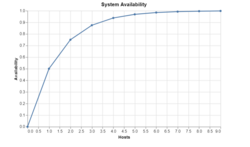
For N parallel components each with availability X, the formula is: 1 - (1 - X)N. This allows for exponential gains. For instance, 10 hosts with only 50% availability each can achieve a combined availability of 99.9023% if they fail independently.
The Complexity Trade-off
Redundancy does not automatically guarantee higher availability because it increases system complexity. To ensure a net-positive improvement, Marc Brooker suggests four requirements:
- The redundancy must result in a net-positive improvement in overall availability.
- Redundant components must fail independently.
- The system must reliably detect which redundant components are healthy.
- The system must reliably scale redundant components in and out.
Modeling Techniques and Systems Engineering
Engineers use Reliability Block Diagrams and Fault Tree Analysis to calculate availability and identify critical failure modes. These models incorporate a wide array of factors:
- Reliability and maintainability models.
- Common cause failures and dormant failures.
- Diagnostics and test coverage.
- Logistical aspects, such as spare part stocking levels, transport times, and manpower availability.
- Uncertainty in parameters.
Types of Availability in Systems Engineering
| Type | Scope | Includes | Excludes |
|---|---|---|---|
| Inherent (Ai) | Ideal support environment | Corrective maintenance | Logistics, admin downtime, preventive maintenance |
| Achieved (Aa) | Ideal support environment | Preventive and corrective maintenance | Logistics, admin downtime |
| Operational (Ao) | Realistic operating environment | Logistics, admin, preventive, and corrective maintenance | N/A (Comprehensive) |
Inherent availability is primarily controlled by the designer and is calculated as MTBF / (MTBF + MTTR) for repairable elements, or MTTF / (MTTF + MTTR) for non-repairable elements. Operational availability (Ao) is the most comprehensive measure, calculated as MTBF divided by the sum of MTBF and Mean Downtime (MDT), reflecting the influence of logisticians and mission planners.
Practical Example
Consider equipment with a Mean Time To Failure (MTTF) of 81.5 years and a Mean Time To Repair (MTTR) of 1 hour.
- Convert MTTF to hours: 81.5 years × 365 days × 24 hours = 713,940 hours.
- Calculate Inherent Availability (Ai): 713,940 / (713,940 + 1) = 99.999860%.
- Calculate Inherent Unavailability: 1 / 713,940 = 0.000140%.
- Annual Outage: 1 / MTTF = 0.01235 hours per year.
Frequently Asked Questions
What is the difference between MTTF and MTBF?
MTTF (Mean Time To Failure) is typically used for non-repairable items, representing the average time until the item fails. MTBF (Mean Time Between Failure) is used for repairable systems, representing the average time between one failure and the next.
Why does adding more components in series decrease availability?
In a series system, the failure of any single component causes the entire system to fail. Mathematically, multiplying the availability (a value between 0 and 1) of each component results in a smaller total product.
Can redundancy actually make a system less available?
Yes. Redundancy increases complexity. If the added complexity introduces new failure points or if the system cannot reliably detect and switch to healthy redundant components, the overall availability may decrease.
What is the difference between Inherent and Operational Availability?
Inherent availability is a design-centric metric that only considers corrective maintenance in an ideal environment. Operational availability is a real-world metric that includes logistics, administrative delays, and preventive maintenance.
How does parallel redundancy improve availability?
Parallel redundancy ensures that the system only fails if all redundant components fail simultaneously. By increasing the number of independent parallel components, the probability of total system failure drops exponentially.