
Bagpipes: History, Construction, and Global Varieties
The bagpipe is a distinctive woodwind instrument characterized by its use of enclosed reeds fed by a constant reservoir of air held in a bag. While the Scottish Great Highland bagpipe is the most globally recognized version, bagpipes have been played for centuries across vast regions, including Europe, North Africa, West Asia, the Persian Gulf, and northern South Asia.
Technically classified as an aerophone—an instrument where sound is produced by a vibrating column of air—the bagpipe allows the musician to maintain a continuous sound without pausing for breath. Pipers often refer to their instrument simply as "the pipes," "a set of pipes," or "a stand of pipes."

Key Facts
- Classification: Aerophone (specifically a reed aerophone with a conical bore).
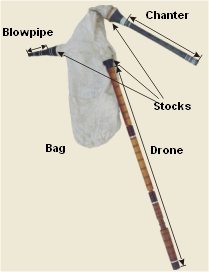
- Core Components: An air supply, a bag, a chanter (melody pipe), and usually one or more drones.
- Global Reach: Found in diverse cultures from Scotland and Ireland to Bulgaria, Tunisia, and India.
- Modern Production: Pakistan is currently the world's largest producer of bagpipes.
- Unique Milestone: The instrument was played in outer space for the first time in 2015 aboard the International Space Station.
Construction and Mechanics
A standard set of bagpipes consists of several integrated parts held together by stocks, which are sockets that fasten the pipes to the bag.
Air Supply
Air is typically supplied by the player's breath, but an innovation from the 16th or 17th century introduced the use of bellows. Bellows-driven pipes, sometimes called "cauld wind pipes," do not moisten or heat the air, allowing for the use of more delicate reeds. Examples include the Irish uilleann pipes, Northumbrian smallpipes, and the French musette de cour.
The Bag and Chanter
The chanter is the melody pipe played with both hands. Depending on the region, a chanter may have a cylindrical (parallel) or conical internal bore. They are typically crafted from woods such as boxwood, cornel, or plum. Some regional variations, particularly in the Balkans and North Africa, feature two chanters.
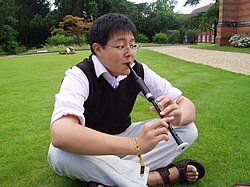
To facilitate learning, students often use a practice chanter. This is a standalone melody pipe without a bag or drones, featuring a quieter reed for discreet practice.
Reeds and Drones
Chanter reeds are traditionally made from bamboo, elder, or arundo donax. Modern versions may use a cotton phenolic body with a resized clarinet reed for increased volume and stability against temperature and humidity.
The drone is a pipe that produces a constant harmonizing note, usually the tonic of the chanter. Most drones are cylindrically bored with a single reed and feature sliding joints to allow for pitch adjustment.
Historical Evolution
Ancient Origins
The exact origins of the bagpipe are debated. Some scholars point to a Hittite slab in Anatolia dated to 1000 BCE, though others interpret this as a pan flute and friction drum. Ancient Greek texts mention the askaulos (wine-skin reed pipe), and Roman historians Suetonius and Dio Chrysostom described Emperor Nero playing the tibia utricularis, a pipe played using a bladder tucked under the arm.
Development in Europe
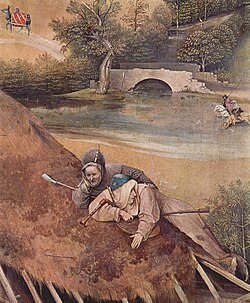
By the 13th century, bagpipes appeared frequently in European art, such as the Cantigas de Santa Maria in Spain. By the 14th century, they were mentioned in Geoffrey Chaucer's The Canterbury Tales.

The Scottish Highland bagpipe gained prominence in the 16th century, notably appearing at the Battle of Pinkie in 1547. During this era, the ceòl mór (great music) developed, consisting of martial tunes, laments, and marches. In Ireland, mentions of the instrument date back to 1206.
Modern Era and Global Spread
The expansion of the British Empire and the role of Scottish regiments in World War I and World War II spread the Great Highland bagpipe worldwide. However, this visibility came at a cost; pipers were easily identified targets on the battlefield, leading to high casualties. Following the Second Battle of El Alamein in 1943, front-line roles for pipers were generally prohibited.

Global Varieties and Modern Usage
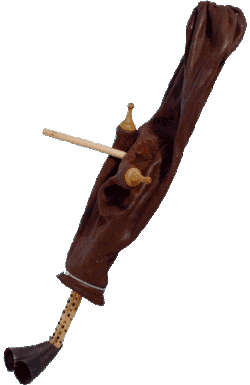
While the Highland pipes dominate public perception, many traditional forms have seen a recent revival. These include the Asturian and Galician gaita, the Bulgarian gaida (including the deep-sounding Kaba gaida), and the Romanian cimpoi.
| Instrument Name | Primary Region | Distinguishing Feature |
|---|---|---|
| Great Highland Bagpipe | Scotland | Most famous; used in military and formal contexts. |
| Uilleann Pipes | Ireland | Bellows-blown; known for a sweeter tone. |
| Gaida | Balkans (Bulgaria/Macedonia) | Varies from deep (Kaba) to high pitch (Dzhura). |
| Mizwad | Tunisia | Small and slender shape. |
| Tulum | Turkey / Black Sea | Regional folk variation. |
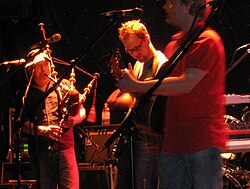
Beyond traditional folk music, bagpipes have integrated into modern genres. They have appeared in rock and metal tracks by artists like AC/DC and Paul McCartney, and in classical compositions such as those by Peter Maxwell Davies.


Frequently Asked Questions
What is the difference between a chanter and a drone?
The chanter is the melody pipe that the player fingers to create different notes. The drone is a pipe that produces a single, constant harmonizing pitch throughout the performance.
How are bellows-blown pipes different from mouth-blown pipes?
Bellows-blown pipes (like the uilleann pipes) use a mechanical device to pump air into the bag, meaning the air is not warmed or moistened by the player's breath. This allows for the use of more delicate reeds.
Where are most bagpipes manufactured today?
Pakistan is currently the world's largest producer of bagpipes, with the industry valued at $6.8 million as of 2010.
Can bagpipes be used in modern music?
Yes, since the 1960s, bagpipes have been incorporated into various genres including rock, jazz, hip-hop, punk, and contemporary classical music.
What is a practice chanter?
A practice chanter is a simplified version of the melody pipe without the bag or drones. It uses a quieter reed, allowing musicians to practice fingering and melodies without the full volume of the instrument.