
Barber's Tenure at the Financial Times
The trajectory of a journalist's career is often measured by the influence they wield and the leaders they engage. For Barber, a career spanning decades at the Financial Times (FT) serves as a testament to high-level international reporting and editorial leadership.
Early Career and International Reporting
Barber joined the Financial Times in 1985, quickly moving into pivotal international roles. Between 1986 and 1992, he served as the Washington correspondent and US editor, establishing a foundation in American politics and economics. He then transitioned to Europe, serving as the Brussels bureau chief from 1992 to 1998.
By 1998, Barber moved into a leadership role as the news editor, a position he held until 2000. His expertise in European affairs led to his appointment as the editor of the FT Continental European edition from 2000 to 2002. During this period, he played a significant diplomatic role, briefing US president George W. Bush prior to the president's first visit to Europe.
Leadership as Editor-in-Chief
In November 2005, Barber was appointed editor of the Financial Times, driven by his belief that the publication required a new editorial direction. Over the next 14 years, he became one of the most influential figures in financial journalism.
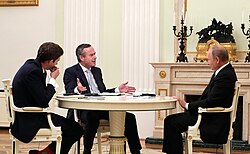
As editor, Barber conducted high-profile interviews with some of the world's most powerful leaders, including Barack Obama, Wen Jiabao, Dmitry Medvedev, Vladimir Putin, Luiz Inácio Lula da Silva, Angela Merkel, David Cameron, and Manmohan Singh.
Challenges and Internal Reforms
His tenure was not without controversy. In July 2012, Barber faced accusations of intimidating and threatening a staff member. The incident involved Steve Lodge, a personal finance writer who had been brought before a disciplinary panel. While the FT claimed Lodge had a "problem working for women," Barber was accused of breaching newspaper procedures by losing his temper and raising his voice.
Toward the end of his leadership, Barber focused on the internal culture of the publication. In October 2018, after sharing a reader's letter that criticized the "lack of diversity" among the paper's columnists, he declared that it was "time for a revolution" at the newspaper.
Departure and Legacy
Barber stepped down as editor on January 17, 2020, and was succeeded by Roula Khalaf. His 14-year tenure is one of the longest in the organization's history, surpassed only by Sir Gordon Newton.
Financial disclosures published at Companies House revealed that in 2019, Barber received pay and pension benefits totaling £1.92 million, a figure that subsequently led to a halt in pay negotiations.
Key Facts
- Joined FT: 1985
- Editor Tenure: November 2005 – January 17, 2020 (14 years)
- Historical Rank: Second longest-serving editor after Sir Gordon Newton
- Key Roles: Washington correspondent, US editor, Brussels bureau chief, and news editor
- Successor: Roula Khalaf
| Period | Role/Position |
|---|---|
| 1986–1992 | Washington correspondent and US editor |
| 1992–1998 | Brussels bureau chief |
| 1998–2000 | News editor |
| 2000–2002 | Editor of FT Continental European edition |
| 2005–2020 | Editor of the Financial Times |
Frequently Asked Questions
Who succeeded Barber as editor of the Financial Times?
Barber was succeeded by Roula Khalaf on January 17, 2020.
How does Barber's tenure compare to other FT editors?
With a 14-year term, Barber is the second longest-serving editor in the history of the Financial Times, following Sir Gordon Newton.
Which world leaders did Barber interview during his time as editor?
He interviewed several global figures, including Barack Obama, Vladimir Putin, Angela Merkel, David Cameron, Wen Jiabao, Dmitry Medvedev, Luiz Inácio Lula da Silva, and Manmohan Singh.
What was the controversy regarding Barber's compensation?
According to Companies House accounts, Barber received £1.92 million in pay and pension benefits in 2019, which resulted in a halt in pay negotiations.
What internal changes did Barber advocate for in 2018?
Barber called for a "revolution" at the newspaper after a reader's letter highlighted a lack of diversity among the publication's columnists.