
Barra: The Historic Heart of Salvador, Bahia
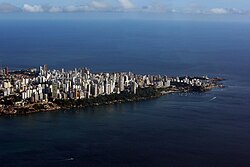
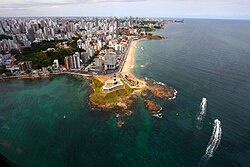
Located at the tip of a peninsula where the Atlantic Ocean meets the All Saints Bay, Barra is more than just a scenic neighborhood in Salvador; it is the cradle of the city's history. From the earliest Portuguese attempts at settlement to its current status as a cultural hub, Barra preserves the architectural and social evolution of Brazil's colonial past.
The area's significance began long before the official founding of Salvador. In 1534, Francisco Pereira Coutinho, the first captain of Bahia, established a settlement in what is now Ladeira da Barra. Assisted by Diogo Alvares Correia (known as Caramuru), this early colony was eventually abandoned due to hostilities with the local Tupi Indians. This site later became known as Vila Velha, or "Old Town."
Barra is also recognized as a site of early cultural blending between indigenous peoples and Europeans. This synthesis is epitomized by the relationship between Caramuru and his indigenous wife, Catarina Paraguaçu, figures who played a pivotal role in mediating relations between the Portuguese and the native populations.
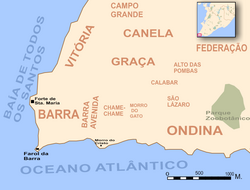
The Santo Antônio da Barra Fort and Lighthouse
The Santo Antônio da Barra Fort stands as Brazil's oldest military construction. Its origins date back to 1534, when defensive structures made of adobe and loose rock were erected on the gneiss formation known as Ponta do Padrão. This location was chosen because a padrão (a stone marker) had been installed there in 1501 by order of the Portuguese king to signal the colony's occupation.
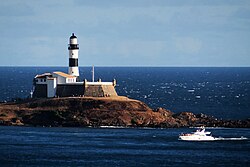
In 1598, Governor Francisco de Souza upgraded the defenses using stone and lime mortar. Over the centuries, the fort underwent numerous redesigns and renovations. Interestingly, the image of Saint Anthony, the patron of Salvador, was granted military ranks at the fort, eventually reaching the rank of lieutenant-colonel between the early 18th century and 1912. A notable event in the fort's history occurred in 1624, when it was briefly occupied by Dutch forces before being reconquered by the Portuguese later that same year.
Today, the fort and its iconic lighthouse, the Farol da Barra, house the Nautical Museum of Bahia. Opened on December 13, 1998, the museum replaced the Museum of Hydrographics and Navigation. It features a diverse collection of nautical instruments, military artifacts, shipwreck finds, and miniatures of historic vessels.
Porto da Barra: The Gateway to Salvador
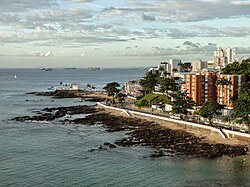
The beach known as Porto da Barra holds immense historical weight as the landing site of Governor-General Tomé de Sousa. On March 29, 1549, Souza arrived with over 1,000 people—including soldiers, sailors, laborers, degredados (exiles), and Jesuit priests led by Manuel da Nóbrega). This event is officially recognized as the foundation day of Salvador.
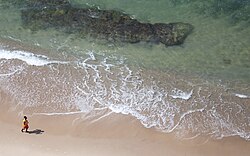
Souza's mission, commissioned by King John III, was to establish a strong fortress and settlement on the Baía de Todos-os-Santos to replace the failing hereditary captaincy system and make the territory profitable. While the landing occurred at the beach, the actual construction of the city began a month later in the area now known as Cidade Alta (High Salvador).
Visitors to the northern end of the beach can find a commemorative marker featuring a marble Maltese cross by sculptor João Fragoso and a tile mural by Eduardo Gomes (a modern interpretation of a 1949 original by Joaquim Rebucho) depicting the arrival of Tomé de Sousa.
Modern Evolution and Culture
Following the growth of the capital, the original "Old Town" was gradually emptied by the 17th century. Barra remained a suburb until the early 20th century, when it transitioned into a maritime spa destination. The neighborhood's consolidation as a major urban center accelerated with the transformation of the Path of the Council into Seven Avenue.
The 20th century brought architectural modernization, most notably with the construction of the Oceânica building in 1942. The neighborhood also became a melting pot of global cultures, welcoming immigrants from Italy, Germany, Poland, Russia, Spain, and Portugal.
Key Facts
- Oldest Fort: Santo Antônio da Barra Fort is the oldest military structure in Brazil.
- Foundation Date: March 29, 1549, marks the arrival of Tomé de Sousa and the foundation of Salvador.
- Museum: The Nautical Museum of Bahia is located within the fort complex.
- Cultural Blend: The area is historically linked to the union of Caramuru and Catarina Paraguaçu.
- Modern Landmark: The Oceânica building (1942) is a key example of modern architecture in the area.
| Year | Event | Significance |
|---|---|---|
| 1501 | Installation of the Padrão | Signaled Portuguese occupation of the colony. |
| 1534 | Settlement of Pereira / First Fort | Earliest Portuguese attempt at settlement and defense. |
| 1549 | Arrival of Tomé de Sousa | Official foundation of San Salvador da Bahia. |
| 1598 | Stone Fort Construction | Upgrade of defenses using stone and lime mortar. |
| 1624 | Dutch Occupation | Brief seizure and subsequent reconquest by Portugal. |
| 1998 | Nautical Museum Opening | Establishment of the current museum in the fort. |
Frequently Asked Questions
What is the significance of the Farol da Barra?
The Farol da Barra is the lighthouse associated with the Santo Antônio da Barra Fort. Together, they form a historic complex that now houses the Nautical Museum of Bahia and serves as a major tourist landmark and gathering point for events like Carnival and New Year's Eve.
Who was Tomé de Sousa?
Tomé de Sousa was Brazil's first governor-general. He arrived at Porto da Barra in 1549 with a fleet of ships and over 1,000 people to establish a strong Portuguese settlement and administrative order in the region.
What is the Nautical Museum of Bahia?
Opened in 1998, this museum is located within the Santo Antônio da Barra Fort. It preserves nautical instruments, military artifacts, miniatures of historic ships, and items recovered from shipwrecks.
Why was the first settlement at Pereira abandoned?
The settlement established by Francisco Pereira Coutinho in 1534 was abandoned because the mistreatment of local Tupi Indians caused them to become hostile toward the settlers.
What is the "Old Town" (Vila Velha) mentioned in Barra's history?
Vila Velha refers to the area of the former Pereira settlement. After the official founding of Salvador in 1549, this earlier site became known as the "Old Town" before it was eventually emptied by the 17th century.