
Biological Colonies: From Microbial Clusters to Superorganisms
In the natural world, survival is often a team effort. A biological colony occurs when two or more conspecific individuals—members of the same species—live in close association or remain physically connected. These arrangements are typically driven by mutual benefit, providing advantages such as enhanced defense mechanisms or the ability to hunt larger prey that a solitary individual could not tackle alone.
While some animals, like jaguars, are solitary and possess all the functions necessary to survive and reproduce independently, others rely on colonial living. Some species are obligate, meaning they must live in a colony to survive (such as corals), while others are facultative, forming colonies only in response to specific environmental conditions (such as certain carpenter bees).

Key Facts
- Colonies consist of two or more individuals of the same species living closely together.
- Unitary organisms have set life stages, whereas modular organisms grow indefinitely through repeated identical modules.
- Clonal colonies are groups of genetically identical individuals (ramets) derived from a single ancestor (genet).
- Eusocial insects, such as ants and bees, exhibit highly organized social structures and are sometimes called superorganisms.
- Microbial colonies are visible clusters of microorganisms, usually grown from a single parent cell on a solid medium.
Types of Biological Colonies
Unitary Organism Aggregations
Unitary organisms have determinate development, meaning they progress through set life stages from zygote to adult. When these organisms aggregate, they form colonies where individuals remain visually distinct. Examples include:
- Protists: Slime molds aggregate when food is scarce to better react to chemical cues from prey.
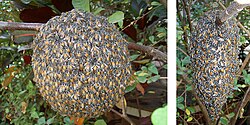
- Eusocial Insects: Ants and honey bees create complex social structures.
- Breeding Colonies: Many birds and mammals nest together to protect offspring and improve mating success. For instance, Bracken Cave hosts approximately 20 million Mexican free-tailed bats, the largest known mammal concentration.
Modular and Clonal Organisms
Modular organisms have indeterminate growth, expanding through the repeated iteration of genetically identical modules. In this context, a genet (the genetic individual from a sexual zygote) reproduces asexually to create ramets (genetically identical clones).
A clonal colony consists of ramets that live in close proximity or are physically connected. Some ramets are independent, while others are interdependent. Examples include plants that propagate via rhizomes or stolons, and sea anemones that reproduce through pedal laceration.
Colonial Organisms
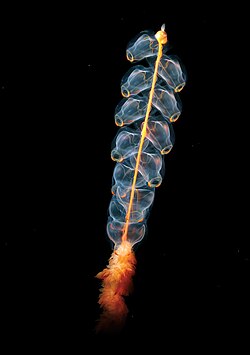
Colonial organisms are a specific type of clonal colony where individuals are physically connected and interdependent. These subunits, known as zooids, ramets, or modules, may exhibit polymorphism—structural variations that assign specific roles like defense, reproduction, or feeding. This physical connection allows the colony to distribute nutrients and energy efficiently. A prime example is the Portuguese man o' war.
Microbial Colonies and Biofilms
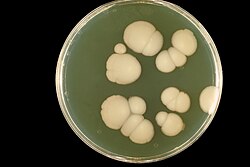
In microbiology, a colony is a visible cluster of microorganisms on a solid medium, typically descending from a single parent cell. Because they are clonal, they are genetically identical (barring rare mutations), which allows scientists to isolate pure strains for study.
A biofilm differs from a simple clonal colony in that it often comprises several different species, creating a community with capabilities greater than the sum of its individual parts.
Colony Ontogeny: The Life Cycle of a Colony
Colony ontogeny is the developmental process from formation to maturity. In eusocial insects, this typically follows four distinct phases:
- Founding Stage: A foundress (queen) or small group establishes the nest and lays the first eggs.
- Worker Emergence: The first generation of workers (the ergonomic stage) emerges to handle foraging and brood care. Over time, labor becomes more specialized.
- Reproductive Phase: The colony produces new virgin queens and males to leave the nest and start new colonies.
- Colony Death: The colony enters senescence, where vitality declines. Following the death of a queen, the colony may die, or a new queen may take over (serial polygyny) or a worker may become the primary reproductive (colony inheritance).
Comparative Advantages of Colonial Life
| Strategy | Primary Benefit | Energy Trade-off |
|---|---|---|
| Solitary | Independence and autonomy | Individual bears all reproductive and survival costs |
| Social Colony | Better defense and foraging | Shared energy costs for reproduction and care |
| Modular/Clonal | Rapid expansion and regeneration | Energy saved via asexual reproduction is diverted to growth |
Frequently Asked Questions
What is the difference between a genet and a ramet?
A genet is the original genetic individual produced from a sexually produced zygote, while a ramet is a genetically identical clone produced asexually from that genet.
How does a biofilm differ from a standard microbial colony?
A standard microbial colony is typically clonal and derived from a single cell of one species, whereas a biofilm is a complex colony that often includes multiple different species working together.
What is a superorganism?
A superorganism is a colony of eusocial insects, such as ants or bees, whose social structure and division of labor are so highly organized that the colony functions as a single integrated unit.
What happens to a colony when the queen dies?
Depending on the species, the colony may die, a virgin queen may replace her (serial polygyny), or a worker may take over the reproductive role (colony inheritance).
What is polymorphism in colonial organisms?
Polymorphism is the presence of different structural and functional forms among the individuals (zooids) within a colony, allowing them to specialize in tasks like feeding, defense, or reproduction.