
Bounty Systems and Rewards: A History of Incentivized Justice
From the ancient streets of Pompeii to the modern galleries of Boston, the practice of offering financial rewards for the capture of criminals or the recovery of stolen goods has been a persistent tool of law enforcement and private citizens. These bounties—sums of money offered as an incentive—have evolved from simple graffiti messages to complex statutory systems, often blurring the line between legal justice and the criminal underworld.
Key Facts
- Ancient Origins: Written reward promises date back to the first-century Roman Empire.
- Legal Evolution: In 17th-century England, rewards became a systematic alternative to combat rising crime.
- High Stakes: 18th-century royal proclamations could offer up to £100 for unmasking murderers.
- Ecological Impact: Bounties were used to hunt species like the thylacine and gray wolf to near or total extinction.
- Modern Use: High-value rewards remain common for art recovery and intelligence in conflict zones.
Ancient and Early Global Examples
The concept of the bounty is not a modern invention. In the Roman city of Pompeii, destroyed in 79 AD, graffiti reveals a shopkeeper offering 65 bronze coins (sestertii) for the return of a missing copper pot, with an additional 20 coins for information leading to the thief's capture.
Over time, governments expanded the use of bounties to achieve political or social goals. In New South Wales, a system was implemented in 1832 to encourage immigration. During the American Civil War, bounties were used to increase military enlistments, though this led to the rise of "bounty jumpers"—individuals who collected the incentive only to desert the army.
Bounties have also had darker applications, specifically targeting indigenous populations. In 1856, Governor Isaac Stevens offered rewards for the heads of Indians in eastern Washington. Similarly, in 1824, 500 acres of land were offered for the capture of the Wiradjuri warrior Windradyne in Australia, though he was never betrayed by his people.
The Rise of Systematic Rewards in England
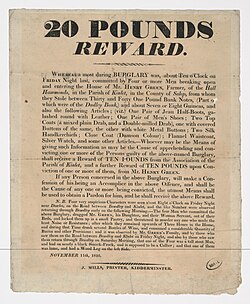
Following the Stuart Restoration, England faced increasing criminality and a failing penal system. This led to the introduction of statutory rewards. Between 1660 and 1692, Parliament passed laws offering rewards up to £40 for information on robbers or burglars.
By 1692, under William III, rewards became a permanent fixture of the legal system. A standard £40 reward (plus the offender's horse, arms, and money) was offered for convictions involving serious property crimes, such as highway robbery and coining. Trial judges were tasked with the critical role of apportioning these rewards among the parties involved in the capture.
In the 18th century, the government utilized royal proclamations to offer even larger sums. In 1720, rewards for murderers or highway robbers could reach £100. When combined with statutory rewards, a single conviction could be worth £140—a staggering amount considering a laborer earned less than £15 per year at the time.
Thief-Takers and the Criminal Underworld
The high financial incentive for capturing criminals gave rise to the thief-taker: a professional who operated in the gray area between the law and the underworld. Because the formal legal process at the Old Bailey was expensive and often failed to return stolen goods to the victim, many chose to bypass the courts.
Victims would advertise rewards with "no questions asked," and thief-takers acted as intermediaries. The most notorious of these was Jonathan Wild. Wild controlled London's underworld in the early 1720s by simultaneously stealing goods and "recovering" them for a fee. His empire collapsed in 1725 when he was convicted and sentenced to death after being caught in a scheme involving stolen lace from a blind woman, Catherine Statham.
Bounties on Animals
Governments have frequently used bounties to eliminate animals deemed undesirable. In the Massachusetts Bay Colony, a 1662 law offered 40 shillings total (split between the town and county) for every wolf killed, verified by the presentation of the animal's ears.
These schemes had devastating ecological consequences. In Tasmania, the thylacine was hunted to extinction through such programs, and gray wolves were similarly extirpated from large portions of the United States.
Summary of Historical Bounty Examples
| Period/Region | Target | Reward/Incentive | Outcome/Note |
|---|---|---|---|
| Ancient Rome | Copper Pot Thief | 85 sestertii (total) | Recorded in Pompeii graffiti |
| 17th C. England | Serious Property Crimes | £40 + assets | Systematized under William III |
| 18th C. England | Murderers/Highway Robbers | Up to £100 (proclamation) | Massive relative to annual wages |
| 19th C. Australia | Windradyne | 500 acres of land | Warrior was never captured |
| 19th C. Australia | Ned Kelly | £8,000 | Most wanted bounty of the 1800s |
| Modern USA | Gardner Museum Art | $5 million | For return of 13 artworks |
Bounties in Popular Culture
The legacy of the bounty hunter persists in fiction. Jonathan Wild served as the inspiration for Mr. Peachum in John Gay's 1728 satirical opera, The Beggar's Opera. In the 20th and 21st centuries, the archetype has been cemented by characters such as Josh Randall in Wanted Dead or Alive, and Boba Fett and Din Djarin in the Star Wars universe.
Modern cinema, particularly the works of Quentin Tarantino in Django Unchained and The Hateful Eight, continues to explore the gritty reality of bounty hunting in the American West.
Frequently Asked Questions
What was a thief-taker?
A thief-taker was a professional who captured criminals or recovered stolen goods for a reward. They often had deep connections to the criminal underworld and sometimes operated outside the formal legal system to ensure victims recovered their property.
How did bounties affect wildlife?
Bounties often led to the mass killing of species. For example, the thylacine in Tasmania was hunted to extinction, and gray wolves were largely removed from the United States due to government-funded reward schemes.
Who was Jonathan Wild?
Jonathan Wild was a prominent 18th-century London figure who masqueraded as a thief-taker while actually controlling the city's criminal underworld. He was eventually executed in 1725.
Were bounties used for things other than criminals?
Yes. Bounties have been used to encourage military enlistment (American Civil War), promote immigration (New South Wales), and eliminate "undesirable" animals.
What is a modern example of a high-value bounty?
The Isabella Stewart Gardner Museum in Boston has offered a $5 million reward for the return of 13 works of art stolen in 1990.