
Brahminy Kite: Breeding Habits, Diet, and Social Behavior
The Brahminy kite is a versatile raptor known for its adaptability and opportunistic nature. From the wetlands of South Asia to the diverse landscapes of Australia, these birds exhibit complex social behaviors and specialized survival strategies that allow them to thrive in various environments.
Breeding and Nesting Patterns
The breeding season for the Brahminy kite varies significantly by geography. In South Asia, the season typically spans from December to April. In Australia, the timing differs by region: birds in the south and east breed from August to October, while those in the north and west breed between April and June.
These raptors demonstrate strong site fidelity, meaning they frequently return to the same nesting area year after year. Their nests are typically constructed in trees—often mangroves—using small branches and sticks to form a structure with a lined bowl of leaves. While tree nesting is the norm, there are rare documented instances of these birds nesting on the ground beneath trees.
A typical clutch consists of two oval eggs, which are dull-white or bluish-white and measure approximately 52 x 41 mm. While both parents contribute to building the nest and feeding the young, incubation is likely performed only by the female. The incubation period lasts roughly 26 to 27 days.
Diet and Foraging Strategies
Primarily a scavenger, the Brahminy kite focuses its diet on dead fish and crabs, particularly within marshlands and wetlands. However, they are opportunistic hunters capable of taking live prey, including bats and hares.
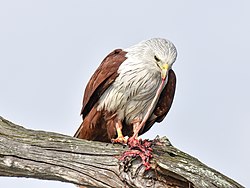
Beyond hunting and scavenging, these birds engage in kleptoparasitism, a behavior where they attempt to steal food from other birds. They have also shown remarkable adaptability in their foraging methods; for example, in the Mekong River, they have been observed following Irrawaddy dolphins to catch fish that the dolphins herd toward the surface.
Their diet can be surprisingly eclectic. Rare records indicate they have fed on honey from Apis florea hives. In India, they are also known to consume rice or cooked food left as offerings.
Social Behavior and Interactions
Brahminy kites are highly social birds that often roost communally in large, isolated trees. These gatherings can be massive, with up to 600 individuals recorded at a single location.
Young birds exhibit playful behavior, such as dropping leaves and attempting to catch them mid-air. They are also proficient in the water; while fishing, they may land on the surface and are capable of swimming and taking off without difficulty.
Interactions with other raptors can be aggressive. Brahminy kites may "mob" (harass in a group) larger raptors like Aquila eagles. However, this behavior carries risks; in encounters with steppe eagles (Aquila rapax), Brahminy kites have been attacked, injured, or killed.
Key Facts
- Diet: Primarily scavenges dead fish and crabs; occasionally hunts hares and bats.
- Nesting: High site fidelity; nests usually made of sticks and leaves in trees or mangroves.
- Clutch Size: Typically two bluish-white or dull-white eggs.
- Sociality: Communal roosts can reach up to 600 birds.
- Adaptability: Known to steal prey from other birds and eat human food offerings in India.
| Feature | Details |
|---|---|
| Incubation Period | 26 to 27 days |
| Egg Dimensions | 52 x 41 mm |
| Primary Habitat for Nesting | Trees and mangroves |
| Common Ectoparasites | Lice (Kurodaia, Colpocephalum, Degeeriella) |
Frequently Asked Questions
What is kleptoparasitism in Brahminy kites?
Kleptoparasitism is the behavior of stealing food or prey that has already been caught by another bird.
Where do Brahminy kites typically build their nests?
They usually build nests in various trees, frequently choosing mangroves, though they have rarely been seen nesting on the ground under trees.
How do Brahminy kites interact with other large eagles?
They may mob larger raptors such as Aquila eagles, but these interactions can be dangerous, as seen in attacks by steppe eagles.
Do Brahminy kites hunt live animals?
Yes, while they are primarily scavengers of dead fish and crabs, they occasionally hunt live prey such as bats and hares.
What is the breeding season for this species?
In South Asia, it is December to April. In Australia, it is August to October (south and east) and April to June (north and west).