
Bras d'Or Hydrofoil: Engineering and Construction
The Bras d'Or was a sophisticated naval project representing a bold leap in maritime engineering. As the third vessel to carry its name, this hydrofoil was designed to combine the speed of an aircraft with the utility of a ship. Its construction involved an unusual partnership between traditional shipbuilders and aviation experts to achieve high-speed foilborne travel.
Construction and Design
The vessel was built at Marine Industries Limited (MIL) in Sorel, Quebec. In a unique arrangement, the primary contractor was de Havilland Canada, a company renowned for aircraft manufacturing rather than ships. The project was initiated by Principal Naval Overseer Commander Donald Clark, CD, RCN, following the launch of HMCS Nipigon in 1964.
The construction process utilized unconventional methods; the aluminum hull was built upside down and was not rotated to its upright position until January 22, 1966. To handle the immense stresses of high-speed travel, the foil system was constructed from maraging steel, a high-strength alloy.
The Foil System
Bras d'Or utilized a canard configuration, meaning it featured a small foil at the front and a larger load-bearing foil at the rear. These were surface-piercing foils, designed to break the water's surface as the ship accelerated.
To combat the harsh marine environment, the maraging steel foils were coated in neoprene to prevent corrosion. Despite this precaution, the neoprene coating proved inadequate, and the foils continued to suffer from corrosion over time.
The foil architecture was complex. The main foils consisted of two anhedral foils (sloping downward), two anhedral tips, two dihedral foils (sloping upward), and a center high-speed foil. The steerable front foil combined two anhedral and two dihedral sections with a central strut, creating a distinct diamond shape.
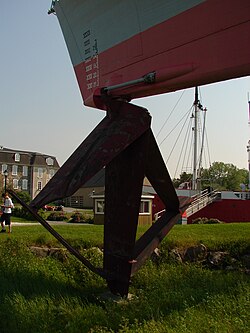
Propulsion and Power
Because the vessel operated in two distinct modes—hullborne (floating on the hull) and foilborne (lifted above the water)—it required two separate propulsion systems. This complexity was so great that the helmsman was required to be qualified as both a sea pilot and an aircraft pilot.
- Foilborne Propulsion: Powered by an FT4A-2 gas turbine producing 25,500 horsepower (19.0 MW) at 21,500 rpm. This power was delivered through General Electric gearboxes to two three-bladed supercavitating propellers (propellers designed to reduce drag by creating a bubble of vapor).
- Hullborne Propulsion: Driven by a Paxman Ventura 16YJCM sixteen-cylinder diesel engine connected to a pair of variable-pitch propellers.
Auxiliary and electrical power during foilborne operations were provided by an ST6A-53 gas turbine. Both the P&W turbines were manufactured by United Aircraft of Canada. For emergency electrical needs, the ship was equipped with a Garrett GTCP85-291 gas turbine.
The 1966 Engine Room Fire
Construction faced a significant setback on November 5, 1966. While the ST6 turbine was running, a hydraulic fluid leak ignited on a hot joint in the exhaust stack, causing a flash fire. A technician managed to rescue a de Havilland employee from the engine room, but the rescue effort meant the fire-suppression system was not activated in time.
The Sorel fire department eventually extinguished the blaze after ninety minutes. The incident resulted in $5.7 million in damages and delayed the ship's official launch until July 12, 1968.
Key Facts
- Primary Contractor: de Havilland Canada.
- Hull Material: Aluminum (built upside down).
- Foil Material: Maraging steel with a neoprene coating.
- Max Foilborne Power: 25,500 hp (19.0 MW).
- Configuration: Canard (small front foil, large rear foil).
- Launch Date: July 12, 1968.
| System | Component | Details |
|---|---|---|
| Foilborne Power | FT4A-2 Gas Turbine | 25,500 hp / 21,500 rpm |
| Hullborne Power | Paxman Ventura 16YJCM | 16-cylinder diesel |
| Auxiliary Power | ST6A-53 Gas Turbine | Provided electrical power while foilborne |
| Emergency Power | Garrett GTCP85-291 | Essential electrical requirements |
Frequently Asked Questions
Who built the Bras d'Or?
The vessel was built at Marine Industries Limited (MIL) in Sorel, Quebec, with the aircraft company de Havilland Canada serving as the primary contractor.
What is a canard configuration in the context of this ship?
In this context, a canard configuration refers to the arrangement of the hydrofoils, where a smaller steerable foil is positioned at the front and a larger load-bearing foil is positioned at the rear.
Why was the helmsman's qualification unique?
Because the ship operated both as a traditional vessel and as a foilborne craft (similar to an aircraft in its dynamics), the helmsman had to be qualified as both a sea pilot and an aircraft pilot.
What caused the delay in the ship's launch?
A flash fire occurred on November 5, 1966, caused by a hydraulic fluid leak in the ST6 gas turbine's exhaust stack. This caused $5.7 million in damage and pushed the launch date to July 12, 1968.
What material were the foils made of and why?
The foils were made of maraging steel for its strength, and were coated in neoprene to prevent corrosion, although the coating was ultimately found to be inadequate.