
Brasília–President Juscelino Kubitschek International Airport
Located in the administrative region of Lago Sul, the Brasília–President Juscelino Kubitschek International Airport (IATA: BSB, ICAO: SBBR) serves as the primary aviation gateway to Brazil's capital. Situated just 13 kilometers from downtown Brasília, this vital transport hub is named in honor of Juscelino Kubitschek, the 21st President of Brazil, a designation official since April 20, 1999.
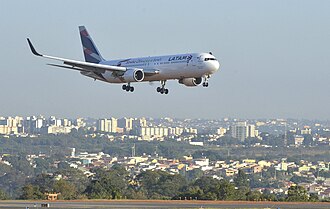
The airport operates as a critical junction for domestic and international travel, serving as a major hub for Gol Transportes Aéreos and LATAM Brasil. Its strategic location and high elevation of 1,066 meters (3,497 feet) above mean sea level make it one of the most significant aviation points in the Federal District.
Key Facts
- Official Name: Aeroporto Internacional de Brasília–Presidente Juscelino Kubitschek.
- Operator: Managed by Inframérica since 2012.
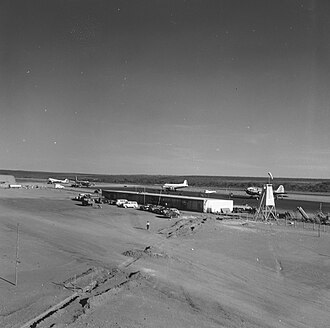
- Opening Date: May 3, 1957.
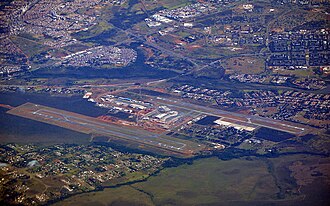
- Runways: Two asphalt runways (11R/29L at 3,300m and 11L/29R at 3,200m).
- 2025 Traffic: Approximately 16.7 million passengers and 150,782 aircraft operations.
- Location: Lago Sul, Federal District, Brazil.
Historical Development and Expansion
The airport has undergone significant transformations to keep pace with Brazil's growth. A major turning point occurred on August 31, 2009, when Infraero announced a BRL 514.8 million investment plan. This renovation was specifically designed to prepare the city for the 2014 FIFA World Cup and the 2016 Summer Olympics in Rio de Janeiro.
The expansion project included several key infrastructure upgrades:
- Apron and Taxiways: Enlarged in April 2013 (BRL 34.5 million).
- Parking Facilities: Expanded in April 2014 (BRL 18 million).
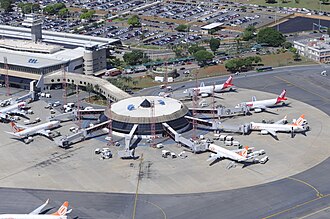
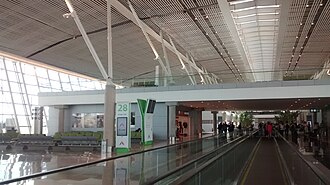
- Passenger Terminal: A massive enlargement completed in April 2015 (BRL 439 million), followed by general renovations finished in November 2015 (BRL 22.5 million).
Airport Infrastructure and Operations
The airport's layout is designed to handle high volumes of traffic efficiently. The South Concourse, which opened in April 2014, connects directly to the main terminal to streamline passenger flow.
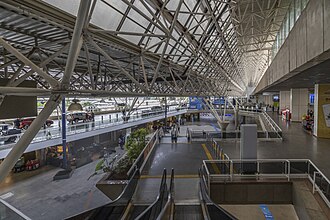
The facility is equipped with two primary asphalt runways that allow for the operation of large commercial aircraft. In recent years, the airport has consolidated its position as a national hub, particularly for flights moving outside the traditional Rio-São Paulo axis.
Operational Statistics Summary
| Year | Passengers | Aircraft Operations | Cargo (Metric Tonnes) |
|---|---|---|---|
| 2025 | 16,713,369 | 150,782 | 54,956 |
| 2023 | 14,860,880 | 140,320 | 49,390 |
| 2021 | 10,499,097 | 102,897 | 42,203 |
| 2019 | 16,727,177 | 143,772 | 70,443 |
| 2015 | 19,821,796 | 186,377 | 46,337 |
Airlines and Global Connectivity
BSB connects travelers to a vast network of domestic and international destinations. Major carriers include Azul Brazilian Airlines, Gol, and LATAM, providing extensive coverage across Brazilian cities such as São Paulo, Rio de Janeiro, Manaus, and Recife.
International connectivity is provided by several key airlines:
- TAP Air Portugal: Direct flights to Lisbon.
- Copa Airlines: Connecting to Panama City.
- Aerolíneas Argentinas: Seasonal service to Buenos Aires.
- LATAM Perú: Flights to Lima.
- Sky Airline: Seasonal service to Santiago de Chile.
Access and Transportation
Travelers can reach the airport from downtown Brasília via several methods. Regular bus lines 102 and 102.1 provide frequent service to the Rodoviária (the main bus terminal), where passengers can transfer to the subway or other city buses. Taxis are also readily available for direct transport.
Frequently Asked Questions
Who operates the Brasília International Airport?
The airport was operated by Infraero from 1973 to 2012 and has been operated by Inframérica from 2012 to the present.
What are the main airlines that use BSB as a hub?
Gol Transportes Aéreos and LATAM Brasil are the primary airlines that utilize the airport as a hub.
How far is the airport from the city center?
The airport is located approximately 13 kilometers (8 miles) from downtown Brasília in the Lago Sul region.
What is the significance of the airport's name?
Since 1999, the airport has been named after President Juscelino Kubitschek, the 21st President of Brazil and the founder of the city of Brasília.
What are the runway specifications at BSB?
The airport has two asphalt runways: 11R/29L, which is 3,300 meters (10,827 ft) long, and 11L/29R, which is 3,200 meters (10,499 ft) long.