
Building Dampers: Engineering Stability in Skyscrapers and Bridges
In the world of modern architecture, the ambition to build taller and more slender structures brings a significant engineering challenge: vibration. From the gentle sway caused by high-altitude winds to the violent shaking of an earthquake, large structures are susceptible to oscillations that can threaten structural integrity or cause discomfort to occupants. To combat this, engineers employ dampers—massive internal systems designed to absorb and dissipate kinetic energy.
At their core, dampers are typically huge concrete blocks or steel bodies mounted within a structure. They function by moving in opposition to the resonance frequency (the natural frequency at which a structure tends to vibrate) of the building. By utilizing springs, fluids, or pendulums, these systems counteract the movement of the building, effectively "quieting" the oscillation.
Key Facts
- Purpose: Dampers reduce oscillations caused by wind, seismic activity, and human movement.
- Mechanism: They move in opposition to the structure's resonance frequency to absorb energy.
- Types: Common forms include solid mass dampers (steel/concrete), pendulums, and tuned liquid column dampers (TLCD).
- History: While used earlier in automotive and aerospace fields, specialized seismic dampers for buildings emerged in the late 1950s.
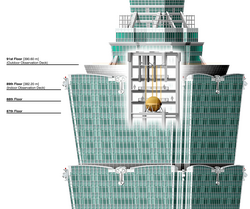
- Scale: Some dampers, such as the one in Taipei 101, weigh hundreds of metric tons.
Sources of Structural Vibration
Vibrations in large structures are rarely the result of a single factor. Instead, they stem from various environmental and mechanical sources that can range from merely inconvenient to catastrophically destructive.
Earthquakes and Seismic Waves
Seismic waves cause buildings to sway and oscillate based on the direction of ground motion, the building's height, and its construction. Excessive oscillation can lead to total structural failure. To prevent this, engineers implement seismic vibration control technologies to enhance performance and mitigate damage.
Wind Forces
Wind acting against tall buildings can cause the top of a skyscraper to move by more than a meter. This motion can manifest as swaying or twisting, which may cause motion sickness for people on upper floors. Because factors like ambient temperature, relative humidity, and wind speed can change a building's natural resonant frequency over time, a Tuned Mass Damper (TMD) must be robustly designed to remain effective throughout the building's lifespan.
Mechanical Human Sources
Even humans can be a source of vibration. In large structures like stadiums, masses of people walking up and down stairs or stomping in unison can create serious resonance problems if proper damping measures are not in place.
Types of Damping Systems
Depending on the needs of the structure, engineers choose different materials and mechanisms to absorb energy.
Solid and Pendulum Dampers
These often consist of massive steel or concrete weights. Some are suspended as pendulums to allow for a specific swing frequency that counters the building's movement.
Liquid Dampers
Tuned Liquid Column Dampers (TLCD) use the movement of water to absorb energy. This can involve water tanks where the liquid "sloshes" to counteract oscillations, or specialized columns of fluid.
Global Examples of Damping Implementation
Dampers are utilized globally in a variety of iconic landmarks and critical infrastructure.
| Structure | Location | Damper Detail |
|---|---|---|
| Taipei 101 | Taiwan | 660 metric ton damper (floors 87-92) |
| 111 West 57th Street | USA (NYC) | World's heaviest solid damper (800 short tons) |
| Comcast Center | USA (Philadelphia) | World's largest TLCD (1,300 short tons) |
| Statue of Unity | India | Two 250-ton dampers at chest level |
| Millennium Bridge | UK (London) | Retrofitted dampers to stop "wobbling" from foot traffic |
| Sydney Tower | Australia | Suspended water tank and a second TMD |
| Akashi Kaikyō Bridge | Japan | Pendulums within suspension towers |
Frequently Asked Questions
What is a Tuned Mass Damper (TMD)?
A TMD is a device mounted in a structure to reduce the amplitude of mechanical vibrations. It is "tuned" to the specific resonant frequency of the building so that it moves in the opposite direction of the vibration, absorbing the energy.
Can a building be designed with a damper from the start?
Yes. While some dampers are added after completion (such as in the John Hancock Tower), others are integrated into the original design, such as the Park Tower in Chicago.
Why are liquid dampers used instead of solid weights?
Liquid dampers, such as Tuned Liquid Column Dampers, can be more versatile and may serve dual purposes (like water storage) while providing effective energy absorption through the movement of the fluid.
Do dampers prevent buildings from moving entirely?
No, they do not stop all movement; rather, they reduce the amplitude of the oscillation to a level that is safe for the structure and comfortable for the people inside.
What causes the "wobble" in pedestrian bridges?
The "wobble" is typically caused by synchronous lateral excitation, where the movement of many people walking in unison matches the bridge's natural frequency, creating resonance.