
Burr Arch Truss: Engineering Principles and American Examples
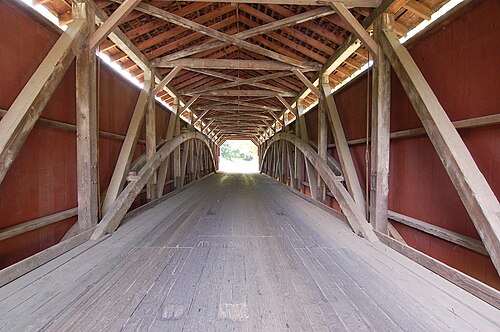
The Burr arch truss is a sophisticated structural design that combines two distinct engineering elements—the arch and the truss—to create a bridge capable of supporting significant weight. By integrating these two systems, engineers achieved a level of stability and load-bearing capacity that neither a standalone arch nor a standalone truss could provide on its own.
The Engineering Logic of the Burr Truss
At its core, the design principle of the Burr arch truss suggests that the arch should be capable of bearing the entire load of the bridge, while the truss serves to keep the structure rigid. This combination is particularly effective because balancing a dynamic load—the shifting weight of traffic moving across the bridge—between two separate structural components is nearly impossible to achieve evenly.
While the kingpost truss (a basic triangular truss design) is capable of bearing a load independently, the addition of the arch enhances the overall integrity. Interestingly, modern computer models have offered an alternative perspective, suggesting that the truss may actually perform the majority of the load-bearing work while the arch provides the necessary stability. Regardless of which component carries the primary load, the synergy between the two results in a more stable bridge.
Notable Examples in the United States
The state of Indiana maintains one of the most significant collections of Burr Truss bridges in the U.S. Out of 92 extant (still existing) bridges in the state, 53 utilize the Burr Truss design, with a high concentration located in Parke County.
Parke County Landmarks
In Parke County, the Sim Smith Covered Bridge provides a clear visual example of the design, where the arch projects below the lower chords of the bridge. Another notable site is the Mansfield Covered Bridge; following a major storm that removed its roof, the interior design became more visible to observers. The Mansfield bridge also demonstrates the scalability of the design, as spans could be added to extend the bridge further than other structures of similar design.
The Medora Covered Bridge
Located in Jackson County, the Medora Covered Bridge stands as the longest covered bridge in the state of Indiana, showcasing the efficiency of the Burr Truss for longer spans.
Key Facts
- Hybrid Design: Combines an arch and a truss for superior stability.
- Load Distribution: Designed to handle dynamic loads more effectively than single-system bridges.
- Indiana Concentration: 53 of Indiana's 92 remaining covered bridges are Burr Trusses.
- Scalability: The design allows for additional spans to increase the bridge's length.
- Regional Hub: Parke County, Indiana, is a primary location for these structures.
| Bridge Name | Location | Notable Feature |
|---|---|---|
| Sim Smith Covered Bridge | Parke County | Arch projects below lower chords |
| Mansfield Covered Bridge | Parke County | Extendable spans; visible interior design |
| Medora Covered Bridge | Jackson County | Longest covered bridge in Indiana |
Frequently Asked Questions
What is the primary purpose of the Burr arch truss?
The primary purpose is to combine the load-bearing capacity of an arch with the rigidity of a truss, allowing the bridge to support greater weight and remain more stable than if it used only one of these elements.
How does the Burr truss handle dynamic loads?
Because it is difficult to evenly balance a moving (dynamic) load between two different structural systems, the Burr design integrates the arch and truss to ensure the bridge remains rigid and stable as weight shifts across it.
Which state has a high concentration of these bridges?
Indiana has a large collection, with 53 of its 92 remaining covered bridges utilizing the Burr Truss design, particularly in Parke County.
Can Burr Truss bridges be extended in length?
Yes, as seen in the case of the Mansfield Covered Bridge, spans can be added to the design to extend the bridge further than other similar designs.
What is the difference between the traditional view and computer model views of the Burr truss?
The traditional view is that the arch bears the entire load while the truss provides rigidity. Conversely, computer models suggest the truss may bear the majority of the load while the arch provides stability.