
Camillus Nyrop: Pioneering Surgical Instruments and Prosthetics in Denmark
In the mid-19th century, the intersection of medicine and metallurgy was revolutionized by skilled craftsmen who could translate surgical needs into precise tools. One such figure was Camillus Nyrop, a master instrumentmaker and bandagist—a specialist in bandages and orthopedic supports—whose work in Copenhagen set new standards for medical equipment in Denmark.
The Rise of a Master Instrumentmaker
Upon returning to Copenhagen in 1838, Nyrop immediately established his own production facility for surgical instruments. His technical proficiency quickly earned him the respect of the city's leading surgeons and medical doctors, positioning him as a key figure in the local medical community.
His professional ascent was marked by official recognition from the highest academic bodies. In 1841, the Royal Danish Academy of Surgery granted him the status of official instrumentmaker. Following the merger of the academy with the University of Copenhagen's Department of Medicine in 1843, Nyrop was elevated to the status of university instrumentmaker.
Innovation and Industrial Expansion
Nyrop was not content with local success; he traveled abroad multiple times to study the latest advancements in surgical tools and explore emerging techniques within the metal industry. This commitment to continuous learning allowed him to integrate international innovations into his own practice.
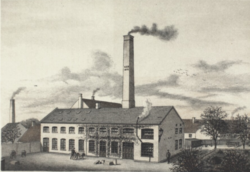
Between 1846 and 1850, Nyrop expanded his industrial footprint by operating a tool factory in partnership with Theodor Marstrand. His influence extended into the broader business community as well, serving as a board member of Industriforeningen (The Industrial Association) starting in 1843.
Contributions to War Medicine and Prosthetics
The First Schleswig War (1848–49) presented a grim necessity for medical innovation. Nyrop dedicated himself to the development of improved artificial limbs to assist the numerous soldiers returning from the conflict with severe injuries. His inventions in the field of prosthetics earned him international acclaim, proving that his skills extended beyond the operating theater to the rehabilitation of the wounded.
As his career progressed, Nyrop shifted his focus toward the refinement of the surgical armamentarium—the complete set of equipment and instruments used by a surgeon—striving to simplify these tools for greater efficiency and ease of use.
Legacy and Publications
Nyrop's contributions to the field were codified in his written work. Between 1864 and 1877, he published Bandager og Instrumenter (Bandages and Instruments) in three volumes, providing a comprehensive reference for the medical community of his time.
| Year/Period | Achievement/Role |
|---|---|
| 1838 | Established surgical instrument production in Copenhagen |
| 1841 | Named official instrumentmaker by the Royal Danish Academy of Surgery |
| 1843 | Named university instrumentmaker; joined Industriforeningen board |
| 1846–1850 | Operated a tool factory with Theodor Marstrand |
| 1848–1849 | Developed advanced artificial limbs during the First Schleswig War |
| 1864–1877 | Published Bandager og Instrumenter I-III |
Key Facts
- Specialization: Expert in both surgical instrument making and bandagist work.
- Academic Ties: Held official appointments with both the Royal Danish Academy of Surgery and the University of Copenhagen.
- War Effort: Gained international recognition for inventing better artificial limbs for soldiers of the First Schleswig War.
- Industrial Role: Served as a board member of Industriforeningen from 1843.
- Major Work: Authored the three-volume series Bandager og Instrumenter.
Frequently Asked Questions
What was Camillus Nyrop's primary profession?
Camillus Nyrop was a professional instrumentmaker and bandagist, specializing in the production of surgical tools and orthopedic bandages.
How did the First Schleswig War influence Nyrop's work?
During the war (1848–49), Nyrop focused his efforts on creating superior artificial limbs for injured soldiers, which brought him international fame.
Which institutions officially recognized Nyrop's expertise?
He was recognized by the Royal Danish Academy of Surgery in 1841 and later by the University of Copenhagen's Department of Medicine in 1843.
What was the goal of Nyrop's later career work?
Towards the end of his career, Nyrop focused on simplifying the surgical armamentarium to make surgical tools more practical and efficient.
Did Camillus Nyrop publish any medical literature?
Yes, he published a three-volume work titled Bandager og Instrumenter between 1864 and 1877.