Whether you are gliding across a mirror-still lake or navigating the adrenaline-fueled rapids of a mountain river, choosing the right craft is essential. While often grouped together, canoeing and kayaking represent distinct traditions with unique equipment, designs, and techniques. From ancient skin-on-frame vessels to modern carbon-fiber racing machines, the evolution of these boats reflects a deep human connection to the water.
Canoes and Kayaks: The Basics
A canoe (referred to as a "Canadian canoe" in British English) is typically a small, open-topped boat pointed at both ends. Paddlers usually sit on a raised seat or kneel, using a paddle that generally features a blade at only one end. While most are human-powered, some may utilize sails, poling, or small electric and gas motors. Touring canoes are commonly operated by two people.
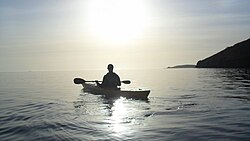
Kayaking on the Helford River: Kayaking on the Helford River
A kayak is a slimmer vessel, also pointed at both ends, designed for a single paddler who sits in a low seat with legs extended. Unlike the open canoe, kayaks usually feature a covered deck. To keep the interior and the paddler's lower body dry, a spray deck (a flexible waterproof cover) is used to seal the cockpit.
Key Differences Between Canoes and Kayaks
Key Facts
Paddle Design: Canoes typically use single-bladed paddles; kayaks use double-bladed paddles.
Seating: Canoeists kneel or sit on raised seats; kayakers sit low with legs extended.
Hull Structure: Canoes are generally open-top, while kayaks feature a closed deck with a cockpit.
Materials: Modern boats are primarily made from Rotomolded plastic, Fiberglass, Kevlar, or Royalex.
Terminology: In the UK, kayaks were historically viewed as a subtype of canoe, influencing the naming of international governing bodies.
Paddle and Position
The most immediate way to tell the two apart is the paddle. A kayak paddle has a blade at each end, allowing the paddler to stroke on alternating sides without switching hands. In contrast, a canoe paddle has a single blade. This difference extends to the paddler's posture: the low center of gravity in a kayak provides stability in rougher seas, while the raised position in a canoe allows for better visibility and different leverage for poling.
Modern Boat Designs and Materials
Modern manufacturing has introduced a variety of materials, each offering different trade-offs in terms of weight, durability, and cost:
Rotomold (Rotationally Molded Plastic): The most common and affordable option. It is highly durable, making it ideal for rocky environments.
Fiberglass: Lighter than plastic but more expensive and fragile, requiring careful handling.
Kevlar: The same material used in bulletproof vests; it is stronger and lighter than fiberglass but comes at a higher price point.
Royalex: A composite material consisting of an inner ABS foam layer and an outer vinyl/ABS layer, bonded by heat. It is frequently used in whitewater canoes.
Specialized Modern Craft
Depending on the activity, specialized hulls are used to optimize performance:
Recreational and Sea Kayaks: Recreational kayaks are for flatwater, while sea kayaks are built for the open ocean, bays, and large lakes.
Fishing Kayaks: Outfitted with rod holders, electronic fish-finders, live-bait containers, and anchor trolleys.
Sit-on-top Kayaks: Virtually unsinkable boats where the paddler sits on top of the hull; these do not keep the paddler dry or warm.
Flyak: A kayak equipped with twin hydrofoils that lift the hull out of the water, reaching speeds up to 27.2 km/h (16.9 mph) on calm water.
Performance Boats: This includes Sprint canoes for flatwater racing (paddled while kneeling on one knee) and International Canoes, which are high-performance sailing vessels with a jib and mainsail.
Folding and Inflatable Kayaks: Portable options using collapsible frames (wood, aluminum, plastic) with waterproof fabric, or inflatable polythene.
Concrete Canoe: An engineering competition craft designed to make a seemingly unfloatable material float.
Whitewater Specializations
Whitewater designs are often interchangeable between kayak (K-1) and canoe (C-1) configurations by changing the seat. Specific types include:
Creek Boat: High-volume, blunt-ended boats for steep creeks and waterfalls (up to class 6).
River Runner: Faster, high-volume boats for class 3 rapids.
Slalom: Low-volume, 3.5-meter boats designed for maximum maneuverability in races.
Freestyle Playboat: Short, flat-bottomed boats used for aerial tricks and surfing standing waves.
Squirt Boat: Extremely low-volume boats designed to sink below the surface in eddy lines.
Wildwater Race Boat: Long, fast boats for downriver racing, though they are difficult to maneuver.
Traditional Designs
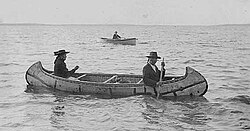
Traditional craft were born from necessity, primarily for fishing and seal hunting. These are often hand-built using a wooden frame—typically western red cedar—covered in treated animal hides or waterproof materials.
Birch-bark canoe: Birch-bark canoe
Notable traditional designs include:
Aleutian Kayak and Baidarka: Driftwood frames covered in seal skins; the Baidarka is associated with early Russian settlers in Alaska.
Umiak: A Yupik/Inuit canoe made from driftwood lashed together and covered in walrus or seal skin.
Waka: Māori canoes ranging from small fishing boats (waka tīwai) to massive war canoes (waka taua) reaching 40 meters in length.
Cayuco: South American canoes carved from a single hollowed-out tree trunk.
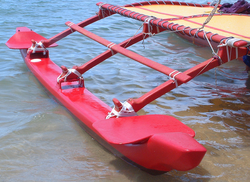
Outrigger Canoe: A hull stabilized by one or more lateral support floats called outriggers.
Outrigger on a Hawaiian canoe: Outrigger on a Hawaiian canoe
Other Traditional Variants
Other unique designs include the Sturgeon-nosed canoe, featuring a reversed prow for navigating bulrushes, the Taimen (a Russian folding kayak), the Chundan Vallam (beaked snake boats from Kerala), and War canoes, which are now primarily used for racing in Canada.
Essential Paddling Gear
Beyond the boat, several pieces of equipment ensure safety and efficiency on the water:
Buoyancy Aid: A specialized personal flotation device (PFD) for canoeists and kayakers.
Paddle Float: A buoyancy aid attached to the paddle to assist in re-entering a kayak after capsizing.
Sea Sock: A waterproof bag fitted inside the cockpit to prevent the boat from filling with water during a capsize.
Tuilik: A traditional Greenlandic garment that integrates a paddling jacket and spray deck into one piece.
Paddle Leash: A strap used to prevent the paddle from drifting away during solo tours.
Albano Buoy System: A system of buoys used to mark race courses for rowing, canoeing, and kayaking.
Comparison of Common Boat Materials
Material
Durability
Weight
Cost
Best Use Case
Rotomold Plastic
Very High
Heavy
Low
Rocky rivers, beginners
Fiberglass
Moderate
Light
Moderate
Calm waters, touring
Kevlar
High
Very Light
High
Professional touring, racing
Royalex
High
Moderate
Moderate
Whitewater canoeing
Frequently Asked Questions
What is the main difference between a canoe and a kayak paddle?
The primary difference is the number of blades. A canoe paddle typically has a single blade at one end, whereas a kayak paddle has a blade at both ends.
Which material is best for kayaking over rocks?
Rotationally Molded Plastic (Rotomold) is the best choice for rocky environments because it is the most durable and impact-resistant material available.
What is a spray deck and why is it used?
A spray deck is a flexible, waterproof cover that seals the cockpit of a kayak or canoe. It is used in whitewater or bad weather to prevent water from entering the boat.
What is the purpose of an outrigger?
An outrigger is a secondary solid hull positioned parallel to the main hull. It provides lateral stability, making the boat less likely to capsize and resisting heel when sailing.
How does a Flyak differ from a standard kayak?
A Flyak uses twin hydrofoils to lift the hull out of the water as it moves, which reduces drag and increases speed, allowing it to reach up to 27.2 km/h on calm water.
References
Concise Oxford English Dictionary (Eleventh Edition)
Thomas S. Yukic. Fundamentals of Recreation, 2nd edition. Harpers & Row, 1970. p. 1f. LCCN70-88646.