
Carrier Recovery Operations: The Mechanics of Naval Aviation Landings
Recovering aircraft onto a moving aircraft carrier is one of the most complex maneuvers in aviation. This process, known as recovery operations, requires precise coordination between the pilots and the ship's control centers. From the moment an aircraft enters the carrier's radar coverage—typically several hundred miles away—it is monitored closely. As it enters the carrier control area, a 50-nautical-mile radius (93 km), it is handed over to marshal control for final clearance into the recovery pattern.
Key Facts
- Recovery Cases: Operations are categorized as Case I (visual), Case II (mixed), or Case III (instrument/night) based on weather.
- The "Meatball": Pilots use an optical landing system to maintain the correct glideslope during the final approach.
- Landing Precision: The landing area is only 120 feet (37 m) wide, requiring extreme accuracy.
- The Bolter: A "bolter" occurs when an aircraft misses all arresting wires and must climb back to 1,200 feet to try again.
- Rapid Stop: An arrested landing brings an aircraft from approach speed to a full stop in approximately two seconds.
Recovery Classifications: Case I, II, and III
The method of recovery is determined by meteorological conditions, ensuring safety regardless of visibility or time of day.
Case I: Visual Recovery
Case I is used when weather permits visual flight. Aircraft enter a port holding pattern—a left-hand circle tangent to the ship's course with a maximum diameter of 5 nautical miles (9.3 km). Aircraft are stacked at altitudes starting at 2,000 feet (610 m), with 1,000 feet (300 m) of vertical separation.
Once cleared, aircraft descend to the "initial" position, 3 nautical miles (5.6 km) astern of the ship at 800 feet (240 m). They fly over the ship and "break" into the landing pattern. If more than six aircraft arrive simultaneously, the flight leader may initiate a "spin," a tight 360° turn within 3 nautical miles of the ship to manage traffic.
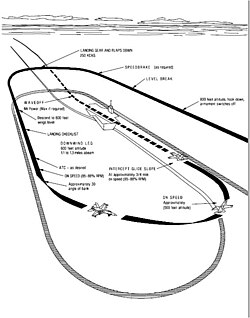
The break consists of a 180° turn at 800 feet, descending to 600 feet (180 m) on the downwind leg. At "the 180" (approximately 1.1 to 1.3 nautical miles from the ship), the pilot begins the final turn and descent. By "the 90," the aircraft is at 450 feet (140 m). The final checkpoint is crossing the ship's wake at roughly 370 feet (110 m), where the pilot acquires the optical landing system.
Case II: Mixed Conditions
Case II is employed when pilots may encounter instrument conditions during descent, but the ship itself has a ceiling of at least 1,000 feet (300 m) and 5 nautical miles (9.3 km) of visibility. Radar control is used until the pilot is within 10 nautical miles (19 km) and reports the ship in sight, at which point they transition to Case I procedures.
Case III: Instrument Recovery
Case III is used during night operations or when weather is below Case II minima. These recoveries are conducted as single aircraft. Pilots hold at a marshal fix—typically 150° from the ship's base recovery course—in a left-handed, 6-minute oval racetrack pattern.
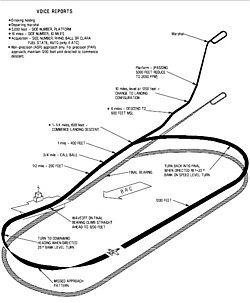
Aircraft descend at 250 knots (460 km/h) and 4,000 feet per minute until reaching 5,000 feet (1,500 m), where the descent slows to 2,000 feet per minute. Depending on their position relative to the final bearing, pilots may perform an "arc" at 12.5 nautical miles (23.2 km) to intercept the approach course.
Precision Approach Systems
Because the landing area is angled about 10° from the ship's axis, the final bearing is slightly different from the ship's heading. Several technical systems help pilots maintain this alignment.
Electronic and Laser Guidance
- Carrier-Controlled Approach: Similar to ground-controlled approaches, controllers provide voice corrections regarding glideslope and bearing.
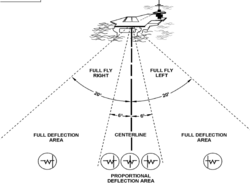
- Instrument Carrier Landing System (ICLS): Uses a "bullseye" display to show position relative to the glideslope and final bearing.
- Automatic Carrier Landing System (ACLS): A "mode II" approach uses needles for guidance, while "mode I" and "mode IA" allow the autopilot to couple with the ship's signals for a hands-off approach.
- Long-Range Laser Lineup System (LLS): Uses eye-safe lasers to provide visual lineup cues from 10 nautical miles down to 1 nautical mile.
The Final Visual Phase
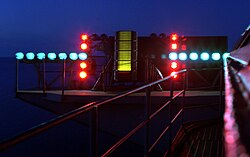
Regardless of the recovery case, the final 3/4 nautical mile (1.4 km) is flown visually. Pilots align themselves using a drop line—a set of lights descending from the stern—and the painted "ladder lines" on the deck.
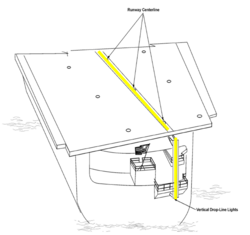
The glideslope (the vertical path of the aircraft) is maintained using an optical landing system, often referred to as the "meatball." This may be a Fresnel lens optical landing system (FLOLS) or a manually operated system.
The Landing and Post-Flight Process
The pilot aims for the middle arresting wire. Upon touchdown, throttles are immediately advanced to military or full power for three seconds. This ensures that if the aircraft misses the wires (a bolter) or a cable snaps, the engines are already spooled up for an immediate climb.
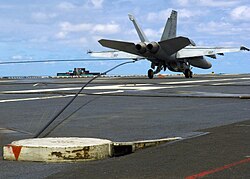
If the tailhook catches a wire, the aircraft is brought to a full stop in about two seconds. If the pilot is waved off by the Landing Signal Officer (LSO) or suffers a bolter, they climb to 1,200 feet (370 m) into the bolter/wave-off pattern to await further instructions.
After a successful landing, the aircraft director guides the plane to clear the landing area. Wings are folded, and aircraft are packed on the bow to keep the deck clear for subsequent recoveries.
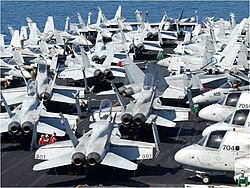
Once shut down, aircraft undergo a rapid turnaround: refueling, rearming, inspection, and minor maintenance before being respotted for the next launch cycle.
| Feature | Case I | Case II | Case III |
|---|---|---|---|
| Weather Conditions | Visual | Mixed (1,000ft ceiling / 5nmi vis) | Instrument / Night |
| Primary Guidance | Visual / Optical | Radar to Visual | ICLS / ACLS / Radar |
| Formation | Stacked Formations | Flights to Single | Single Aircraft |
| Approach Pattern | Port Holding / Break | Case III to Case I transition | Marshal Fix / Racetrack |
Frequently Asked Questions
What happens during a "bolter"?
A bolter occurs when an aircraft touches down but fails to catch any of the arresting wires. Because the pilot advances the throttles to full power upon touchdown, the aircraft has sufficient thrust to accelerate off the deck and climb to 1,200 feet to attempt another approach.
Why do pilots advance the throttle to full power upon landing?
Throttles are advanced to ensure the engines are spooled up. This provides immediate power to safely fly away from the ship in the event of a bolter or a cable failure.
What is the "meatball" in carrier landings?
The "meatball" is the visual indicator of the optical landing system (such as the FLOLS). It tells the pilot if they are too high, too low, or on the correct glideslope for a safe touchdown.
How does the angled flight deck affect the approach?
The landing area is angled about 10° from the ship's axis. Consequently, the final approach heading (final bearing) is approximately 10° less than the ship's base recovery course.
What is the purpose of the marshal fix in Case III recoveries?
The marshal fix is a specific location where aircraft hold in a racetrack pattern. This allows the ship to sequence aircraft for landing at precise one-minute intervals, ensuring safe separation during low-visibility operations.