
Central University of Venezuela: A History of Academic Excellence and Resilience
The Central University of Venezuela stands as a cornerstone of intellectual life in South America. From its humble beginnings as a religious seminary to its current status as a UNESCO World Heritage site, the institution has mirrored the political and social evolution of Venezuela itself. Its journey is one of transformation, shifting from a colonial ecclesiastical center to a secular bastion of modern research and democratic struggle.
Origins and Colonial Foundation
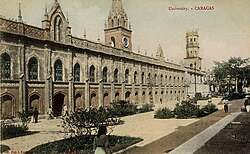
The university's roots trace back to 1673, when Friar Antonio González de Acuña, a Spanish Bishop born in Peru, founded the Seminary Saint Rose of Lima in Caracas. Named after the first Catholic Saint born in the Americas, the institution was expanded in 1696 by Friar Diego de Baños y Sotomayor, who established the School and Seminary of Saint Rose of Lima.
During this era, students seeking formal university degrees were forced to travel vast distances to Mexico City, Bogotá, or Santo Domingo. To resolve this, Rector Francisco Martínez de Porras and the citizens of Caracas petitioned the Spanish royal court. On December 22, 1721, King Philip V signed a Royal Decree in Lerma, transforming the school into the Universidad Real y Pontificia de Caracas (Royal and Pontifical University of Caracas). This was formally sanctioned by Pope Innocent XIII via a Papal bull in 1722.
The university initially offered degrees in Medicine, Canon law, Theology, and Philosophy. It remained the sole university in the country until 1810, when the Universidad de Los Andes was established in Mérida.
The Transition to a Republican Institution
As the 18th century closed, the university became a quiet hub for Enlightenment thought. Despite official royal and papal censorship, works by influential philosophers such as Locke, Montesquieu, Voltaire, Rousseau, Diderot, Helvetius, and Grotius were smuggled into Venezuela via ships from the Guipuzcoana Company.
The institution underwent a fundamental shift on June 24, 1827, when Simón Bolívar proclaimed the Republican Statutes. These statutes stripped the university of its religious character, establishing it as a secular institution and transferring primary authority to the Rector.
Political Turmoil and the 20th Century
The early 20th century was marked by volatility. Following a 1908 coup d'état, dictator Juan Vicente Gómez took power. Viewing the education of free minds with suspicion, Gómez closed the university from 1912 to 1922. Upon its reopening, Rector Felipe Guevara Rojas modernized the academic structure by replacing traditional schools with specialized departments.
In 1928, the university became a center of political resistance. A group of students known as the Generation of 1928—including figures such as Rómulo Betancourt, Miguel Otero Silva, Juan Oropeza, Isaac Pardo, and Rodolfo Quintero—organized protests during "Students Week" to oppose the Gómez dictatorship. This culminated in an attempted overthrow of the regime on April 7, 1928, leading to the imprisonment or exile of many students.
The university's role as a democratic vanguard continued in 1936. When President Eleazar López Contreras suspended constitutional rights and censored the press during an oil workers' strike, Rector Francisco Antonio Rísquez led public protests through the streets of Caracas.
The Architectural Masterpiece: Ciudad Universitaria
By 1942, the university had outgrown its fragmented facilities. To create a cohesive academic environment, the administration of President Isaías Medina Angarita purchased the Hacienda Ibarra. The government commissioned architect Carlos Raúl Villanueva to design a unified campus, inspired by the University City of Bogotá.
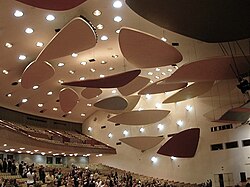
The resulting 200-hectare complex consists of 40 buildings and is celebrated as a pinnacle of Modern Architecture in Latin America. Villanueva implemented a "Synthesis of Arts," collaborating with 28 avant-garde artists to integrate art directly into the architecture. Notable works include the 1953 Floating Clouds by Alexander Calder, sculptures by Henri Laurens and Jean Arp, and murals by Wifredo Lam, Fernand Léger, and Victor Vasarely.
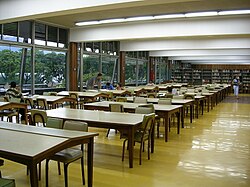
Due to its unique design and cultural significance, the Ciudad Universitaria de Caracas was declared a UNESCO World Heritage site, the only modern campus designed by a single architect to receive this honor.
Modern Era and Academic Growth
Following the fall of dictator Marcos Pérez Jiménez in 1958, a new university law was enacted on December 5, guaranteeing academic freedom and tolerance. However, this autonomy was tested in the 1960s when guerrilla rebels supported by Fidel Castro used the campus as a refuge. This tension peaked on October 3, 1970, when President Rafael Caldera ordered a military raid on the university, forcing Rector Jesús María Bianco to resign. The institution reopened in 1971 with a new renovation plan.
Academically, the latter half of the 20th century saw a surge in quality due to the arrival of European immigrants fleeing the Spanish Civil War and World War II. These scientists and humanists expanded research lines and mentored the current generation of faculty members.
Key Facts
- Founded: 1673 as a seminary; 1721 as a university.
- UNESCO Status: The Ciudad Universitaria de Caracas is a World Heritage site.
- Architect: Carlos Raúl Villanueva designed the modern campus.
- Key Movement: The Generation of 1928 led student protests against dictatorship.
- Global Ranking: Ranked 731-740 in the 2026 QS World University Rankings.
| Period | Status/Name | Key Characteristic |
|---|---|---|
| 1673–1721 | Seminary Saint Rose of Lima | Ecclesiastical training |
| 1721–1827 | Universidad Real y Pontificia de Caracas | Royal and Papal sanction |
| 1827–Present | Republican/Secular University | Secular authority under the Rector |
| 1942–Present | Ciudad Universitaria de Caracas | Modernist architectural complex |
Frequently Asked Questions
Who founded the original seminary that became the university?
The institution began as the Seminary Saint Rose of Lima, founded in 1673 by Friar Antonio González de Acuña, a Spanish Bishop born in Peru.
What is the "Synthesis of Arts" in the campus design?
It is the guiding principle of architect Carlos Raúl Villanueva, who integrated works by 28 avant-garde artists—including Alexander Calder and Victor Vasarely—directly into the architecture of the campus.
Why was the university closed between 1912 and 1922?
Dictator Juan Vicente Gómez ordered the closure because he was ambivalent about the purpose of educating free minds, preferring to hire foreign experts for technical needs.
What was the significance of the Generation of 1928?
The Generation of 1928 was a group of students who organized protests and attempted to overthrow the dictatorship of Juan Vicente Gómez, marking a pivotal moment in the university's history of political activism.
How did European immigration affect the university?
Intellectuals arriving after the Spanish Civil War and World War II helped develop new lines of research and teaching, significantly strengthening the faculty body in the second half of the 20th century.