
Cheese Curds: From Fresh Snacks to Fried Delicacies
Cheese curds—the fresh, solid pieces of curdled milk produced during the cheesemaking process—are more than just a step in production; they are a versatile culinary staple. Depending on where you are in North America, these savory morsels are enjoyed as simple snacks, indulgent fair foods, or the heart of a national dish.
Key Facts
- Fresh curds are commonly eaten as appetizers or finger foods.
- Deep-fried curds vary by region, with Minnesota using batter and Wisconsin using breading.
- Poutine is a Canadian dish from Quebec featuring fries, curds, and gravy.
- Faspa is a traditional light lunch served by Russian Mennonites that includes fresh curds.
Fresh Cheese Curds
In their natural state, fresh cheese curds are prized for their mild flavor and unique texture. They are frequently served as a snack or appetizer, either on their own or paired with cured meats like smoked sausage or pork, often held together with a toothpick.
To enhance the taste, fresh curds are often dressed with various flavorings. Popular options include garlic, jalapeño chili peppers, and various herbs. In particular, the combination of garlic and dill on cheddar curds is a favorite among enthusiasts. Other regional variations include the use of Cajun seasoning.
Beyond simple snacking, fresh curds hold cultural significance. For Russian Mennonites, they are a key component of faspa, a traditional light lunch.
Deep-Fried Cheese Curds
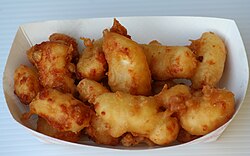
Deep-fried cheese curds are a staple of carnivals, fairs, and local bars. While they appear in some regional chains like Culver's and Dairy Queen, they are most common in non-chain fast-food establishments. In regions where frying is the norm, the term "cheese curds" often refers specifically to the fried version, while non-fried versions are labeled as "raw" or "plain."
Regional Styles: Minnesota vs. Wisconsin
There are two primary methods for preparing fried curds in the American Midwest:
- Minnesota Style: The curds are dipped in a batter similar to that used for onion rings before being deep-fried.
- Wisconsin Style: These curds are coated in breading rather than batter. In Wisconsin, they are typically called "fried curds," though some other regions refer to them as "cheeseballs."
These golden treats are typically served with dipping sauces such as ranch dressing, marinara sauce, or ketchup.
Poutine
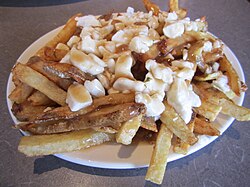
One of the most famous uses of cheese curds is in poutine. This dish originated in the 1950s in rural Quebec, Canada. Poutine consists of a base of french fries topped with fresh cheese curds and smothered in a rich brown gravy. Some variations may include additional ingredients, but the curd-and-gravy combination remains the defining characteristic.
Cheese Curd Summary
| Type | Preparation | Common Pairings/Styles | Regional Association |
|---|---|---|---|
| Fresh | Unprocessed/Raw | Garlic, Dill, Cured Meats | General / Russian Mennonite (Faspa) |
| Fried (MN) | Battered | Ranch, Ketchup, Marinara | Minnesota |
| Fried (WI) | Breaded | Ranch, Ketchup, Marinara | Wisconsin |
| Poutine | Fresh on Fries | Brown Gravy | Quebec, Canada |
Frequently Asked Questions
What is the difference between Minnesota and Wisconsin fried curds?
The primary difference is the coating: Minnesota style uses a batter similar to onion rings, while Wisconsin style uses breading.
What is faspa?
Faspa is a traditional light lunch served by Russian Mennonites that typically includes fresh cheese curds.
Where did poutine originate?
Poutine originated in rural Quebec, Canada, during the 1950s.
How are fresh cheese curds typically flavored?
Fresh curds are often flavored with garlic, dill, jalapeño chili peppers, herbs, or Cajun seasoning.
What are "raw" cheese curds?
In areas where fried curds are common, the term "raw" or "plain" is used to distinguish non-fried cheese curds from the deep-fried variety.