
Chilean Police Rubber Pellet Injuries: Analysis of Composition and Responsibility
During the civil unrest in Chile in late 2019, the use of rubber pellets by security forces led to a wave of severe injuries, most notably the permanent loss of vision for numerous protesters. While often categorized as non-lethal, the physical composition and deployment patterns of these munitions suggest a far more dangerous reality.
The Composition and Lethality of Rubber Pellets
Technical analysis reveals that the munitions used by the Chilean police were not composed primarily of rubber. Instead, 80% of the pellets consisted of hard substances, specifically silica and barium sulfate, with rubber making up only 20%. These pellets measured 96.5 on the Shore A hardness scale, a level of rigidity that explains the high frequency of "exploded eyes" among the injured.
Furthermore, police sources cited by Ciper indicate that the "supersock" brand shotgun munitions contained lead and reached velocities of 82 meters per second.
Deployment Statistics and Patterns of Use
The scale of munition deployment was immense. Between October 18 and late December, Chilean riot police fired 152,000 rubber pellet cartridges. A significant concentration occurred early on, with 104,000 cartridges fired in the first two weeks alone. Given that each cartridge contains 12 pellets, approximately 1.25 million pellets were deployed in that initial period.
Evidence suggests that these weapons may have been used deliberately to cause harm. A survey of 19 individuals with eye injuries revealed that 9 recalled police aiming directly at their faces. Statistical anomalies further support this; while fewer cartridges were fired in November compared to October, the number of eye injuries doubled. Astrophysicist Nestor Espinoza estimated that if pellets had been fired randomly, non-eye injuries would have been in the magnitude of 750,000.
Institutional and Individual Responsibility
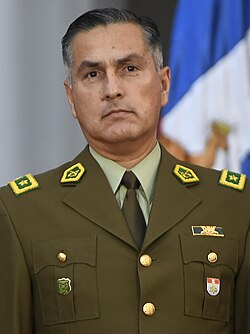
Several factors contributed to the escalation of violence. The classification of these tools as non-lethal weapons may have misled officers regarding their potential for severe harm. Additionally, there was a reported lack of respect among field officers for the authority of Mario Rozas, the Director General of Carabineros.
Individual accountability is highlighted in the case of a police officer identified as "G-3." This Subprefect is accused of abusive weapon use and is specifically investigated for the complete blinding of Gustavo Gatica on November 8. Amnesty International criticized the police high command for tolerating the repetitive improper use of weapons by high-ranking officials like "G-3." Following an internal investigation in June, "G-3" was fired for manipulating evidence from his corporal GoPro camera.
Political Consequences and Legal Actions
The crisis led to significant political upheaval. In November 2019, the impeachment of Minister of the Interior and Public Security Andrés Chadwick became a focal point. During these proceedings, Ministry of Health Jaime Mañalich informed the Chamber of Deputies that 12 people had lost an eye and approximately 30 others suffered serious injuries. Izkia Siches, President of the Chilean Medical College, testified that police had failed to follow established protocols for rubber bullet use.
On December 11, 2019, the Senate passed the impeachment motion, barring Chadwick from holding public office for five years. A separate attempt to impeach President Sebastián Piñera was rejected by the Chamber of Deputies on December 12 as unconstitutional.
Key Facts
- Composition: Pellets were 80% hard substances (silica/barium sulfate) and only 20% rubber.
- Hardness: Measured at 96.5 shore A.
- Volume: 1.25 million pellets were fired in the first two weeks of protests.
- Casualties: 12 people lost an eye and roughly 30 suffered serious eye injuries.
- Political Outcome: Minister Andrés Chadwick was barred from public office for five years.
| Metric | Detail/Value |
|---|---|
| Hard Substance Content | 80% (Silica and Barium Sulfate) |
| Rubber Content | 20% |
| Hardness Rating | 96.5 Shore A |
| Muzzle Velocity | 82 m/s |
| Total Cartridges (Oct-Dec) | 152,000 |
Frequently Asked Questions
What were the rubber pellets actually made of?
Despite their name, the pellets were composed of 80% hard materials, specifically silica and barium sulfate, and only 20% rubber.
Why did so many people suffer eye injuries?
The high hardness of the pellets (96.5 shore A) and evidence suggesting that police aimed directly at faces contributed to the frequency of severe eye trauma.
Who was "G-3" and why was he fired?
"G-3" was a Subprefect accused of abusive weapon use, including the blinding of Gustavo Gatica. He was fired after an internal investigation found he had manipulated GoPro camera evidence.
What political actions were taken in response to the injuries?
The Senate impeached Minister of the Interior Andrés Chadwick, barring him from public office for five years. An attempt to impeach President Sebastián Piñera was rejected as unconstitutional.
How many pellets were fired during the initial protests?
In the first two weeks of protests, 104,000 cartridges were fired, totaling approximately 1.25 million individual pellets.