
Cliefden Caves Area: A Geological and Cultural Treasure of New South Wales
The Cliefden Caves Area stands as a site of immense state significance, offering a rare window into the geological evolution of New South Wales and eastern Australia. Once submerged beneath the palaeo-Pacific Ocean, this landscape now preserves a complex lithological and sedimentological sequence—the study of rock characteristics and sediment layers—that helps scientists reconstruct the continent's ancient past.
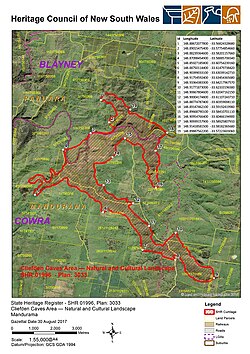
Listed on the New South Wales State Heritage Register on August 30, 2017, the area is celebrated not only for its scientific value but also for its deep spiritual connection to the Wiradjuri people and its historical role in Australian exploration.
Key Facts
- Global Significance: Contains the best exposures of Late Ordovician island marine invertebrate fossil assemblages in Australia.
- Unique Biodiversity: Home to 191 genera and 263 species of fossils, including the endemic Belubula spectacula.
- Karst Diversity: One of the most cavernous limestone areas in NSW, featuring over 100 recorded caves and 120 karst features.
- Ancient Occupation: Skeletal remains and carved trees provide evidence of human presence dating back over 6,000 years.
- Historical Milestone: The site of the first discovery of limestone in mainland Australia by surveyor G.W. Evans in 1815.
A Palaeontological Powerhouse
The Belubula River Valley and Cliefden Caves are internationally recognized for their Ordovician island faunal (shelly fossils) and floral (algae) assemblages. This region preserves a volcanic island succession, a short-lived geological phenomenon that is rarely captured so clearly in the rock record.
Icons of Heritage
Three specific sites—Fossil Hill, Dunhill Bluff, and Trilobite Hill—are considered icons of Australia's palaeontological heritage. These areas contain well-preserved strata of coral, shells, and trilobites. Notably, Fossil Hill holds the world's oldest known in-situ brachiopod shell beds and the earliest rugose corals found on Earth.
The fossils also reveal ancient plate tectonic movements. For example, the genus Belubula is found only here and in Zhuhuia, South China, proving these two distant regions were once geographically close during the Ordovician period.
The Karst System and Rare Formations
The Cliefden Caves karst system—a landscape formed from the dissolution of soluble rocks—is one of the most diverse in the state. It features a wide array of karst features, including dolines (sinkholes), tufa deposits, and a rare thermal spring, which is one of only three such springs associated with karst in New South Wales.
Exotic Speleothems
The caves are renowned for their speleothems (mineral deposits formed in caves). While common stalactites and stalagmites are present, the area is famous for rare formations, including:
- Helictites: Twisted, gravity-defying formations.
- Boxwork: Intricate, honeycomb-like ceiling structures.
- Dogtooth spar: Large, sharp crystals.
- Rare Colors: Speleothems ranging from pure white and orange to exceptionally rare sky-blue and aqua green, such as those found in Taplow Maze, Boonderoo, and Murder Cave.
Cultural and Social Significance
Beyond its geology, the area is deeply imbued with cultural value. The Belubula Valley was home to the Wiradjuri language group, who lived as hunters and fishers until European settlement began around the 1830s.
Wiradjuri Connection
For the Wiradjuri traditional owners, the landscape is a sacred creation place, powerful and inhabited by the spirits of ancestors. The caves are used for ritual purposes, and the community continues to visit the thermal spring, collect colored ochres, and fish in the Belubula River to maintain their cultural obligations to the land.
European History and Research
The area holds historical weight as the site where G.W. Evans first discovered mainland Australian limestone in 1815. Additionally, 'Rothery's Ruins' on Island Flat provide a physical link to the Cliefden Estate. Today, the site remains a hub for international collaboration, with researchers from China and the Czech Republic studying its fossils and hydrology.
Biodiversity and Environmental Records
The region is a recognized bat "hot spot," supporting over fifteen species. Two species reside in the caves year-round: the Eastern Horseshoe bat and the Eastern Bentwing Bat, the latter of which is listed as "Vulnerable" under the NSW TSC Act (1995).
Furthermore, the environment acts as a natural archive. Mud deposits in the caves and active tufa dams on Davy's Creek contain minerals that record past climate events and environmental changes.
| Category | Key Features | Significance |
|---|---|---|
| Geology | Late Ordovician limestone, thermal spring | Evidence of palaeo-Pacific submergence and karst diversity |
| Palaeontology | Belubula spectacula, rugose corals | World-first fossil records and biogeographic links to China |
| Cultural | Skeletal remains, carved trees, Rothery's Ruins | 6,000+ years of human occupation; Wiradjuri sacred site |
| Biology | Eastern Bentwing Bat, 15+ bat species | Critical habitat for vulnerable microbat species |
Frequently Asked Questions
What makes the fossils at Cliefden Caves unique?
The area contains the best exposures of Late Ordovician island marine invertebrate fossils in Australia, including species like the brachiopod Belubula spectacula, which is found nowhere else in the world.
Who are the traditional owners of this land?
The Wiradjuri people are the traditional owners. They regard the area as a sacred creation place and continue to use the caves and river for ritual and cultural purposes.
What are the rare geological features found in the caves?
The caves feature rare blue speleothems, "boxwork" ceilings, and a thermal spring, which is one of only three karst-associated thermal springs in New South Wales.
How old is the evidence of human occupation in the area?
Skeletal remains found within the caves, along with carved trees, indicate that Aboriginal people occupied the area more than 6,000 years ago.
Why is the site important for international research?
Because of its unique fossil beds and karst processes, the site facilitates ongoing collaborative research between Australian scientists and experts from the Czech Republic and China.