
Cocos (Keeling) Islands: A History of Discovery, Conflict, and Integration
The Cocos (Keeling) Islands are a remote archipelago with a storied past, evolving from a chance discovery by East India Company explorers to a strategic military outpost and, eventually, an integrated territory of Australia. The islands' history is marked by eccentric settlers, global conflicts, and a unique transition from a feudal-style estate to a modern democratic society.
Discovery and Early Settlement
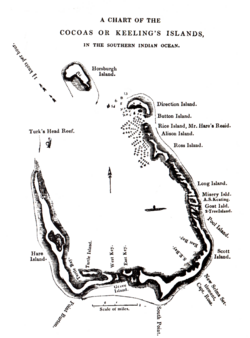
The archipelago was first discovered in 1609 by Captain William Keeling of the East India Company during a return voyage from the East Indies. For over a century, the islands remained largely unmapped until 1749, when Swedish captain Carl Gustaf Ekeberg sketched North Keeling, noting the presence of coconut palms. By 1789, the islands appeared on charts produced by British hydrographer Alexander Dalrymple.
The early 19th century saw the islands become the center of a strange rivalry. In 1825, Scottish merchant seaman Captain John Clunies-Ross claimed the islands for himself. Shortly after, a wealthy Englishman named Alexander Hare arrived with a harem of 40 Malay women, hoping to escape the constraints of civilization. This led to a feud between Hare and Clunies-Ross; eventually, Hare's companions deserted him for Clunies-Ross's sailors, prompting Hare to leave the islands. He died in Bencoolen in 1834.
Clunies-Ross established a settlement by recruiting Malay workers, creating a closed economic system where employees were paid in a private currency called the Cocos rupee, which could only be spent at the company store.
![Historic compass chart of the Cocos islands[17]](/images/80/c9/80c9d855471a6e77ba249cea8fa1156325a389180de29e59040ccbc51d679227.jpg)
The Visit of Charles Darwin
In 1836, the HMS Beagle arrived to survey the atoll. On board was the naturalist Charles Darwin, who used the findings to support his theory on how atolls—ring-shaped coral reefs—are formed. His observations were later published in The Structure and Distribution of Coral Reefs.
Annexation and British Administration
The British Empire formally annexed the islands in 1857 via Captain Stephen Grenville Fremantle of the HMS Juno. Over the following decades, administrative control shifted from the Governor of Ceylon to the Governor of the Straits Settlement. In 1886, Queen Victoria granted the islands to John Clunies-Ross in perpetuity, allowing the family to maintain semi-official status as Resident Magistrates.
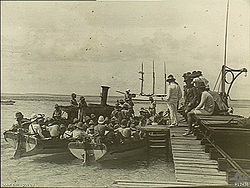
By the turn of the century, the islands gained strategic importance. A telegraph cable station was established on Direction Island in 1901, linking the archipelago to Mauritius, Java, and Western Australia. A wireless station followed in 1910 to communicate with passing ships.
The Islands in Global Conflict
World War I and the Battle of Cocos
On November 9, 1914, the islands became the site of the Battle of Cocos. A landing party from the German cruiser SMS Emden captured the wireless station on Direction Island. However, a distress call reached the Australian cruiser HMAS Sydney, which intercepted the German ship. After a fierce engagement, the Emden was forced to beach herself on North Keeling Island.
The battle resulted in 134 German deaths and 69 wounded, while the HMAS Sydney suffered four deaths and 16 wounded. This victory ensured that troopships from Australia and New Zealand could sail without naval escorts.
World War II and the Y Service
During World War II, the islands served as a vital link for the Y service, a global intelligence system used for direction finding. To avoid Japanese detection, radio transmitters remained silent except in emergencies.
The period was not without internal strife. On May 8–9, 1942, a mutiny broke out among the Ceylon Defence Force garrison, led by Gratien Fernando. The uprising was crushed, and three men were executed—the only British Commonwealth soldiers executed for mutiny during the war.
Later in the war, the islands became an airbase for the RAF, including Supermarine Spitfires and Liberator bombers. Airmen even produced a daily newspaper called Atoll, which was dropped over POW camps to provide news to prisoners.
Transfer to Australian Sovereignty
On November 23, 1955, the islands were transferred from the United Kingdom to the Commonwealth of Australia through a complex legal process involving the Cocos Islands Act and the Cocos (Keeling) Islands Act. This transition moved the islands from the Colony of Singapore to Australian authority.
By the 1970s, the Australian government grew dissatisfied with the feudal rule of the Clunies-Ross family. In 1978, Australia forced the family to sell the islands for A$ 6,250,000. Following a legal battle over their home, Oceania House, and the bankruptcy of John Clunies-Ross, the family's influence waned.
In 1984, a UN-supervised referendum was held. Out of 261 eligible voters, 229 voted for integration with Australia, officially ending the islands' colonial status.
Modern Infrastructure and Indigenous Status
Today, West Island features an airstrip capable of handling Boeing 737s. In 2023, the Australian parliament approved a 150-metre extension to accommodate Boeing P-8 Poseidon aircraft for anti-submarine warfare and surveillance, with completion expected by 2026.
Regarding social identity, descendants of the Cocos Malays—originally brought to the islands as indentured workers, slaves, or convicts—have sought recognition as Indigenous Australians as of 2019, despite not being ethnically Aboriginal.
Key Facts
- Discovery: Found in 1609 by Captain William Keeling.
- Scientific Significance: Used by Charles Darwin to develop his theory on atoll formation.
- Military History: Site of the Battle of Cocos (1914) and a WWII intelligence hub.
- Governance: Transferred from the UK to Australia on November 23, 1955.
- Integration: Formally integrated with Australia following a 1984 referendum.
- Strategic Asset: Currently hosts an airstrip for high-tech military surveillance.
| Period/Date | Status/Event | Key Figure/Entity |
|---|---|---|
| 1609 | Discovery | Captain William Keeling |
| 1825–1857 | Private Settlement | John Clunies-Ross |
| 1857 | British Annexation | Captain Stephen Fremantle |
| 1914 | Battle of Cocos | HMAS Sydney vs. SMS Emden |
| 1955 | Transfer to Australia | Commonwealth of Australia |
| 1984 | Integration Referendum | Cocos Malay Population |
Frequently Asked Questions
Who were the Clunies-Ross family?
The Clunies-Ross family were Scottish settlers who established a private estate on the islands in the 19th century. They ruled the islands in a feudal style for generations until the Australian government forced the sale of the islands in 1978.
What was the significance of the Battle of Cocos?
The battle in 1914 resulted in the defeat of the German cruiser SMS Emden by the Australian cruiser HMAS Sydney. This removed the last active Central Powers warship from the Indian and Pacific Oceans, securing Allied shipping lanes.
How did Charles Darwin contribute to the islands' history?
During a visit aboard the HMS Beagle in 1836, Darwin studied the natural history of the islands. His observations provided the evidence needed to formulate his theory on the structure and distribution of coral reefs and atolls.
Why is the airstrip on West Island being extended?
The extension is designed to allow the landing of Boeing P-8 Poseidon aircraft, which are used for high-tech military surveillance and low-level anti-submarine warfare operations.
What happened during the Cocos Islands Mutiny?
In May 1942, 15 members of the Ceylon Defence Force mutinied against British officers. The uprising was suppressed, leading to the execution of three soldiers, the only such executions for mutiny in the British Commonwealth during WWII.