
Commodore Business Machines: The Rise and Fall of a Computing Giant
The story of Commodore is a saga of aggressive entrepreneurship, vertical integration, and a relentless drive to bring computing to the masses. From its humble beginnings in the typewriter business to dominating the home computer market in the 1980s, Commodore redefined how the world interacted with personal technology.
The Early Years: From Typewriters to Calculators
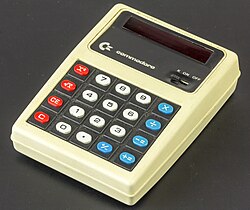
The company's origins date back to the early 1950s when Jack Tramiel and Manfred Kapp partnered in New York City to sell reconditioned typewriters. By 1955, they established Everest Office Machines in Toronto, securing exclusive Canadian rights to Everest adding machines. This venture evolved on October 10, 1958, with the incorporation of Commodore Portable Typewriter, Ltd. in Toronto, focusing on importing Czechoslovak portable typewriters.
As the adding machine market slowed, Tramiel pivoted toward the emerging technology of electronic calculators in the late 1960s. By 1969, Commodore began manufacturing its own calculators, becoming a popular brand for both consumer and scientific models. However, the market shifted in 1975 when Texas Instruments, a primary parts supplier, began selling machines below Commodore's own component costs.
To secure its supply chain, Tramiel used a cash infusion from Gould in 1976 to purchase several second-source chip suppliers, most notably MOS Technology, Inc. This move toward vertical integration—controlling both the components and the final product—would become a cornerstone of Commodore's future success.

Entering the Computer Market (1977–1984)
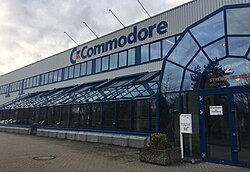
Reorganized as Commodore International, Ltd., the company moved its financial headquarters to the Bahamas and its operational base to West Chester, Pennsylvania. In 1980, it expanded into Europe, establishing a massive production site in Braunschweig, Germany.
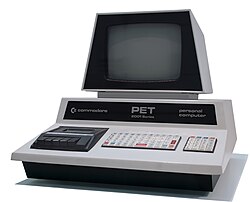
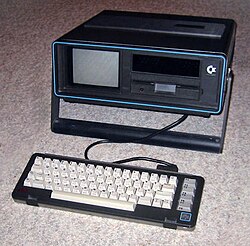
Commodore's early entry into the microcomputer market was marked by the PET (Personal Electronic Transactor) line. While the PET was successful in schools due to its rugged metal construction and networking capabilities, it struggled in the home market where sound and graphics were prioritized.
The tide turned in 1981 with the launch of the VIC-20. Priced at US$299 and marketed with aggressive advertisements featuring William Shatner, the VIC-20 became the first computer to ship over one million units, eventually selling 2.5 million. This success paved the way for the 1982 release of the Commodore 64 (C64).
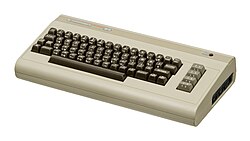
The C64 featured advanced sound and graphics powered by MOS Technology chips, making it a favorite for the emerging computer demo scene. To capture market share, Tramiel ignited a "home computer war" in 1983 by dramatically cutting prices. By selling through mass-market retailers like K-Mart, Commodore outpaced rivals like Atari and Texas Instruments. The C64 eventually shipped approximately 22 million units, remaining the best-selling computer model until the Raspberry Pi surpassed it in 2019.
![The "heart" of Commodore's philosophy: Early Commodore 16 main PCB (prototype), not used in the regular series model. According to Commodore computer engineer Bil Herd, this single-sided PCB was an extraordinary attempt of cost saving by Commodore, which probably failed due to technical problems.[29]](/images/5c/4a/5c4ab51688942420386af6082f188e5a9a3f085488cc303ff8aaac48141a27cc.jpg)
The Amiga Era and the Atari Rivalry

Despite financial dominance, internal strife led to Jack Tramiel's resignation in January 1984 following disagreements with board chairman Irving Gould. Tramiel subsequently founded Tramel Technology and purchased the consumer division of Atari Inc. from Warner Communications.
In a bid to secure the future, Commodore purchased the Amiga Corporation in August 1984 for $25 million. This led to the 1985 release of the Amiga 1000, a 32-bit machine that was far ahead of its time. The Amiga is often regarded as the first true multimedia computer due to its advanced graphics and sound capabilities.
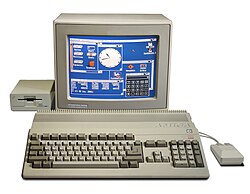
A fierce rivalry ensued between the Amiga and the Atari ST. While the Amiga 500 (1987) eventually outsold the ST by a ratio of roughly 1.5 to 1, neither platform could withstand the industry-wide shift toward Intel-based x86 computers running Microsoft Windows.
Decline and Liquidation (1987–1994)
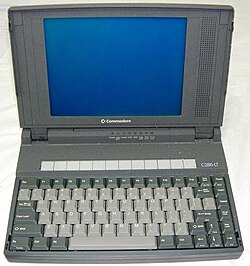
By the late 1980s, Commodore struggled with a fragmented brand identity, seen simultaneously as a maker of cheap 8-bit machines and high-end workstations. While the C64 remained a "cash cow," the company failed to update the Amiga hardware quickly enough to compete with the advancing PC and Apple Macintosh platforms.
Management instability was a recurring theme, with executives frequently changing in what was described as a "revolving door." Despite strong PC sales in Germany, where Commodore held a 28% market share in 1990, the company's US presence dwindled.
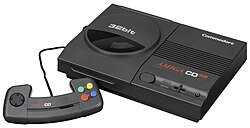
A final attempt at a turnaround came in 1993 with the Amiga CD32, a 32-bit CD-ROM game console. However, the system arrived too late to save the company from insolvency. By 1994, only the UK, German, and Canadian operations remained profitable. On April 29, 1994, Commodore announced voluntary bankruptcy and liquidation.
Key Facts
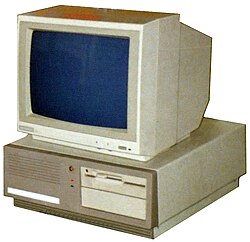
- Best-Selling Model: The Commodore 64 shipped approximately 22 million units.
- Vertical Integration: The acquisition of MOS Technology allowed Commodore to control its own chip production.
- First Milestone: The VIC-20 was the first computer to ship more than one million units.
- Multimedia Pioneer: The Amiga 1000 is credited as the first multimedia computer.
- Final Product: The Amiga CD32 was the company's last major attempt to enter the game console market.
| Product | Year | Key Feature/Market | Significance |
|---|---|---|---|
| PET 2001 | 1977 | Education/Business | Rugged build, early LAN capabilities |
| VIC-20 | 1981 | Home Market | First to sell 1M+ units |
| Commodore 64 | 1982 | Home Market | Best-selling computer of its era |
| Amiga 1000 | 1985 | Multimedia | Advanced 32-bit graphics and sound |
| Amiga CD32 | 1993 | Gaming Console | Final 'make or break' hardware attempt |
Frequently Asked Questions
Why was the Commodore 64 so successful?
The C64 combined advanced sound and graphics chips from MOS Technology with an aggressive pricing strategy. By selling through mass-market retailers like K-Mart and undercutting competitors, Commodore made powerful computing affordable for the average household.
What was the significance of MOS Technology?
MOS Technology provided the essential integrated circuits (chips) for Commodore's machines. By owning the supplier, Commodore could reduce costs and design custom hardware, giving them a competitive edge during the price wars of the 1980s.
How did the Amiga differ from the Commodore 64?
While the C64 was an 8-bit home computer designed for general use and gaming, the Amiga was a 32-bit multimedia powerhouse. It offered vastly superior graphics, sound, and video capabilities, targeting a more professional and creative market.
What led to Commodore's eventual bankruptcy?
A combination of factors led to its downfall, including poor management, a failure to update the Amiga hardware to keep pace with PC and Mac advancements, and a struggle to transition from the 8-bit market to the professional workstation market.
Who was Jack Tramiel?
Jack Tramiel was the co-founder and driving force behind Commodore. Known for his focus on cost control and market share, he led the company to its peak before resigning in 1984 to later acquire Atari.