
Communion Tokens: History, Usage, and Symbolism
Communion tokens are small, physical markers used by various Christian denominations to regulate access to the Eucharist. Falling under the study of exonumia—the study of tokens and medals not issued as official currency—these objects provide a fascinating glimpse into the intersection of faith, discipline, and church administration.
The Origins and Global Spread of Tokens
The concept of communion tokens was first proposed in 1560 by John Calvin and Pierre Viret in Geneva. While the Geneva city council initially rejected the idea, the practice was adopted the following year in Le Mans and Nîmes. By 1586, the Walloon church in Amsterdam had implemented the system.
Although used in several regions, the practice was most prevalent in Scotland, where more than 5,000 distinct types of tokens have been recorded. The tradition spread globally through Presbyterian churches, appearing in Australia, New Zealand, Canada, and the United States. Tokens were also issued in diverse locations such as Bombay, Cochin, Corfu, Florence, Madeira, Port Louis, Kingston (Jamaica), Berbice, Demerara, and Hartslog. While most tokens date from the 19th century, some were still in use by a few congregations in the Presbyterian Church of Eastern Australia as late as 1964. Additionally, Scottish Episcopal churches utilized these tokens.
The Purpose of Closed Communion
The use of tokens was fundamentally tied to the practice of closed communion, a tradition where only official members of a specific church are permitted to participate in the Lord's Table. To prevent the profanation of the Eucharist, church elders acted as moral watchdogs, distributing these entry counters only to members they deemed qualified based on their conduct and beliefs.
Before tokens were distributed, members typically underwent catechetical instruction—a formal process of religious education and examination of faith.
Design, Materials, and Symbolism
Communion tokens were typically crafted from lead or other base metals. They appeared in various geometric shapes, including round, oval, square, and oblong forms.
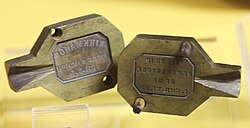
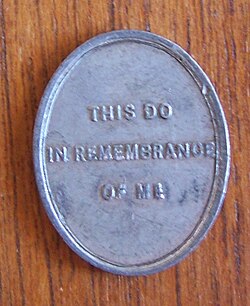
The imagery and text on these tokens often carried deep spiritual meaning. Many featured biblical verses, such as "Let a man examine himself" (1 Corinthians 11:28) or "This do in remembrance of me" (1 Corinthians 11:24). Common symbols included:
- The Burning Bush: A frequent motif on many tokens.
- Religious Objects: Bibles, communion cups, or communion tables.
- Christian Symbols: The fish, the lamb, or the cross.
Early tokens often bore the initials of the minister or the name of the church. A significant surge in production occurred in 1843 with the formation of the Free Church of Scotland, leading many congregations to issue stock tokens marked with that specific year.
The Transition to Communion Cards
Toward the end of the 19th century, the use of metal tokens began to decline. They were gradually replaced by communion cards as rules regarding admission to the Lord's Table became more flexible. This shift allowed visitors from other denominations to participate in communion upon the profession of their faith.
Today, these artifacts are preserved in museums, with the Dunblane Museum housing a significant collection of over 6,000 tokens.
Key Facts
- Origin: Proposed by John Calvin and Pierre Viret in 1560.
- Primary Region: Most widely used in Scotland (5,000+ types recorded).
- Purpose: To enforce closed communion by verifying a member's moral and doctrinal standing.
- Materials: Primarily lead or other base metals.
- Key Date: 1843 saw a large issuance due to the formation of the Free Church of Scotland.
- Field of Study: Exonumia.
| Feature | Details |
|---|---|
| Common Materials | Lead and base metals |
| Common Shapes | Round, oval, square, oblong |
| Common Symbols | Burning bush, fish, lamb, cross, Bible, communion cup |
| Distribution Method | Issued by elders after catechetical instruction |
| Replacement | Communion cards (late 19th century) |
Frequently Asked Questions
What is the purpose of a communion token?
Communion tokens served as entry counters to ensure that only qualified members of a church, who had been vetted by elders for their belief and conduct, could participate in the Eucharist.
Which country produced the most communion tokens?
Scotland produced the highest number of tokens, with over 5,000 different types recorded.
What is exonumia?
Exonumia is the field of study concerned with tokens, medals, and other similar objects that are not issued as official government currency.
Why did churches stop using metal tokens?
By the end of the 19th century, metal tokens were largely replaced by communion cards, and admission rules were eased to allow members of other denominations to participate.
What symbols are commonly found on these tokens?
Common symbols include the burning bush, the fish, the lamb, the cross, and depictions of Bibles or communion tables.