
Concept2 Equipment: From Olympic Oars to Advanced Ergometers
Concept2 has evolved from a small venture by the Dreissigacker brothers into a global leader in rowing and fitness technology. By combining engineering precision with a focus on accessibility, the company has shaped how athletes train both on the water and in the gym. Their product line spans from professional-grade oars used in the Olympics to a diverse range of ergometers—machines designed to measure the work performed during exercise.
Key Facts
- Olympic Influence: Concept2's "hatchet" blades were adopted by most Olympic crews by 1992.
- Industry Standard: The RowErg is the official specification rower for the CrossFit Open and Games.
- Air Resistance: Most Concept2 machines use flywheel technology to provide dynamic resistance.
- Diverse Range: The current lineup includes the RowErg, SkiErg, BikeErg, and the new StrengthErg.
- Data Driven: All modern machines utilize the PM5 Performance Monitor for precise workout tracking.
Professional Rowing Oars
Concept2 established itself as a premier manufacturer of oars by innovating blade design. In 1991, they introduced asymmetrical "hatchet" blades, which quickly revolutionized the sport. By 1992, these blades became the standard for most Olympic crews. Today, Concept2 and Croker oars dominate international rowing competitions.
As of May 2024, the company offers a wide array of blade designs to suit different needs, including the Comp, Fat2, Smoothie2 Vortex Edge, Smoothie2 Plain Edge, Big Blade, Macon Blade, and Bantam Blade. To further customize performance, they provide various shaft and handle options, such as Ultralight, Skinny, and Skinny Coastal (exclusive to sculling).
The Evolution of the RowErg
The journey of the indoor rower began in 1981 when the Dreissigacker brothers created the Model A. Built largely from bicycle parts, it featured a moving seat and an air-resistance flywheel. While competitors sold machines for $3,000, the brothers marketed theirs for $600, leading to immediate success. This foundation led to a series of iterations: the Model B (1986), Model C (1993), Model D (2003), Model E (2006), and the Dynamic (2010).
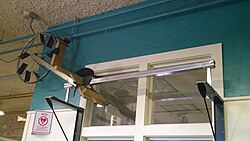
The Dynamic RowErg differs from standard models by utilizing a moving foot stretcher instead of a moving seat. This design reduces body mass movement, providing a more accurate simulation of rowing on water.
In 2021, Concept2 simplified its naming convention. The Model D and Model E were replaced by the RowErg and RowErg with Tall Legs. The only difference between these two is the leg height: 14 inches for the standard model and 20 inches for the tall version. This change ensured consistency across the entire product range.
![Early model performance monitor, model PM1. The PM1 was available from 1986-1995.[24]](/images/26/1a/261a497229b76f2f4648f884bef3565978298fa238515a7a3a5e3c50b843f1b7.jpg)
Due to their consistency and accuracy, these machines are used in major events like BIRC and CRASH-B. In 2018, CrossFit designated Concept2 as the official specification manufacturer for the CrossFit Open and Games after finding that rival machines were significantly easier to use than the competition standard.
To ensure longevity, Concept2 coats friction-prone components, such as the chain, with nickel. This coating improves durability and simplifies lubrication and maintenance.
Expanding the Ergometer Lineup
Beyond rowing, Concept2 has applied its air-resistance technology to other disciplines to create a comprehensive fitness ecosystem.
SkiErg
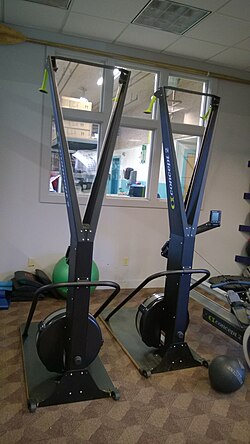
Introduced in 2009, the SkiErg is designed to build strength and endurance for Nordic skiing. It emulates the double-pole technique by having the user stand and pull two handles downward in a "crunch" motion. This total-body workout heavily engages the triceps, chest, and abdominals, alongside the back muscles.
BikeErg
Launched in 2017, the BikeErg is a stationary bike that mimics the feel of outdoor cycling. Unlike traditional spin bikes that use belts or chains, the BikeErg employs a clutch and air resistance system. This means resistance increases as the user pedals harder, requiring minimal maintenance while providing a responsive ride for all fitness levels.
StrengthErg
Released in 2025, the StrengthErg is a compact, multifunctional machine that brings flywheel technology to strength training. It eliminates the need for weight plates, racks, and barbells by using air resistance. The machine accurately measures power output, which users can track via the free ErgData app.
Performance Monitoring and Legacy
Every Concept2 ergometer is paired with a Performance Monitor to track metrics such as stroke rate, split, duration, calories, and meters. The current standard is the PM5, introduced in August 2014, which is included with all new RowErg, SkiErg, BikeErg, and StrengthErg models.
The company also has a history of experimentation, such as the DYNO. Sold between 2001 and 2007, the DYNO was an air-resistance machine used for seated rows, leg presses, and bench presses.
| Product | Primary Use | Key Feature | Resistance Type |
|---|---|---|---|
| RowErg | Indoor Rowing | Official CrossFit Spec | Air Flywheel |
| SkiErg | Nordic Skiing | Double-pole emulation | Air Flywheel |
| BikeErg | Cycling | Dynamic resistance | Air/Clutch |
| StrengthErg | Strength Training | Plate-free training | Air Flywheel |
| Oars | On-water Rowing | Asymmetrical Hatchet Blades | N/A |
Frequently Asked Questions
What is the difference between the RowErg and the RowErg with Tall Legs?
The two machines are identical in function and design; the only difference is the height of the front and rear legs. The standard RowErg has 14-inch legs, while the Tall Legs version has 20-inch legs.
How does the Dynamic RowErg differ from the standard model?
Unlike the standard RowErg, which has a moving seat, the Dynamic RowErg features a moving foot stretcher. This design more closely simulates the body mass movement experienced during on-water rowing.
What are "hatchet" blades?
Introduced by Concept2 in 1991, hatchet blades are asymmetrical oar blades that became highly popular in the rowing community and were adopted by most Olympic crews by 1992.
What does the PM5 monitor track?
The PM5 Performance Monitor provides real-time data on several key metrics, including meters, calories, duration, split, and stroke rate.
Why is nickel used on Concept2 machines?
Nickel is used to coat friction-prone areas, such as the chain, to increase the longevity of the parts and to assist with lubrication and general maintenance.