
Congressional Hearings on Campus Antisemitism and University Leadership
Following the Israel–Hamas war, the United States witnessed a period of intense scrutiny regarding how higher education institutions manage campus protests and combat discrimination. Starting in late 2023, the House Committee on Education and the Workforce launched a series of congressional hearings to examine antisemitism—prejudice or hatred directed toward Jewish people—and the institutional responses of U.S. universities.
These proceedings focused on the delicate balance between protecting free speech and ensuring a safe environment for students, leading to high-profile confrontations between lawmakers and university presidents.
Key Facts
- The House Committee on Education and the Workforce led the inquiries into campus antisemitism and protest responses.
- High-profile resignations occurred at Harvard and the University of Pennsylvania following the December 2023 hearing.
- Controversy centered on whether specific slogans constitute calls for genocide or are protected by context-dependent speech policies.
- The scope of the hearings expanded from Ivy League schools to include state universities and other private colleges by 2025.
The December 2023 Hearing and Leadership Fallout
On December 5, 2023, the committee convened a hearing featuring the presidents of three prestigious institutions: Claudine Gay (Harvard University), Liz Magill (University of Pennsylvania), and Sally Kornbluth (Massachusetts Institute of Technology), alongside history professor Pamela Nadell of American University.
The session became a flashpoint for public debate when Representative Elise Stefanik questioned the leaders on whether slogans such as "from the river to the sea" and "globalize the intifada" violated their respective codes of conduct. The presidents testified that such determinations depended on the context of the speech. This response sparked widespread criticism from donors and lawmakers, who argued the leaders failed to adequately address antisemitism.
The aftermath of this testimony led to significant leadership changes. Liz Magill resigned as president of the University of Pennsylvania four days after the hearing. Claudine Gay resigned from Harvard University on January 2, 2024, following both the hearing backlash and publicized allegations of plagiarism.
Columbia University in Crisis
While Columbia University president Minouche Shafik had declined a November 2023 invitation due to scheduling, she was called to testify on April 17, 2024, in a hearing titled "Columbia in Crisis: Columbia University's Response to Antisemitism." She was joined by board of trustees co-chairs Claire Shipman and David Greenwald, and David Schizer of Columbia's Task Force on Antisemitism.
The hearing occurred just hours after students established the Gaza Solidarity Encampment on the New York City campus. Reports indicated that Shafik monitored these protests from a temporary headquarters at the law firm Covington & Burling near the White House.
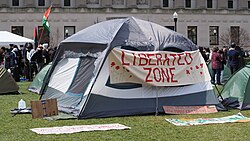
During the testimony, lawmakers pressed Shafik on several fronts. Rep. Elise Stefanik questioned the university's disciplinary actions regarding faculty members, such as professor Joseph Massad, who were accused of making antisemitic statements. Other exchanges included Rep. Rick W. Allen referencing Genesis 12:3, Rep. Jim Banks questioning the use of terms like "ashkenormativity" and "folx," and Rep. Haley Stevens citing a "D" grade given to Columbia by the Anti-Defamation League.
Expanding the Scope: 2025 Hearings
By 2025, the committee broadened its investigation beyond the Ivy League to examine the wider landscape of American higher education.
Beyond the Ivy League
On May 7, 2025, the committee held a hearing featuring presidents from California Polytechnic State University, San Luis Obispo (Jeffrey D. Armstrong), DePaul University (Robert L. Manuel), and Haverford College (Wendy Raymond). Observers noted that these leaders generally avoided the controversial missteps seen in earlier testimonies.
Faculty, Funding, and Ideology
A subsequent hearing on July 15, 2025, focused on the roles of faculty and funding. Witnesses included Robert Groves (Georgetown University), Félix V. Matos Rodríguez (City University of New York), and Rich Lyons (University of California, Berkeley). The session highlighted a partisan divide, with Republicans focusing on foreign funding and campus ideology, while Democrats criticized the Trump administration's approach to higher education.
| Date | Key Institutions Involved | Primary Focus | Notable Outcome |
|---|---|---|---|
| Dec 5, 2023 | Harvard, UPenn, MIT | Speech codes and antisemitic slogans | Resignations of Gay and Magill |
| Apr 17, 2024 | Columbia University | Campus encampments and faculty speech | Scrutiny of institutional discipline |
| May 7, 2025 | Cal Poly, DePaul, Haverford | Spread of antisemitism beyond Ivy League | Broadened institutional scrutiny |
| Jul 15, 2025 | Georgetown, CUNY, UC Berkeley | Faculty, funding, and ideology | Debate on foreign funding and policy |
Frequently Asked Questions
Why did the university presidents' answers about slogans cause such controversy?
The presidents stated that whether slogans like "from the river to the sea" violated conduct codes depended on the context. Critics argued this was an insufficient response to what they characterized as calls for genocide.
Which university leaders resigned following the December 2023 hearing?
Liz Magill of the University of Pennsylvania and Claudine Gay of Harvard University both resigned shortly after the hearing and subsequent public pressure.
What was the "Columbia in Crisis" hearing about?
This April 2024 hearing examined Columbia University's response to antisemitism, specifically focusing on campus protests, the Gaza Solidarity Encampment, and the conduct of university faculty.
Did the hearings only focus on Ivy League universities?
No. While the initial focus was on the Ivy League, hearings in 2025 expanded to include institutions such as Cal Poly, DePaul University, Haverford College, and the City University of New York.
What issues were discussed in the July 2025 hearing?
The July 2025 hearing focused on the influence of faculty, the impact of foreign funding, and the role of campus ideology in the prevalence of antisemitism.