
Continuing Resolutions and the 2024 US Federal Funding Crisis
In the United States government, a continuing resolution (CR) is a temporary funding measure that allows federal agencies to continue operating at previous spending levels when Congress fails to pass regular appropriations bills by the start of the fiscal year. Throughout 2023 and early 2024, the U.S. government narrowly avoided multiple shutdowns through a series of these stopgap measures, marked by intense internal party conflict and historic leadership changes.
The Summer 2023 Funding Standoff
Negotiations for the 2024 fiscal year began in July 2023, immediately meeting resistance from Republicans who demanded significant cuts to government spending. While the Senate Committee on Appropriations, led by Patty Murray and Susan Collins, sought a deal, members of the House Freedom Caucus—a group of conservative Republicans—threatened to block spending bills supported by then-Speaker Kevin McCarthy.
The conflict extended beyond general spending. Republicans attempted to block funding for the Department of Agriculture and the Food and Drug Administration (FDA), specifically seeking to reverse an FDA ruling that allowed the oral abortion pill mifepristone to be sold in retail pharmacies. Additionally, the federal indictment of Donald Trump in August 2023 complicated funding efforts for the Department of Justice and the Federal Bureau of Investigation (FBI).
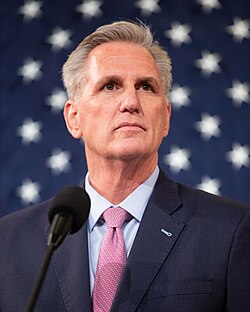
The September 2023 Crisis and the Ousting of Kevin McCarthy
By September, the government was on the brink of a shutdown. The Freedom Caucus demanded the inclusion of Trump-era border policies, such as the construction of the border wall and stricter detention and deportation measures for asylum seekers and minors. This internal divide led several Freedom Caucus members to vote with Democrats to block procedural rule votes on military funding.
To prevent a total shutdown, Speaker McCarthy eventually struck a bipartisan deal with Democrats. This continuing resolution maintained 2023 funding levels but excluded aid to Ukraine. To bypass the procedural blocks from his own party, McCarthy used a suspension of the rules, a legislative maneuver that skips the rule-voting process but requires a two-thirds supermajority for passage. The bill passed 335–91.
The fallout from this bipartisan compromise was immediate. On October 2, Representative Matt Gaetz filed a motion to vacate the chair, a rare parliamentary move to remove the Speaker. The motion passed 216–210, making Kevin McCarthy the first Speaker in U.S. history to be removed by a formal vote.
Leadership Transition and Subsequent Funding Measures
The House remained without a Speaker for 22 days, during which time Patrick McHenry served as speaker pro tempore. This leadership vacuum occurred during the outbreak of the Gaza war on October 7, leaving the House unable to pass resolutions or military aid to Israel. Eventually, Mike Johnson was elected Speaker with unanimous Republican support.
Speaker Johnson attempted to pass individual appropriations bills, but only three (HR 4821, 4364, and 4394) passed before the deadline. This necessitated a second continuing resolution in November 2023, which extended funding for four key areas—including Transportation, Housing, and Agriculture—until January 19, 2024, and others until February 2.
The January and March 2024 Extensions
In January 2024, Speaker Johnson and Senate Majority Leader Chuck Schumer agreed to a $1.59 trillion topline spending deal. Despite this, hardline Republicans continued to block rule votes on unrelated legislation in protest. Consequently, Johnson relied heavily on the suspension of the rules to pass a third CR on January 18, extending deadlines to early March.
The cycle concluded in March 2024. Due to a combination of Senate breaks and House district work periods, Congress had only three days to act before the deadlines. On February 29, the House passed a final short-term CR, extending the first four appropriations bills to March 8 and the remainder to March 22, which was signed into law on March 1.
Key Facts
- Continuing Resolutions: Temporary bills used to prevent government shutdowns when regular budgets are not passed.
- Suspension of the Rules: A procedure allowing the House to bypass rule votes, requiring a two-thirds majority for passage.
- Leadership Change: Kevin McCarthy was ousted on October 2, 2023, and replaced by Mike Johnson after a 22-day vacancy.
- Topline Spending: A $1.59 trillion spending deal was reached in January 2024 between Schumer and Johnson.
- Political Friction: The House Freedom Caucus frequently joined Democrats to block procedural votes to pressure leadership.
| Resolution Date | Key Terms | Funding Extension | Outcome |
|---|---|---|---|
| September 30, 2023 | Bipartisan; no Ukraine aid; 2023 levels | Through November | Passed (335–91) |
| November 17, 2023 | Bipartisan support | Jan 19 / Feb 2, 2024 | Passed (336–95) |
| January 19, 2024 | Based on $1.59T topline deal | March 1 / March 8, 2024 | Passed (314–108) |
| March 1, 2024 | Short-term extension | March 8 / March 22, 2024 | Passed (320–99) |
Frequently Asked Questions
What is a continuing resolution?
A continuing resolution is a temporary legislative measure that allows the federal government to continue operating at existing funding levels when a formal budget has not been passed by the deadline.
Why was Kevin McCarthy removed as Speaker?
McCarthy was removed after passing a bipartisan continuing resolution to avoid a government shutdown, which angered members of the House Freedom Caucus who opposed temporary spending bills.
What does "suspension of the rules" mean in the House?
It is a procedure that allows the House to pass a bill immediately without a separate vote on the rules of the debate, though it requires a higher threshold of two-thirds of the members to pass.
How did the Gaza war affect the House of Representatives?
Because the House was without a Speaker for 22 days following McCarthy's removal, it was unable to pass any resolutions or military aid to Israel when the Gaza war broke out on October 7.
What were the primary demands of the House Freedom Caucus?
The Freedom Caucus demanded significant spending cuts and the revival of Trump-era border policies, including the construction of the border wall and stricter asylum seeker detentions.