
Cornish-Windsor Covered Bridge: A Historic Landmark of the Connecticut River
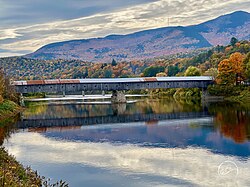
Spanning the Connecticut River between New Hampshire and Vermont, the Cornish-Windsor Covered Bridge stands as a testament to 19th-century engineering and regional history. Known for its impressive scale and romantic reputation, this wooden structure serves as a vital link between the towns of Cornish and Windsor, offering a glimpse into an era of toll roads and early American infrastructure.
Key Facts
- Built: 1866 by Bela Jenks Fletcher and James Frederick Tasker.
- Dimensions: Approximately 449 feet long and 24 feet wide.
- Engineering: Utilizes the Ithiel Town lattice truss design.
- Status: Longest wooden covered bridge carrying automobile traffic.
- Designations: National Historic Civil Engineering Landmark (1970) and National Register of Historic Places (1976).
A Legacy of Spans
The current bridge is not the first to occupy this site. Three previous bridges were constructed here in 1796, 1824, and 1828. The latter two were managed by a group of businessmen, including Allen Wardner, who operated the crossings during the early 19th century.
The present structure was completed in 1866 at a cost of $9,000, which is equivalent to approximately $197,898 in 2025. It was designed using a lattice truss—a structural framework of crisscrossing timbers—patented by Ithiel Town in 1820 and 1835.
Tolls, Temperance, and the "Kissin' Bridge"
For nearly eight decades, from 1866 until 1943, the bridge operated as a toll crossing. Its history reflects the social divides of the time; in 1866, the bridge connected "temperance" Windsor (where alcohol was restricted) with "wet" Cornish. Consequently, authorities charged foot travelers 2 cents to enter New Hampshire, but increased the fee to 3 cents for those returning to the "dry" side in Vermont.
Tolls for vehicles were significantly higher, with four-horse carriages paying up to 20 cents (roughly $4 in 2025). Beyond its economic role, the bridge earned the nickname "kissin' bridge," a common term for covered bridges of the era, referring to the brief moment of privacy provided to couples as they crossed the span.
Preservation and Engineering Status
The bridge's significance was formally recognized in 1970 when the American Society of Civil Engineers (ASCE) designated it a National Historic Civil Engineering Landmark. Two years later, in 1976, it was added to the National Register of Historic Places. To ensure its longevity, the Federal Highway Administration funded a comprehensive rehabilitation of the structure in 1988.
There is often debate regarding its status as the "longest" bridge. While the Smolen-Gulf Bridge is longer overall and the Old Blenheim and Bridgeport bridges have longer clear spans, those are either pedestrian-only or not covered. The Cornish-Windsor Bridge remains the longest wooden covered bridge that carries automobile traffic, though the Hartland Bridge in New Brunswick is longer (a fact that was less emphasized while the Hartland bridge was closed).
| Feature | Detail |
|---|---|
| Construction Year | 1866 |
| Length | ~449 feet (137 m) |
| Width | 24 feet (7 m) |
| Truss Type | Ithiel Town Lattice |
| Original Cost | $9,000 |
| Toll-Free Since | 1943 |
Visiting the Bridge
Accessing the bridge depends on your direction of travel. From the Vermont side, visitors follow Vermont Route 44 in Windsor southeast to Main Street, then continue onto Bridge Street for about 0.2 miles. From the New Hampshire side, travelers use New Hampshire Route 12A (Town House Road) in Cornish, turning onto Bridge Road.
Interestingly, while many perceive the bridge as being in Windsor, it is mostly located in Cornish. This is because the state boundary follows the western mean low-water mark of the Connecticut River; thus, travelers entering from Vermont immediately cross into New Hampshire.
For those wishing to view the structure, a parking area is located approximately 100 feet south of the bridge intersection in Cornish. This area features New Hampshire historical marker number 158, one of four such markers in the town.
Frequently Asked Questions
Is the Cornish-Windsor Covered Bridge the longest in the world?
It is the longest wooden covered bridge that carries automobile traffic. While other bridges, such as the Hartland Bridge in New Brunswick or the Smolen-Gulf Bridge, may be longer overall or have longer clear spans, they differ in use or construction.
Why was it called a "kissin' bridge"?
This was a vernacular term used for covered bridges, referring to the temporary privacy the enclosed structure provided to passengers as they crossed the river.
How did the "temperance" laws affect the bridge tolls?
Because Windsor was a "dry" town and Cornish was "wet," authorities charged a higher toll (3 cents instead of 2 cents) for foot travelers returning from New Hampshire to Vermont.
Who designed the bridge's structure?
The bridge was built by Bela Jenks Fletcher and James Frederick Tasker, utilizing a lattice truss design patented by Ithiel Town in 1820 and 1835.
When did the bridge stop charging tolls?
The state of New Hampshire purchased the span in 1936, and it officially became toll-free in 1943.