
CRC Handbook of Chemistry and Physics: The Essential Reference for Scientists
In the world of scientific research, having a reliable, centralized source of data is critical. For over a century, the CRC Handbook of Chemistry and Physics has served as a comprehensive one-volume reference resource, providing researchers and students with the precise data needed for complex calculations and experiments.
First published in 1914, the handbook is colloquially known among chemists as the "Rubber Bible." This nickname stems from its original publisher, the Chemical Rubber Company, which later became known as CRC Press.
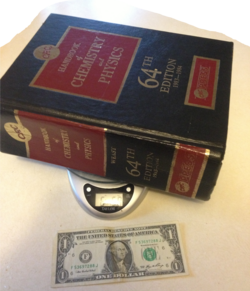
Key Facts
- First Published: 1914
- Common Name: The "Rubber Bible"
- Publisher: CRC Press (formerly The Chemical Rubber Company)
- Scope: Comprehensive data on chemistry and physics
- Recent Scale: The 102nd edition contains 1,624 pages
Evolution of the Handbook
Over the decades, the scope of the CRC Handbook has shifted to better serve the evolving needs of the scientific community. In its earlier years, the publication acted as a broad encyclopedia of science and engineering.
The Broad Scope of Early Editions
The 1962–1963 edition was particularly expansive, spanning 3,604 pages. During this era, the handbook included a vast array of sections, such as:
- Mathematics and Chemical Tables
- Properties of Matter, Heat, and Sound
- Hygrometric (humidity measurement) and Barometric (atmospheric pressure) Tables
- Quantities and Units
Earlier versions were even more eclectic, containing practical information that would be considered "common knowledge" today. These included guides on the Greek alphabet, musical scales, twist drill and steel wire gauges, and the percent composition of anti-freeze solutions. It even provided specialized data on the properties of the Earth's atmosphere at elevations up to 160 kilometers and lists of antidotes for poisons.
Modern Specialization
As the volume of scientific data grew, the handbook became more focused. Much of the general information was eliminated to prioritize core chemistry and physics topics. For example, the Mathematical Tables, which were a supplement until the 9th edition (1952), were eventually moved into a separate publication called the CRC Standard Mathematical Tables starting with the 10th edition in 1956.
Reference Summary
| Attribute | Detail |
|---|---|
| Publisher | CRC Press |
| 102nd Edition Page Count | 1,624 |
| 101st Edition ISBN | 9780367417246 |
| Official Website | https://hbcp.chemnetbase.com |
Frequently Asked Questions
Why is it called the "Rubber Bible"?
It earned this nickname because it was originally published by the Chemical Rubber Company (CRC) and is viewed as an authoritative, essential text for chemists.
Who publishes the handbook today?
The handbook is published by CRC Press, a publisher specializing in textbooks and reference handbooks across nearly all scientific and engineering disciplines.
How has the content changed over time?
Earlier editions included a wide variety of general science and engineering data, including musical scales and wire gauges. Modern editions focus almost exclusively on chemistry and physics.
Was the mathematics section always part of the main volume?
No. Mathematical Tables were a supplement until the 9th edition (1952). From the 10th edition (1956) onward, they were published as a separate volume titled CRC Standard Mathematical Tables.