
Croton Dam: A Milestone in American Hydroelectric Engineering
The story of the Croton Dam is more than just a tale of concrete and water; it is a chronicle of the dawn of the electric age in the American Midwest. Built at the turn of the 20th century, this facility pushed the boundaries of power generation and transmission, attracting international attention from engineers across the globe. Its creation was driven by the ambition of the Foote brothers and the technical ingenuity of civil engineer William G. Fargo.
The Visionaries Behind the Power
The development of the Croton Dam was spearheaded by William A. Foote and his brother James B. Foote. William's journey began in 1884 as a grist mill operator in Adrian, Michigan, where he first experimented with providing shaft power to a local electric utility startup. This fascination led the brothers to found the Jackson Electric Light Works in 1886, a predecessor to today's Consumers Energy.
Initially, the Footes focused on small-scale projects for street and residential lighting. However, as the demand for electricity grew—fueled by the rise of streetcars and industrialization—they required larger water sources. Partnering with engineer William G. Fargo, they first tackled the Trowbridge Dam on the Kalamazoo River in 1898. This project was groundbreaking for its time, transmitting power over 25 miles, a distance previously considered impractical due to power loss.
Damming the Muskegon River
Seeking to serve the large market of Grand Rapids, the Footes turned to the Muskegon River. Chosen for its high outflow and lack of navigability—meaning dams would not obstruct river traffic—the Muskegon became the site for the Rogers and Croton dams. Commissioned in 1904 via the Grand Rapids–Muskegon Power Company, the Croton Dam was the more ambitious of the two.
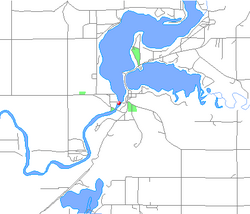
Located where the Little Muskegon River joins from the east, the project was so vast that its impoundment lake submerged one-third of the village of Croton when it began filling in August 1907.
Engineering Innovation: Hydraulic Sluicing
Chief Engineer William G. Fargo implemented a pioneering construction technique known as hydraulic sluicing to build the earth embankment dam on soft soil. This method involved using high-pressure water streams to move soil and water mixes into iron troughs, which then deposited the material in layers to be compacted.
This technique was remarkably cost-effective. The 370-foot-long embankment, containing 104,000 cubic yards of material, cost only $7,076—roughly 7 cents per cubic yard. This represented one of the earliest uses of hydraulic sluicing east of the Mississippi River.
The Powerhouse Architecture
The powerhouse was designed as an L-shaped structure consisting of a generator building to the west and a turbine building to the east. The entire facility rests on approximately 3,000 oak timber pilings and concrete foundations, with sheet steel pilings preventing water from undercutting the structure.
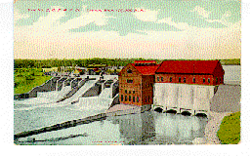
The original setup featured two Westinghouse horizontal generators producing 3-phase 60-cycle AC. To transport this power 50 miles to Grand Rapids, the team built a 100,000-volt line—the highest-voltage transmission line in the world at the time. The project was so significant that Dr. Charles Steinmetz of General Electric visited in 1908 to conduct tests on the lines.
Expansion and Evolution
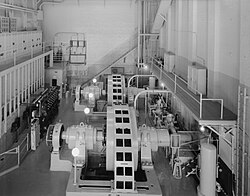
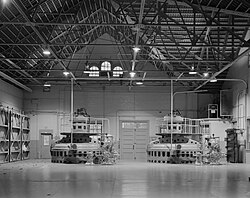
As power needs grew, the facility underwent significant upgrades in 1915. The generator building was equipped with Allis-Chalmers quadriplex horizontal turbines, and the operating voltage was increased. The turbine building was also expanded to accommodate vertical turbine/generator sets.
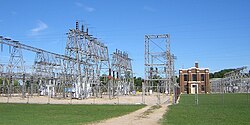
By 1930, the facility's infrastructure evolved further with the addition of a separate west switchyard, removing the transformers and switching equipment from the main generator building.
The regional hydroelectric network was completed in 1931 with the addition of the Hardy Dam. This 40-foot-high dam created a 1,209-acre reservoir holding 7.2 billion gallons of water, capable of producing 8,850 kilowatts at peak outflow.
Key Facts
- Completion Date: September 1907.
- Innovation: One of the first uses of hydraulic sluicing east of the Mississippi.
- World Record: Featured the world's highest-voltage transmission line (initially 100,000 volts).
- Construction Cost: The embankment cost approximately 7 cents per cubic yard of material.
- Historical Status: Listed on the National Register of Historic Places (ID #79001165).
| Feature | Detail |
|---|---|
| Chief Engineer | William G. Fargo |
| Embankment Length | 370 feet (110 m) |
| Material Volume | 104,000 cubic yards |
| Original Generators | Westinghouse horizontal |
| Transmission Distance | 50 miles to Grand Rapids |
| Peak Line Voltage (1909) | 110,000 volts |
Frequently Asked Questions
Who were the primary figures responsible for the Croton Dam?
The project was driven by brothers William A. and James B. Foote, who built an electric power empire in Michigan, and William G. Fargo, the civil engineer who designed the plant and the dam.
What made the construction of the Croton Dam unique?
The dam utilized a technique called hydraulic sluicing, using high-pressure water to move and layer soil, which significantly reduced construction costs to about 7 cents per cubic yard.
Why was the transmission line at Croton Dam historically significant?
At the time of its completion, it was the highest-voltage transmission line in the world, starting at 100,000 volts to efficiently move electricity 50 miles to Grand Rapids.
What happened to the village of Croton during construction?
The creation of the impoundment lake in August 1907 resulted in the submersion of one-third of the village of Croton.
Is the Croton Dam recognized as a historical site?
Yes, it is listed in the National Register of Historic Places and has been awarded a Michigan Historical Marker.