
Crowding Out: How Government Borrowing Affects Private Investment
In macroeconomics, crowding out occurs when increased government spending leads to a reduction in private investment and the accumulation of real resources. Essentially, when the public sector increases its demand for resources, it shifts the distribution of production away from private use and toward public use. This process can limit the capital stock available to the private sector, potentially hindering long-term growth if the public spending is non-productive.
However, the impact of government borrowing is not uniform. It depends heavily on the current state of the economy and how financial markets react to increased deficits. While some argue that deficits always stifle growth, others suggest that under specific conditions, government spending can actually encourage private activity.
Key Facts
- Crowding out is the reduction in private investment resulting from increased government spending.
- The effect is most severe when the economy is at full employment or capacity.
- When an economy has excess capacity, government spending can lead to "crowding in," where increased demand bolsters private spending.
- The LM curve (Liquidity preference—Money supply) and IS curve (Investment—Saving) determine how interest rates and income react to fiscal changes.
- A liquidity trap represents a scenario where fiscal policy has a maximal effect because interest rates do not rise.
The Role of Economic Capacity
The extent to which resource crowding out occurs depends on whether the economy is operating at its limit. If an economy is at full capacity, a sudden increase in the budget deficit—such as through stimulus programs—creates direct competition for scarce resources. In this scenario, the positive effects of the stimulus are offset by the redistribution of production, effectively neutralizing the growth impact.
Conversely, if the economy is below capacity with a surplus of available resources, government deficits do not create competition with the private sector. In these instances, stimulus programs are far more effective. A prime example occurred after the 2008 subprime mortgage crisis; the U.S. economy remained well below capacity, meaning increased deficits put idle funds to use rather than stealing them from private investors.
Economist Laura D'Andrea Tyson notes that the outcome depends on the nature of the spending. While deficits can raise interest rates and reduce private investment, spending on highly productive physical and human infrastructure can expand the population's productive potential, fostering long-run growth.
Determinants of Crowding Out
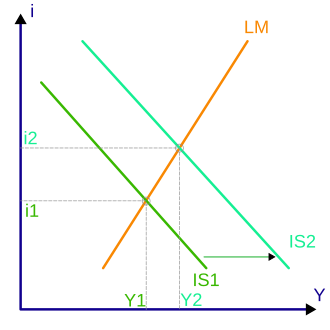
The degree to which interest rate adjustments dampen output expansion is governed by the relationship between income and interest rates, often visualized through the IS-LM model.
The Influence of Curve Slopes
- Flatter LM Curve: Income increases more than interest rates, reducing the crowding-out effect.
- Flatter IS Curve: Interest rates increase more than income, increasing the crowding-out effect.
- The Multiplier: A larger multiplier results in a larger horizontal shift of the IS curve, increasing both income and interest rates.
Ultimately, the more interest rates rise in response to government spending, the greater the extent of crowding out.
Extreme Economic Scenarios
To understand the boundaries of this theory, economists look at two extreme cases regarding the LM curve.
The Liquidity Trap
In a liquidity trap, the LM curve is horizontal. In this state, the demand for money is extremely sensitive to interest rates. Consequently, an increase in government spending has its full multiplier effect on equilibrium income without raising interest rates. Because there is no increase in interest rates, there is no reduction in private investment, and fiscal policy achieves its maximal effect while monetary policy has little to no impact.
The Classical Case
In the classical case, the LM curve is vertical, meaning the demand for money is unrelated to interest rates. Here, an increase in government spending cannot change equilibrium income; it only raises interest rates. To maintain the same level of output while government spending increases, there must be an equal and opposite reduction in private spending. This results in full crowding out.
| Economic Condition | LM Curve Shape | Effect on Interest Rates | Impact on Private Investment | Fiscal Policy Effectiveness |
|---|---|---|---|---|
| Liquidity Trap | Horizontal | No Change | No Reduction | Maximal |
| Below Capacity | Sloped | Low/Moderate Increase | Minimal (Crowding In) | High |
| Full Employment | Sloped | Significant Increase | Reduction (Crowding Out) | Low/Offset |
| Classical Case | Vertical | High Increase | Full Reduction | None (on Income) |
Frequently Asked Questions
What is the difference between crowding out and crowding in?
Crowding out occurs when government borrowing raises interest rates or consumes scarce resources, reducing private investment. Crowding in occurs when government spending increases overall demand and economic activity, which in turn encourages private businesses to increase their own spending and investment.
Does government spending always lead to crowding out?
No. Crowding out primarily happens when the economy is operating near or at full capacity. If there is significant excess capacity (idle resources), government spending can stimulate the economy without displacing private investment.
How does the LM curve affect fiscal policy?
The LM curve represents the equilibrium in the money market. If it is horizontal (liquidity trap), fiscal policy is highly effective. If it is vertical (classical case), fiscal policy cannot increase income and only raises interest rates, leading to full crowding out.
Can government deficits ever be positive for long-term growth?
Yes, if the deficit is used to fund highly productive state investments in human and physical infrastructure, it can expand the economy's productive potential and increase long-run growth, outweighing the negative effects of borrowing.
Why did the 2008 crisis change the perspective on crowding out?
Following the 2008 subprime mortgage crisis, the U.S. economy operated well below its potential production. Because there was so much "headroom," increasing the budget deficit put idle resources to work rather than competing with active private investment.