
Cuatro Puertas: The Ancient Troglodyte Complex of Montaña Bermeja
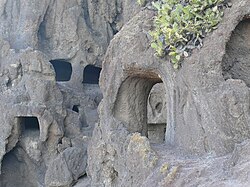
Perched upon the slopes of Montaña Bermeja, the Cuatro Puertas site stands as a remarkable testament to the ingenuity of the pre-Hispanic Canarians. This extensive complex, carved directly into tuff (consolidated volcanic ash) using stone picks, comprises a sophisticated network of caves, ceremonial spaces, granaries, and ancient pathways. While the site spans nearly the entire mountain, the upper regions offer the most significant insights into the spiritual and daily lives of its former inhabitants.
Despite its proximity to the Conquest tower in Gando's sandy bay—located only 4 kilometers away—the site received little mention in the chronicles of the conquest, leaving its mysteries to be uncovered by modern archaeology.
Key Facts
- Location: Montaña Bermeja, Gran Canaria.
- Construction: Man-made structures excavated from tuff using stone tools.
- Primary Features: The Four Doors cave, a ritual almogarén, and a troglodyte village.
- Economic Activity: Significant production of hand-grindstones for processing gofio.
- Astronomical Alignment: Evidence of modifications to observe the summer solstice.
The Sacred Spaces of Montaña Bermeja
The Four Doors Cave (Cuatro Puertas)
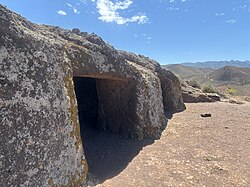
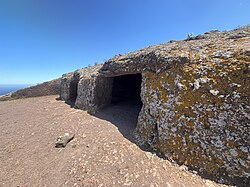
The namesake of the complex, the Four Doors cave, is a monumental man-made structure measuring 17 by 7 meters. Located near the summit of the northern part of the mountain, it opens toward the northeast. The cave is characterized by four large entrances leading into a single expansive space, which may have been sealed with animal skins or other coverings. Outside the porch, approximately 20 post-holes suggest the area was once fully enclosed.
Archaeologists have discovered deliberate modifications to the floors and walls, indicating the cave was oriented to observe the summer solstice. Due to its monumental scale and proximity to ritual sites, it is believed to have been a sacred space where the faycán (chief priest) and harimaguadas (noble virgin priestesses) performed religious rites.
The Ritual Place (Almogarén)
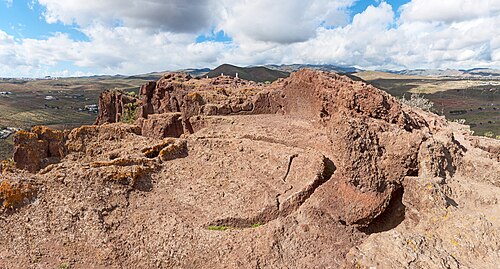
Situated slightly east and above the Four Doors cave is an almogarén, a sacred ritual space. This area served as a site for libations and offerings to deities, including the Sun god Alcorac. Ceremonies here often involved the use of milk, mirroring ritual practices found at other significant sites like Bentayga Rock.
Cueva de los Papeles (Papers' Cave)
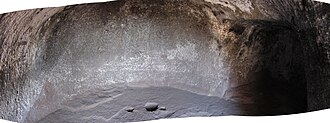
Located in the southern part of the mount, the Papers' cave is reached via a path cut into the tuff. This cave features a roughly circular floor plan and walls engraved with triangles. These symbols are widely associated with fertility, suggesting the cave was dedicated to rituals surrounding that theme.
The Troglodyte Village and Daily Life
Cueva de los Pilares (Pillars' Cave)
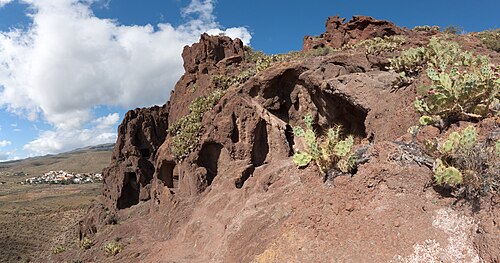
The Pillars' cave serves as the heart of the Montaña Bermeja troglodyte village. Accessed via a system of ramps, stairs, and tunnels, this south-oriented settlement was strategically sheltered from dominant winds and provided a wide view of the coast. The dwellings were likely protected by thick dry stone walls.
The interior of these circular caves reveals the intricacies of ancient domestic life, featuring:
- Depressions in the ground for cooking fires.
- Wall cavities used for storage.
- Built-in seats and holes for support beams.
- Grooves for window and door frames, which were likely closed with vegetal cloths or pelts.
The Audience Cave and Surrounding Infrastructure
Connected to the village by a rock arch and a narrow "chimney," the Audience cave served multiple utilitarian purposes, including as a granary, silo, kitchen, and sleeping quarters. It is located approximately 200 meters from the Four Doors cave.
The Industry of Grindstones
The Importance of Gofio
Hand-grindstones were essential to Canarian domestic life, used primarily to produce gofio (roasted flour), often made from barley. While livestock was the primary food source on other islands, agriculture dominated Gran Canaria, making these tools indispensable.
Tuff vs. Basalt
Grindstones were crafted from either tuff or vesicular basalt (lava with gas bubbles). Tuff was used three times more frequently than basalt because it was easier to carve. However, because tuff is composed of compacted volcanic ash and lacks the structural integrity of fired basalt, it wore down easily. Minute particles of tuff would mix into the flour, leading to significant dental wear among the ancient islanders.
The Mills' Quarry (Cantera de Molinos)
The Cuatro Puertas site contains two main production areas for grindstones: a prehistoric site and a more recent historic site. Located on the northern slope between 197 and 210 meters in altitude, these quarries are identified by "negative imprints"—round or oval hollows left in the rock after a stone was extracted.
The south-facing orientation of these quarries has protected them from humidity and lichen growth, leaving the site in an excellent state of conservation.
| Feature | Primary Function | Key Characteristic |
|---|---|---|
| Four Doors Cave | Sacred/Ritual | Summer solstice orientation; 4 large entrances |
| Almogarén | Offerings/Libations | Dedicated to gods like Alcorac (the Sun) |
| Papers' Cave | Fertility Rituals | Engraved triangles on walls |
| Pillars' Cave | Residential Village | Circular rooms with cooking fires and storage |
| Mills' Quarry | Industrial Production | Extraction of tuff for hand-grindstones |
Frequently Asked Questions
Who were the faycán and harimaguadas?
The faycán was the chief priest, and the harimaguadas were virgin priestesses, typically daughters of nobles, who operated under the authority of the faycán to perform sacred rituals.
Why did the use of tuff grindstones affect the inhabitants' teeth?
Tuff is a relatively loose igneous rock made of compacted ash. During the grinding process, tiny fragments of the stone would break off into the flour, acting as an abrasive that wore down the teeth of those who consumed it.
What is an almogarén?
An almogarén is a sacred ritual space or site used for making offerings and libations to the gods, often characterized by the use of specific substances like milk.
How do archaeologists identify ancient grindstone quarries?
They look for "negative imprints," which are the round or oval hollows left in the bedrock after a block of stone was carved out and removed.
What was the purpose of the engravings in the Papers' cave?
The walls of the Papers' cave contain engraved triangles, which are symbols associated with fertility, suggesting the cave was used for rituals related to that theme.