
Daig: The History and Evolution of Basel's City Aristocracy
In the heart of Basel, the term Daig refers to a distinct social milieu and a quasi-city aristocracy. While the word literally translates to "dough" in Swiss German, its origins are rooted in the city's physical defenses and social stratification. The history of the Daig is a story of power shifts—from medieval knights and prince-bishops to wealthy guild members and industrial dynasties.
The Origins of the Daig
Etymologically, it is likely that "Daig" derives from the Middle High German word deig, meaning a moat in front of a rampart. This connection is supported by the Greek τεĩχος (wall) and the modern German Deich (dike). In the early Middle Ages, social status in Basel was visually defined by geography.
Residents of the lower city near the Rhine held lower social standing, while the elite lived on the slopes of the Münsterhügel (cathedral hill) and the Spalenberg hill. These elevated locations were prestigious not only for their views but because they provided a constant supply of fresh water via primitive wooden aqueducts from higher springs.
The Münsterhügel served as the seat of the prince-bishop and home to clerics. In contrast, the Spalenberg was inhabited by knights and nobility. Their proximity to the 11th-century city walls—now known as the Burckhardtsche Stadtmauer—was strategic, allowing them to man the ramparts instantly during an attack. Consequently, the term "Daig" originally described those who lived at and defended the city walls.
The Shift from Feudalism to Civic Power
During the late Middle Ages, the Bürgerschaft (commoners with civic rights), primarily artisans and powerful guild members, began stripping the Prince-Bishop of Basel of his authority. They acquired various regalia (royal rights), including the Münzregal (the right to mint coins), the right to impose tariffs, and the right to low jurisdiction.
Low jurisdiction allowed commoners to operate their own courts for most crimes, excluding those punishable by death, which remained under the Blutgerichtsbarkeit (high justice/blood court). By 1500, the city council, dominated by guilds, forced the prince-bishop to move his residence out of Basel. This transition allowed Basel to join the Eidgenossenschaft (Swiss Confederacy) as its 11th canton.
As the original nobility departed with the prince-bishop, their estates were purchased by wealthy families—some noble, some not. These families inherited the residences and the name "Daig," evolving into the city's new aristocracy.
Conflict and the Division of Basel
By the early 19th century, tension grew between the city of Basel and the surrounding countryside (the Baselbieter). Although both were represented in the Grand Council (cantonal parliament), the city maintained dominance despite having a smaller population than the combined rural municipalities.
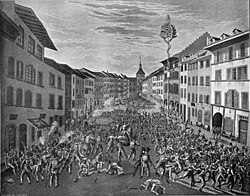
This imbalance led to armed conflict in 1830. After initial city victories, Basel was defeated in 1833. The Tagsatzung (the highest national authority in Switzerland at the time) mandated the separation of the canton. The city retained only the municipalities of Riehen, Bettingen, and Kleinhüningen to prevent them from becoming enclaves.
This separation created deep resentment among Basel's ruling elite, fostering a lasting antipathy toward the citizens of the new canton of Basel-Landschaft and "outsiders" in general. This sentiment became a defining characteristic of the Daig mentality.
Industrialization and Modern Influence
The Daig dynasties originally built their fortunes through private banking and silk manufacture. However, the rise of the pharmaceutical and chemical industries in the late 19th and early 20th centuries challenged their hegemony. These new industries were often led by newcomers who were not part of the Daig.
The introduction of stock corporations further diluted the influence of these traditional families. Despite this, the legacy of the Daig persists. Family names such as Vischer, Sarasin, Burckhardt, and Merian are still frequently associated with high-ranking positions in public service, industry, and the Grand Council of Basel-Stadt.

Key Facts
- Etymology: Likely derived from the Middle High German deig (moat/rampart), not the Swiss German word for dough.
- Social Geography: Historically, the elite lived on the Spalenberg and Münsterhügel for status and access to fresh water.
- Political Shift: Basel became de facto independent after guilds acquired regalia from the Prince-Bishop, officially joining the Swiss Confederacy in 1500.
- Canton Split: Armed conflict in 1830-1833 led to the separation of Basel-Stadt and Basel-Landschaft.
- Economic Evolution: Wealth shifted from traditional banking and silk to the modern chemical and pharmaceutical sectors.
| Period | Dominant Power | Economic Basis | Key Geographic Focus |
|---|---|---|---|
| Early Middle Ages | Prince-Bishop & Knights | Feudalism | Münsterhügel & Spalenberg |
| Late Middle Ages/1500s | Guilds & Bürgerschaft | Trade & Artisanship | City Center / Guild Halls |
| 19th Century | Daig Aristocracy | Private Banking & Silk | Basel-Stadt |
| 20th Century - Present | Industrialists & Corporations | Pharma & Chemicals | Globalized Industry |
Frequently Asked Questions
What does the word "Daig" actually mean?
While it means "dough" in Swiss German, in a historical context, it likely comes from the Middle High German word for a moat or rampart, referring to the nobility who lived by the city walls.
Why did the city of Basel split into two cantons?
The split occurred after armed conflict between 1830 and 1833, caused by the rural population's (Baselbieter) discontent with the city's political dominance in the Grand Council.
Who were the original members of the Daig?
Originally, the term applied to the knights and nobility tasked with defending the city walls. Over time, it came to describe the wealthy families who purchased these estates after the Prince-Bishop left the city.
How did the Daig maintain their wealth?
The Daig dynasties primarily accumulated their wealth through private banking and the silk manufacturing industry.
Is the Daig still influential today?
While their absolute hegemony was diminished by the rise of stock corporations and the pharmaceutical industry, names associated with the Daig still frequently appear in Basel's public service and industrial leadership.