
Dáil Éireann: Composition and Evolution of the Irish Free State Parliament
The Dáil Éireann served as the primary legislative chamber of the Irish Free State, establishing the foundational democratic structures of the early state. Its composition and the rules governing its membership reflected the complex political transitions of the era, balancing universal suffrage with controversial constitutional requirements.
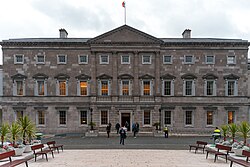
Key Facts
- Eligibility: Membership was open to citizens aged 21 and over, excluding those legally disqualified or members of the Seanad (the Senate).
- Voting System: Elections were conducted via proportional representation using the Single Transferable Vote (STV) system.
- Term Lengths: Originally set at four years, the maximum term was later increased to six years constitutionally and five years legally in 1927.
- University Seats: Special constituencies existed for Dublin University and the National University until 1936.
- The Oath: A mandatory oath of fidelity to the King was required until its abolition in 1936.
Membership and Constitutional Requirements
Under the Free State constitution, any citizen who had reached the age of twenty-one was eligible for membership in Dáil Éireann. However, certain restrictions applied: individuals who were legally disqualified or who already held seats in the Seanad were barred from membership.
One of the most contentious aspects of the Oireachtas (the national parliament) was the requirement for members to swear an oath of fidelity to the King, alongside an Oath of Allegiance to the Free State constitution. This requirement proved a significant political barrier, leading Sinn Féin to refrain from taking their seats in the chamber. This controversial mandate remained in place until it was abolished via a constitutional amendment in 1936.
Electoral Systems and Suffrage
The Irish Free State employed universal adult suffrage, meaning all adult citizens had the right to vote, though this was restricted to those aged twenty-one and older. To ensure fair representation, the constitution mandated the use of proportional representation, specifically the Single Transferable Vote system.
Unlike the modern era, where constituencies are limited to five seats, the Free State period featured larger districts. Many constituencies held six, seven, or eight seats, with Galway serving as a notable example of a single nine-seat constituency.
Parliamentary Terms and Dissolution
The duration of a Dáil's term was initially four years, unless shortened by law or early dissolution. Following legislative and constitutional changes in 1927, the constitutional maximum was extended to six years, while the legal maximum was set at five. While the King could theoretically dissolve the Dáil on the advice of the Executive Council, such an action likely would have prompted the Free State to sever all constitutional ties.
University Constituencies and Malapportionment
In addition to geographical districts, the Free State utilized two university constituencies: Dublin University and the National University. Eligibility for these seats was granted to anyone awarded a degree from the respective institutions. To prevent double-voting, individuals voting in a university constituency were prohibited from voting in their geographical district.
Each university constituency returned three TDs (Teachta Dála, or members of parliament) regardless of the actual population. Because these populations were significantly smaller than those of geographical constituencies, this created malapportionment—a situation where the number of representatives is disproportionate to the population. These university seats were abolished in 1936 under the Electoral (University Constituencies) Act and the Constitution (Amendment No. 23) Act, though they were later revived for the Senate in 1937.
| Election Year | Context |
|---|---|
| 1922 | First General Election |
| 1923 | Second General Election |
| June 1927 | Third General Election |
| September 1927 | Fourth General Election |
| 1932 | Fifth General Election |
| 1933 | Sixth General Election |
| 1937 | Seventh General Election |
Frequently Asked Questions
Who was eligible to be a member of Dáil Éireann?
Membership was open to all citizens aged 21 and over, provided they were not legally disqualified or members of the Seanad.
What was the purpose of the oath of fidelity?
The oath required members of the Oireachtas to pledge fidelity to the King and allegiance to the Free State constitution; it was a point of major political conflict until its removal in 1936.
How did the university constituencies work?
Graduates of Dublin University and the National University could vote for three dedicated TDs. However, doing so meant they could not vote in their local geographical constituency.
What voting system was used during the Irish Free State?
The state used proportional representation via the Single Transferable Vote (STV) system.
How did constituency sizes differ from today?
While modern constituencies are capped at five seats, the Free State had larger constituencies of six, seven, and eight seats, with Galway even reaching nine seats.