
Daily News: A Legacy of Journalism and Courage in Bogalusa
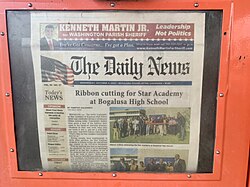
The Daily News has served as a critical record of community life and social change since its inception in 1927. Over nearly a century, the publication has evolved from a traditional daily paper into a modern digital-first entity, while playing a pivotal role during some of the most turbulent eras of American history.
Ownership and Evolution
The publication's ownership has shifted several times to adapt to the changing media landscape. In the 1940s, Wick Communications acquired the paper. However, by 2013, Wick began closing its various Louisiana-based newspapers. This led to a transition in 2014, when the Daily News and the LaPlace L'Observateur were sold to the Carpenter Media Group, a division of Boone Newspapers.
To manage operational costs and prioritize its digital presence, the paper transitioned from a daily to a weekly print format in 2023, though it retained its original name.
The Struggle for Civil Rights in Bogalusa
During the 1960s, Bogalusa became a flashpoint for the Civil Rights Movement. Two distinct groups led the push to end racial segregation: the Congress of Racial Equality (CORE), which utilized nonviolent protest, and the Deacons for Defense and Justice, an armed organization focused on protection. These efforts were met with violent opposition from the local Ku Klux Klan (KKK), resulting in the deaths of two African American men, Oneal Moore and Clarence Triggs.
Journalistic Courage Under Lou Major
Under the leadership of editor Lou Major, the Daily News took a bold stand against racial injustice. In 1964, the paper published editorials condemning the secrecy of the KKK. In a significant move toward equality, the publication abolished its separate African-American edition, ensuring that all subscribers received the same version of the news.
The KKK responded with a campaign of intimidation and harassment. They distributed a racist newsletter called the Midnight Mail to compete with the Daily News and targeted the paper's physical presence by burning a cross at the downtown offices. Editor Lou Major also faced personal threats, with the KKK burning crosses at his home on four separate occasions. In a display of defiance, Major famously used one of the burning crosses to roast marshmallows.
Major later documented these harrowing experiences and the paper's fight for truth in an autobiography published in 2021.
Key Facts
- Founded: 1927
- Key Editor: Lou Major, who fought KKK intimidation in the 1960s.
- Major Ownerships: Wick Communications (1940s–2014) and Carpenter Media Group (2014–Present).
- Format Change: Switched to a weekly format in 2023 to focus on digital growth.
- Civil Rights Impact: Ended segregated editions of the paper in 1964.
| Year/Era | Event/Change |
|---|---|
| 1927 | Establishment of the paper |
| 1940s | Acquired by Wick Communications |
| 1964 | Editor Lou Major ends segregated editions and challenges the KKK |
| 2014 | Sold to Carpenter Media Group (Boone Newspapers) |
| 2021 | Publication of Lou Major's autobiography |
| 2023 | Transition to weekly print format |
Frequently Asked Questions
When did the Daily News change its publication frequency?
The paper switched from a daily to a weekly format in 2023 to reduce costs and place a greater emphasis on its website.
Who owned the paper before the Carpenter Media Group?
The paper was owned by Wick Communications from the 1940s until 2014.
How did the Daily News support the Civil Rights Movement?
Under editor Lou Major, the paper ran editorials against the Ku Klux Klan and stopped publishing a separate African-American edition, providing the same content to all readers.
What was the Midnight Mail?
The Midnight Mail was a racist newsletter distributed anonymously by the KKK to compete with the coverage provided by the Daily News.
How did Lou Major respond to the KKK's intimidation tactics?
Despite the KKK burning crosses at his office and home, Major remained defiant, even using one of the crosses at his home to roast marshmallows.