
DECstation RISC Workstations
The evolution of the DECstation line represents a pivotal shift in computing history, marking Digital Equipment Corporation's (DEC) transition toward Reduced Instruction Set Computing (RISC). Launched in the late 1980s, these machines were designed to deliver unprecedented performance for UNIX environments, often outpacing traditional architectures of the era.
Key Facts
- First Release: The DECstation 3100 debuted on January 11, 1989, as DEC's first commercial RISC machine.
- Architecture: Primarily based on MIPS processors, including the R2000, R3000, and R4000 series.
- Expansion: Later models introduced the TURBOchannel Interconnect to solve early limitations in expandability.
- Integration: The series progressed from discrete components to highly integrated ASICs (Application-Specific Integrated Circuits), culminating in the Model 260.
- Server Variants: Configurations sold without graphics accelerators were branded as DECsystem.
The Early Era: DECstation 3100 and 2100
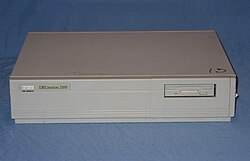
The DECstation 3100, codenamed "PMAX," was marketed as the world's fastest UNIX workstation upon its release, performing approximately three times faster than the contemporary VAXstation 3100. It was soon followed by the cost-reduced DECstation 2100, known as "PMIN."
Processor and Memory Architecture
Both the 3100 and 2100 utilized the R2000 processor, supported by an R2010 floating-point coprocessor and four R2020 write buffers. To optimize performance, the system employed 64 KB direct-mapped instruction and data caches. The write buffers allowed the CPU to write to the data cache without stalling, significantly increasing efficiency.
Memory capacity ranged from 4 to 24 MB, utilizing 2 MB SIMMs (Single Inline Memory Modules) installed in pairs. The system also featured dedicated VRAM for framebuffers: a 256 KB module for monochrome and a 1 MB module for color.
Graphics and Connectivity
Graphics were handled by the Brooktree Bt478 RAMDAC, supporting a resolution of 1024 × 864 pixels. A dedicated Programmable Cursor Chip (PCC) provided a 16 × 16 pixel hardware cursor. For data transfer, these machines featured a 5 MB/s single-ended SCSI interface and 10 Mbit/s Ethernet.
The Personal DECstation 5000 Series
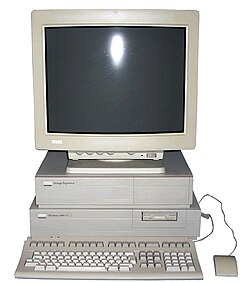
The Personal DECstation 5000 series brought RISC power to a more accessible price point, with entry-level diskless models starting at $3,995. These systems introduced the TURBOchannel Interconnect and were compatible with the ARC (Advanced RISC Computing) standard.
CPU and Memory Evolution
The 5000 series offered various CPU modules. Early versions used the R3000A chipset (20, 25, or 33 MHz), while later high-performance models integrated the R4000 microprocessor with a 1 MB secondary cache. Memory could be expanded up to 40 MB using 2 MB or 8 MB SIMMs.
Integrated I/O and Graphics
These workstations featured an integrated 8-bit color framebuffer (1024 × 768 resolution) using an INMOS IMS G332 RAMDAC. The I/O subsystem was robust, incorporating an NCR 53C94 SCSI controller, AMD LANCE Ethernet, and Zilog SCC for serial communications.
Mid-Range and High-End: Model 100 and 200 Series
DECstation 5000 Model 100 (3MIN)
The Model 100 series served as mid-range workstations. They utilized daughter cards for the CPU, allowing for upgrades from the R3000A to the R4000. A notable feature was the support for up to 128 MB of memory, with compatibility for 2 MB SIMMs from older 2100/3100 models.
DECstation 5000 Model 200 (3MAX)
The Model 200 series represented the high-end tier. These were often configured as servers (DECsystem 5000) and lacked internal storage, relying instead on external SCSI drive enclosures or network file servers.
The Model 200 series showcased a transition in engineering. While the Model 200 used discrete components, the Model 240 and 260 transitioned to custom ASICs (MB, MT, and MS) to handle memory buffering and control. The Model 260 was the pinnacle of this integration, utilizing a single VLSI ASIC for much of its control logic.
Advanced Graphics and Multimedia
High-end models supported a variety of graphics modules, from monochrome (MX) and color (CX) to True Color (TX) with 24-bit depth. For 3D workloads, DEC offered the PXG series of accelerators. These used i860 processors and featured Z-buffers and double buffering. The "Turbo" and "+" variants provided higher clock speeds and additional SRAM for off-screen pixmaps.
Multimedia was expanded via the DECaudio TURBOchannel module, which combined AMD DSCs for voice audio and a Motorola 56001 DSP for high-fidelity sound.
Technical Specifications Summary
| Series/Model | Processor | Max Memory | Key Feature |
|---|---|---|---|
| 3100/2100 | R2000 | 24 MB | First commercial RISC DECstation |
| Personal 5000 | R3000A / R4000 | 40 MB | ARC compatible, TURBOchannel |
| Model 100 | R3000A / R4000 | 128 MB | Mid-range, SIMM reuse |
| Model 200 | R3000 / R3400 / R4400 | 480 MB | High-end, VLSI ASIC integration |
Frequently Asked Questions
What is the difference between a DECstation and a DECsystem?
A DECstation is a full workstation including graphics capabilities. A DECsystem is a server configuration of the same hardware, distributed without a framebuffer or graphics accelerator.
What was the purpose of the TURBOchannel Interconnect?
The TURBOchannel was introduced in the DECstation 5000 series to provide expansion capabilities that were lacking in the heavily integrated early models.
Could memory from a DECstation 2100 be used in later models?
Yes, the 2 MB SIMMs used in the DECstation 2100 and 3100 were compatible with the DECstation 5000 Model 100 series.
What were the 3D graphics options for the Model 200 series?
The Model 200 series supported the PXG, PXG Turbo, and PXG Turbo+ accelerators, which utilized i860 processors and supported 8-bit or 24-bit color with Z-buffering.
How did the Model 260 differ from the Model 240 in terms of hardware?
The Model 260 used a single VLSI ASIC for most of its control logic and contained the boot ROM firmware on the CPU module, whereas the Model 240's boot ROM was located on the system module.