
Devil's Lair: Dating the Earliest Human Occupation in Australia
Devil's Lair stands as one of the most significant archaeological sites in Australia, providing critical insights into the timing and nature of the continent's first human colonizers. Through a combination of advanced dating techniques and material analysis, researchers have determined that human occupation of the site began approximately 48,000 years BP (Before Present), placing it among the earliest known human settlements in the region.
Key Facts
- Earliest Occupation: Human presence dates back to approximately 48,000 years BP.
- Settlement Patterns: Evidence shows sporadic inhabitation across three distinct climatic periods.
- Stone Tool Assemblage: 1,047 artefacts recovered, with 82% linked to the Last Glacial Maximum.
- Symbolic Evidence: Some of Australia's earliest ornaments, including bone beads and a stone pendant, were found here.
- Human Remains: Findings include a male pelvis and three teeth dating from 8,000 to 19,000 years BP.
Chronology and Carbon Dating
Determining the age of Devil's Lair required overcoming significant challenges. Initially, researchers feared that Carbon 14 dating (a method used to determine the age of organic materials) would be impossible due to high local vegetation endemism—where 65-85% of species are unique to the area. However, by using an Environmental Scanning Electron Microscope (ESEM) to compare charcoal samples from the site with global data, scientists confirmed the charcoal was reliable for dating.
Analysis of local wooded plants mixed within the charcoal allowed researchers to correlate inhabitation periods with ancient climate shifts. The data reveals three primary settlement phases:
- 24,000 – 17,000 BP: A period characterized by a drier climate and sparse vegetation.
- 12,000 BP: A period of moist climate and dense vegetation.
- 500 – 300 BP: A climate most similar to modern conditions.
While these phases show sporadic use, more detailed radiocarbon dating confirms the very first human presence at the site occurred 48,000 years BP.
Lithic Analysis and Tool Technology
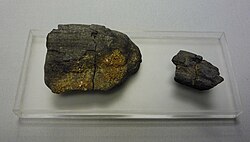
The study of stone tools, or lithic analysis, provides further evidence of how early humans utilized the cave. A total of 1,047 stone artefacts were recovered, the vast majority (82%) of which are attributed to the Last Glacial Maximum (LGM), the period of coldest global temperatures during the last ice age.
In the lowest occupation layers, 111 tools were identified, including flakes and adze-like scrapers. These were primarily crafted from quartz or chert, though limestone from the cave, calcrete, and opaline were also used. The assemblage shows early evidence of bipolar flaking, a technique where a stone core is held against an anvil and struck from above.
Regarding tool construction, earlier theories suggested the use of resin for hafting (attaching a tool head to a handle). However, current sedimentary and lithic analyses contradict this, leaving the evidence for resin and hafted tools inconclusive. Stratigraphic analysis of layers 19-30 upper suggests a consistent occupation date starting at 31,000 years BP for these specific tools.
Human Remains and Biological Evidence
Physical evidence of the site's inhabitants has been recovered from within Devil's Cave. A male human pelvis found in Trench 9 was radiocarbon dated to 12,000 years BP. The pelvis was found lying on its side near a hearth, a position that may hold further archaeological significance.
Additionally, three human teeth were recovered, providing a timeline of different individuals:
- A child's small incisor dated to 19,000 ± 500 BP.
- An upper, left, central deciduous (baby) incisor dated to 17,000 BP.
- A permanent, maxillary central incisor dated between 8,000 and 12,000 BP.
Early Symbolic Behaviour and Ornamentation
Devil's Lair is internationally significant for its evidence of early symbolic behavior. Excavations uncovered three ground bone beads dating from 19,000 to 12,700 years BP. These were created by cutting the limb-bones of macropods into short segments and smoothing them using abrasive stones.
Further evidence of adornment includes a stone object dated to 14,000 years BP. While unmodified, the object was deliberately perforated and shows wear patterns suggesting it was used as a pendant. These items represent some of the earliest known examples of human symbolic capacity in Australia.
| Category | Key Findings | Approximate Date (BP) |
|---|---|---|
| Earliest Occupation | Initial human presence | 48,000 |
| Lithic Tools | 1,047 artefacts (mostly LGM) | 31,000 (lower layers) |
| Human Remains | Pelvis and teeth | 8,000 – 19,000 |
| Ornaments | Macropod bone beads & stone pendant | 12,700 – 19,000 |
Frequently Asked Questions
How old is the earliest human occupation at Devil's Lair?
The earliest dates of occupation at Devil's Lair are marked at approximately 48,000 years BP.
What materials were used to make the stone tools?
The tools were primarily made from chert and quartz, with some items crafted from opaline, calcrete, and limestone sourced from the cave itself.
What evidence of symbolic behavior was found at the site?
Symbolic behavior is evidenced by three ground bone beads made from macropod limb-bones (19,000–12,700 BP) and a perforated stone pendant (14,000 BP).
How did researchers date the charcoal despite local vegetation issues?
Researchers used an Environmental Scanning Electron Microscope (ESEM) to compare the site's charcoal with global samples, confirming its reliability for Carbon 14 dating.
What were the three main periods of settlement?
The site was inhabited sporadically during three periods: 24,000–17,000 BP (dry climate), 12,000 BP (moist climate), and 500–300 BP (modern-like climate).