
E.P. Thompson: Redefining Social History and the Working Class
E.P. Thompson was a transformative figure in 20th-century scholarship, fundamentally altering how historians approach the study of the past. By shifting the focus from elite power structures to the lived experiences of ordinary people, Thompson helped establish the field of social history—the study of the social patterns, cultural norms, and daily lives of common citizens.
His work bridged the gap between political theory and archival research, challenging the prevailing academic narratives of his time and providing a voice to those previously dismissed as mere casualties of history.
The 1950s: William Morris and the Rise of the New Left
Thompson's early scholarly efforts were deeply intertwined with his political convictions. His first major work was a biography of William Morris, titled From Romantic to Revolutionary. Written while Thompson was a member of the Communist Party, the biography sought to highlight the domestic British roots of Marxism and reclaim Morris's political legacy from critics who had focused solely on his art.
While the 1955 first edition was largely ignored by the literary establishment due to its Marxist perspective, a rewritten second edition published in 1976 received significantly more acclaim. In this work, Thompson utilized his literary skills to analyze Morris's early Romantic poetry, an area that had previously been overlooked.
The mid-1950s marked a period of intense political volatility. Following Nikita Khrushchev's 1956 "secret speech," which exposed the crimes of Joseph Stalin, Thompson and others launched The Reasoner, a dissident publication within the Communist Party. By late 1956, disgusted by the Soviet invasion of Hungary, Thompson left the party.
Identifying as a socialist humanist, Thompson co-founded The New Reasoner. This journal aimed to create a democratic socialist alternative to the "ossified" Marxism of the Communist and Trotskyist parties and the managerial social democracy of the Labour Party. This publication became the primary organ for the "New Left," an informal movement of dissident leftists linked to the nuclear disarmament movement.
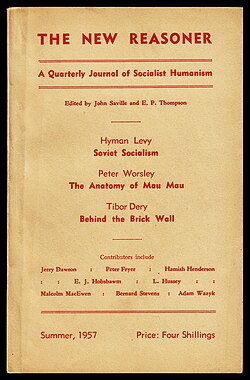
In 1960, The New Reasoner merged with the Universities and Left Review to form the New Left Review. However, by 1962, Thompson fell out with the group led by Perry Anderson. Historians now distinguish between the "first New Left" (associated with Thompson) and the "second New Left" (associated with Anderson and later figures like Tariq Ali).
The Making of the English Working Class
Published in 1963 while Thompson was at the University of Leeds, The Making of the English Working Class remains his most influential contribution to scholarship. This massive volume, exceeding 800 pages, served as a watershed moment for social history by documenting the first working-class political left in the late 18th and early 19th centuries.
Thompson pioneered a method known as history from below. Rather than relying on official state records, he interrogated "scraps from the archive"—popular songs, threatening letters, union club cards, and workshop rituals—to reconstruct the beliefs and aspirations of the marginalized.
In his preface, Thompson famously expressed his desire to rescue figures such as the Luddite cropper and the hand-loom weaver from the "enormous condescension of posterity," arguing that their aspirations were valid within the context of their own lived experiences.
Redefining Class and Consciousness
One of Thompson's most significant theoretical contributions was his definition of class. He argued that class is not a static structure or a mathematical category, but a relationship. According to Thompson, class emerges when people with shared experiences feel and articulate their interests as being opposed to those of another group.
He distinguished between the productive relations people are born into and class-consciousness, which is the cultural way those experiences are handled through traditions, ideas, and value systems. This dynamic definition allowed subsequent historians, including David Montgomery and Herbert Gutman in the United States, to investigate the working classes as active agents in their own history.
Thompson also explored the role of crime and disorder, arguing that these were often characteristic responses to oppression. He noted that the English lower classes were controlled through harsh deterrents—such as execution, imprisonment in "hulks" (old warships), and transportation to colonies—rather than through any attempt at reform.
Time, Work-Discipline, and Industrial Capitalism
In 1967, Thompson published Time, Work-Discipline, and Industrial Capitalism, expanding his analysis into the realms of sociology and anthropology. He examined time discipline: the social and economic rules governing how time is measured and observed.
Thompson posited that the Industrial Revolution necessitated a shift from "natural rhythms" (such as sunrise and seasonal changes) to a precise, standardized clock-time. He argued that neither the modern state nor industrial capitalism could have functioned without this imposition of synchronic time.
Under this new system, clock-time became a tool for social control. Capitalists required precise monitoring of labor to maximize profit, fundamentally changing the relationship between the worker and the clock and replacing collective wisdom with mechanized discipline.
Key Facts
- Major Work: The Making of the English Working Class (1963) established the foundation for modern social history.
- Methodology: Championed "history from below," using non-traditional archives to recover the voices of the poor and marginalized.
- Class Theory: Defined class as a relationship and a process of consciousness rather than a fixed social structure.
- Political Influence: A key figure in the "first New Left" and a proponent of socialist humanism.
- Sociological Insight: Identified "time discipline" as a critical mechanism of control during the Industrial Revolution.
| Work/Movement | Key Focus | Core Contribution |
|---|---|---|
| Biography of William Morris | Politics and Art | Emphasized the domestic roots of British Marxism. |
| The New Reasoner | Democratic Socialism | Developed a socialist alternative to official Marxism. |
| The Making of the English Working Class | Social History | Rescued the history of the early working class from "posterity." |
| Time, Work-Discipline, and Industrial Capitalism | Sociology of Time | Linked clock-time to capitalist social control. |
Frequently Asked Questions
What is "history from below"?
History from below is a methodological approach that focuses on the experiences and perspectives of ordinary people—such as laborers, artisans, and the poor—rather than focusing exclusively on political leaders, elites, or official state narratives.
How did Thompson define "class"?
Thompson viewed class not as a rigid structure, but as a relationship that develops when people with common experiences articulate their shared interests in opposition to those with different, often opposing, interests.
What was the "New Left"?
The New Left was an informal movement of dissident leftists in the late 1950s and early 1960s. It sought a democratic socialist alternative to both the official Marxism of the Soviet-aligned parties and the managerial social democracy of the Labour Party.
What is "time discipline" in the context of Thompson's work?
Time discipline refers to the shift from natural, collective perceptions of time to the standardized, precise measurement of clock-time. Thompson argued this was essential for the functioning of industrial capitalism and served as a tool for monitoring and controlling labor.
Why was the biography of William Morris significant?
It was an attempt to reclaim William Morris as a political figure and a revolutionary, countering decades of criticism that had focused almost entirely on his artistic achievements while downplaying his socialist convictions.