
Eagle Mountain: The Rise and Fall of a California Mining Town
Nestled in the desert landscape of Southern California, Eagle Mountain stands as a testament to the rapid industrialization and subsequent decline of the American mid-century mining era. Founded in 1948 by the Kaiser Steel Corporation, this planned community was built to support what would become the largest iron mine in Southern California, fueling the growth of the West Coast's industrial infrastructure.
The Golden Era of Kaiser Steel
The origins of Eagle Mountain are tied to the strategic vision of Kaiser Steel. In the late 1930s, Kaiser established the first fully integrated steel mill—a facility capable of handling every stage of steel production from raw ore to finished product—on the West Coast. By 1942, a mill was operational in Fontana, California, located 112 miles west of the mine. To secure a steady supply of high-grade iron ore, Kaiser purchased idle mines from the Southern Pacific Railroad, transforming a former agricultural area known for pig farming into an industrial powerhouse.
As production ramped up during World War II, the town of Eagle Mountain was constructed to house the workforce. At its peak, the community boasted a population of 4,000 residents. It was a fully realized town featuring wide, landscaped streets, over 400 homes (some with up to four bedrooms), boarding houses, and dormitories for itinerant workers.
The town offered an array of amenities that made it a self-sufficient hub, including:
- Education and Faith: Three schools and eight churches.
- Recreation: A community swimming pool, lighted tennis courts, a baseball diamond, a park, and a bowling alley.
- Commerce: A shopping center and two gas stations.
- Culture: A community auditorium.
The workforce was highly organized, with various crafts represented by a single bargaining unit consisting of five unions, including the International Brotherhood of Teamsters and the Laborers' International Union of North America.
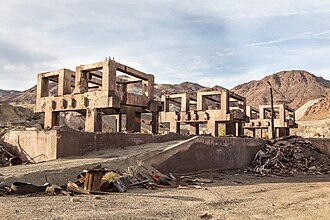
Logistics and Production
The operation relied on the Eagle Mountain Railroad, a 51-mile branch line connecting the mine to the Southern Pacific Railroad near the northeast shore of the Salton Sea. This rail link was vital for transporting ore to the Fontana plant, with five to eight 100-car trains running weekly. The scale of the operation was immense, culminating in a ceremony on August 17, 1977, to commemorate the shipment of the mine's 100 millionth ton of iron ore.
The Decline and Shutdown
The prosperity of Eagle Mountain began to fade in the 1970s. A combination of stiff foreign competition and increasing environmental concerns led to a sharp reduction in iron output. By 1980, the population had plummeted. Although the mine briefly shut down in the summer of 1980, it reopened in September with a significantly reduced workforce of 750 residents and 150 workers based in Indio.
The end came swiftly in the early 1980s. On November 3, 1981, Kaiser Corporation announced the phased closure of the Eagle Mountain Mine and half of the Fontana works. The community dismantled rapidly: the grocery store closed in October 1982, and the post office closed in 1983. The final graduating class of Eagle Mountain High School celebrated their commencement in June 1983, marking the official end of the town's primary era.
Attempts at Resurgence
Following the mine's closure, several attempts were made to repurpose the site. In 1988, the shopping center was converted into the Eagle Mountain Community Correctional Facility, a privately operated prison for low-risk inmates. However, this facility closed in December 2003 following state budget issues and a fatal riot.
Another ambitious proposal sought to turn the massive open-pit mine—measuring 1.5 miles long by half a mile wide—into a high-tech sanitary landfill. This project, involving Kaiser Ventures and the Los Angeles Sanitation District (LASD), aimed to transport waste by rail from Los Angeles. However, the project was plagued by environmental lawsuits and was eventually discontinued by the LASD in May 2013 due to increased recycling rates and the acquisition of an alternative site in Imperial County.
Renewable Energy and New Ownership
More recently, the site has been eyed for green energy. Eagle Crest Energy, later partnering with NextEra Energy, proposed a 1300 MW pumped-storage hydroelectricity plant. This system would pump groundwater from the Chuckwalla Valley aquifer between two reservoirs (former mining pits) to store energy during low demand and generate electricity during peak periods. While praised for promoting renewable energy, the project faced criticism from environmentalists concerned about the impact on Joshua Tree National Park.
The most recent chapter began on April 17, 2023, when California-based Ecology Mountain Holdings purchased the land and mining site for $22.5 million. The current intentions for the property remain undisclosed.
Key Facts
- Peak Population: 4,000 residents.
- Major Milestone: 100 millionth ton of iron ore shipped on August 17, 1977.
- Infrastructure: Connected to the Salton Sea via the 51-mile Eagle Mountain Railroad.
- Mine Dimensions: Open-pit mine measuring 1.5 miles long by 0.5 miles wide.
- Recent Sale: Purchased by Ecology Mountain Holdings in 2023 for $22.5 million.
| Era/Project | Primary Purpose | Status/Outcome |
|---|---|---|
| Kaiser Steel (1948-1983) | Iron Ore Mining | Closed due to competition/environment |
| Correctional Facility (1988-2003) | Low-risk Prison | Closed due to riots/budget |
| Proposed Landfill (1988-2013) | Waste Management | Cancelled by LASD |
| Pumped-Storage Project | Hydroelectric Power | Proposed/Contested |
Frequently Asked Questions
Why did the Eagle Mountain mine close?
The mine closed due to a combination of increased environmental concerns during the 1970s and intense competition from foreign iron producers, which made the operation economically unsustainable.
What happened to the town's infrastructure after the shutdown?
The town's population dwindled as businesses and services closed. The grocery store shut down in 1982, the post office in 1983, and the high school ceased operations after the final graduation in June 1983.
What is a pumped-storage hydroelectricity plant?
It is a system that stores energy by pumping water from a lower reservoir to an upper reservoir during periods of low electricity demand. When demand is high, the water is released back down through turbines to generate power.
Who currently owns the Eagle Mountain site?
As of April 17, 2023, the land and mining site are owned by Ecology Mountain Holdings, which purchased the property for $22.5 million.
How was the iron ore transported to the steel mill?
Ore was transported via the Eagle Mountain Railroad, a 51-mile branch line that connected the mine to the Southern Pacific Railroad, eventually reaching the Fontana steel plant via five to eight 100-car trains per week.