
Edme-Louis Daubenton and the Illustrations of Histoire Naturelle
In the golden age of 18th-century natural history, the pursuit of documenting the natural world required not only scientific observation but also immense artistic coordination. Edme-Louis Daubenton (1730–1785) was a French naturalist who played a pivotal role in this endeavor, bridging the gap between scientific description and visual representation.
The Collaboration with the Comte de Buffon
Daubenton is most recognized for his work with Georges-Louis Leclerc, the Comte de Buffon. Buffon engaged Daubenton to supervise the colored illustrations for his monumental work, Histoire Naturelle, published between 1749 and 1789. This massive undertaking sought to categorize the natural world, and the visual component was essential to its scope.
The resulting collection, known as the Planches enluminée (illuminated plates), began appearing in 1765. These plates were a feat of production, consisting of 1,008 plates that were all engraved by François-Nicolas Martinet and subsequently painted by hand.
Production and Scope of the Planches enluminée
The creation of these illustrations was a collaborative effort involving more than 80 artists. While the Parisian publisher Panckoucke released a version of the plates without accompanying text between 1765 and 1783, the original project remained a cornerstone of Buffon's work.
The distribution of the subjects within the 1,008 plates was heavily weighted toward ornithology. A total of 973 plates focused on birds, while the remaining illustrations covered butterflies, other insects, and corals.
Although the illustrations were not considered highly successful in their time, they remain scientifically valuable today. They provide a reliable means of species determination, including for some species that are now extinct.
Nomenclature and Scientific Legacy
A significant challenge arose regarding the naming of the species. Buffon did not utilize the system of biological nomenclature—the formal system of naming species—developed by Carl von Linné. To resolve this discrepancy, Pieter Boddaert published a correspondence table in 1783, linking Buffon's terminology with the standard Linnean binomial names (the two-part naming system consisting of genus and species).
Key Facts
- Role: Edme-Louis Daubenton supervised the colored illustrations for the Histoire Naturelle.
- Volume: The Planches enluminée consisted of 1,008 hand-painted plates.
- Artistry: All plates were engraved by François-Nicolas Martinet, with contributions from over 80 artists.
- Subject Matter: 973 plates depicted birds, with others focusing on insects and corals.
- Scientific Value: The plates allow for the identification of species, including extinct ones.
- Correction: Pieter Boddaert provided the link between Buffon's names and Linnean binomial nomenclature.
| Feature | Detail |
|---|---|
| Total Plates | 1,008 |
| Engraver | François-Nicolas Martinet |
| Bird Illustrations | 973 plates |
| Publication Period | 1765–1783 (Panckoucke version) |
| Number of Artists | 80+ |
Frequently Asked Questions
Who was Edme-Louis Daubenton?
He was a French naturalist who supervised the hand-painted illustrations for the Comte de Buffon's Histoire Naturelle.
What were the Planches enluminée?
They were a series of 1,008 hand-painted, engraved plates illustrating various species, primarily birds, for the Histoire Naturelle.
Why was Pieter Boddaert's work important?
Because Buffon did not use the Linnean system of biological nomenclature, Boddaert created a table to map Buffon's names to the accepted Linnean binomial names.
Are the illustrations still useful today?
Yes, they are useful for the determination of species, particularly for those that have since become extinct.
Where is Edme-Louis Daubenton buried?
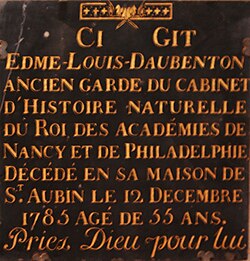
His tombstone is located in the church of Saint-Pierre in Avon, Seine-et-Marne.