
Election History and Voting Trends (1910-2024)
The electoral landscape of this constituency has undergone a profound transformation over the last century. From its inception as a Unionist stronghold in the early 20th century to the competitive multi-party contests of the modern era, the voting patterns reflect broader shifts in political alignment and voter engagement.
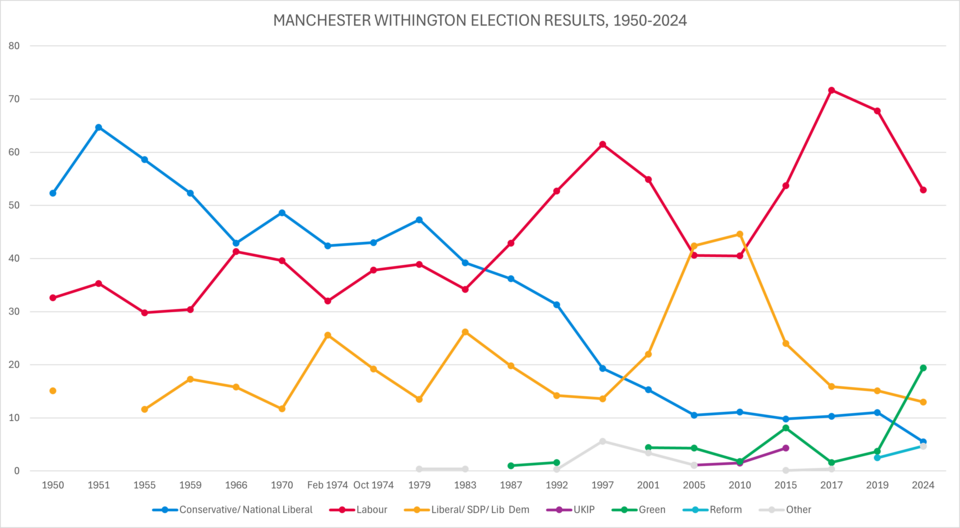
Historically, the seat was dominated by the Conservative and Unionist parties for several decades. However, the latter half of the century saw a steady rise in Labour support, eventually leading to a period of volatility where the Liberal Democrats also emerged as a significant force before the current era of Labour dominance.
Key Facts
- Longest Tenure: The Conservative Party held the seat consistently from the 1910s through the 1970s.
- Modern Dominance: Jeff Smith (Labour) has been a central figure in recent elections, securing a hold in the 2020s with 52.9% of the vote.
- Highest Turnout: The 1950s saw some of the highest engagement levels, peaking at 85.31% in one instance.
- Recent Shifts: The Green Party has seen a significant surge in the 2020s, reaching 19.4% of the vote.
- Historical Volatility: The 1920s were marked by frequent swings between the Liberal and Unionist parties.
Detailed Electoral Analysis
The Modern Era: 2000s to 2020s
In the most recent election of the 2020s, Labour maintained its hold with Jeff Smith receiving 22,066 votes (52.9%). While Labour remains the dominant party, there has been a notable shift in the opposition; the Green Party, led by Sam Easterby-Smith, saw a significant increase to 19.4%, while the Conservatives fell to 5.5%.
The 2010s were characterized by a strong Labour presence, with Jeff Smith achieving peaks of 71.7% of the vote. However, the decade also saw a period of Liberal Democrat strength, including a gain from Labour in the early 2010s when John Leech secured the seat.
The Mid-Century Transition: 1940s to 1990s
The late 20th century marked the transition from Conservative to Labour control. Throughout the 1990s, Keith Bradley established a firm grip on the seat for Labour, often securing over 50% of the vote. This followed a period in the 1980s where the seat swung from Conservative to Labour, signaling a permanent shift in the local political climate.
From the 1940s through the 1970s, the Conservatives remained the primary power. Robert Cary and Fred Silvester were key figures during this era, maintaining holds despite fluctuating turnouts and the occasional rise of Liberal challengers.
Early Foundations: 1910s to 1930s
The seat was created in the 1910s with a Unionist victory. The 1920s were particularly unstable, featuring a "tug-of-war" between the Liberals and Unionists. Ernest Simon (Liberal) and Thomas Watts (Unionist) traded the seat multiple times before the Conservatives regained a stable hold in the 1930s under Edward Fleming.
Election Summary Table
| Era | Dominant Party | Key Candidate(s) | Notable Trend |
|---|---|---|---|
| 2020s | Labour | Jeff Smith | Rise of Green Party |
| 2010s | Labour / Lib Dem | Jeff Smith / John Leech | High Labour peaks |
| 1990s | Labour | Keith Bradley | Consolidation of Labour hold |
| 1950s-70s | Conservative | Robert Cary / Fred Silvester | Consistent Conservative hold |
| 1910s-30s | Unionist / Liberal | Ernest Simon / Thomas Watts | High volatility and seat swaps |
Frequently Asked Questions
Who is the current representative based on the latest data?
Jeff Smith of the Labour Party holds the seat, most recently securing 52.9% of the vote in the 2020s election.
Which party held the seat for the longest continuous period?
The Conservative Party held the seat most consistently from the 1910s through the 1970s, with figures like Robert Cary and Fred Silvester maintaining control.
How has the Green Party's performance changed recently?
The Green Party has seen a substantial increase in support, rising from low single digits in previous decades to 19.4% in the most recent 2020s results.
What was the highest voter turnout recorded?
The highest recorded turnout was 85.31% during the 1950s elections.
When did the seat first become available?
The seat was first contested in the 1910s, resulting in a Unionist win.