
Elizabeth Garrett Anderson: A Pioneer of Women in Medicine
In the mid-19th century, the medical profession was a strictly guarded male bastion. Elizabeth Garrett Anderson challenged these systemic barriers, not only by securing her own qualifications but by building the infrastructure necessary for other women to follow in her footsteps. Her journey from a private practitioner to a medical educator and institutional leader redefined the role of women in British healthcare.
Breaking Barriers in Private Practice
Despite becoming a licentiate of the Society of Apothecaries, Garrett found that her gender barred her from holding medical posts in any established hospital. In response, she opened her own private practice at 20 Upper Berkeley Street, London, in late 1865. While her patient base grew slowly at first, a cholera outbreak in Britain during 1865 helped shift public perception; the urgency of the crisis led some to overlook their prejudices against female physicians.
Driven by a desire to provide medical care to impoverished women, Garrett established St Mary's Dispensary for Women and Children at 69 Seymour Place in 1866. The impact was immediate: in its first year alone, the dispensary treated 3,000 new patients across 9,300 outpatient visits.
Pursuing International Qualifications
Recognizing that the University of Sorbonne in Paris was open to female medical students, Garrett studied French to pursue a formal medical degree. Despite facing various difficulties, she successfully obtained her degree in 1870, further solidifying her professional standing.
Institutional Leadership and Education
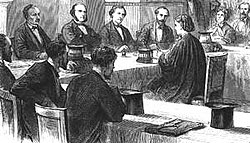
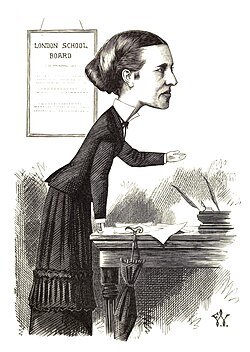
The year 1870 marked a turning point in Garrett's public life. She was elected to the first London School Board—a role newly available to women—receiving the highest vote of all candidates. Simultaneously, she became a visiting physician at the East London Hospital for Children (later the Queen Elizabeth Hospital for Children), making her the first woman in Britain to hold a hospital medical post. However, the demands of motherhood and her private practice led her to resign from these roles by 1873.
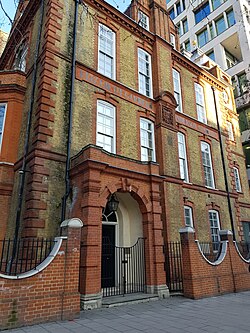
In 1872, her dispensary evolved into the New Hospital for Women and Children, specializing in gynaecological conditions. By 1874, the hospital moved to new premises in Marylebone Street. The facility was designed by architect J. M. Brydon, with contributions from Garrett's sister, Agnes Garrett, and her cousin, Rhoda Garrett. For many years, the hospital remained staffed entirely by women.
The London School of Medicine for Women
To ensure a sustainable pipeline of female doctors, Garrett co-founded the London School of Medicine for Women (LSMW) in 1874 alongside Sophia Jex-Blake. As a lecturer and later the dean from 1883 to 1902, Garrett helped lead the only teaching hospital in Britain offering courses for women. The school, located in Hunter Street, eventually grew to over 200 students, many of whom pursued degrees from London University after it opened its doors to women in 1877. The institution later became the Royal Free Hospital School of Medicine and eventually integrated into University College London.
Advocacy and the British Medical Association
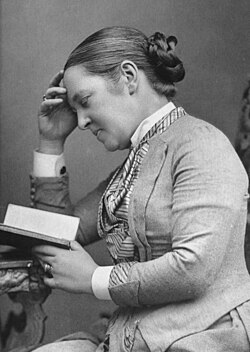
Garrett's entry into professional societies was often met with resistance. After she gained membership in the British Medical Association (BMA) in 1873, a motion was proposed in 1878 to exclude women following the election of Garrett Anderson and Frances Hoggan. While Dr. Norman Kerr defended the equal rights of members, the BMA eventually moved to exclude women.
Garrett did not relent. Following a long campaign, she, Dr. Sarah Gray, and Dr. Eliza Walker Dunbar successfully lobbied for the readmission of women at the 1892 BMA meeting in Nottingham. Her leadership within the organization culminated in 1897, when she was elected president of the East Anglian branch of the BMA.
Key Facts
- First Hospital Post: First woman in Britain appointed to a medical post (East London Hospital for Children).
- Educational Legacy: Co-founded the London School of Medicine for Women in 1874.
- Clinical Impact: St Mary's Dispensary treated 3,000 new patients in its first year.
- Academic Achievement: Obtained a medical degree from the University of Sorbonne in 1870.
- BMA Leadership: Elected president of the East Anglian branch of the British Medical Association in 1897.
| Year | Achievement/Event | Significance |
|---|---|---|
| 1865 | Opened private practice | Established independent medical career in London |
| 1866 | Founded St Mary's Dispensary | Provided care for poor women and children |
| 1870 | Sorbonne Medical Degree | Secured formal medical qualification |
| 1872 | New Hospital for Women and Children | Created a specialized gynaecological facility |
| 1874 | Co-founded LSMW | Established medical education for women in Britain |
| 1892 | BMA Readmission | Successfully lobbied for women's return to the BMA |
Frequently Asked Questions
Why did Elizabeth Garrett Anderson study in Paris?
She studied in Paris because the Dean of the faculty of medicine at the University of Sorbonne was in favor of admitting women, allowing her to obtain a medical degree that was difficult to secure in Britain at the time.
How did the cholera outbreak affect her practice?
The 1865 cholera outbreak created a state of panic that led some people to set aside their prejudices against female physicians, helping her practice grow.
What was Garrett's response to Henry Maudsley's views on women's education?
Maudsley argued that education caused over-exertion and reduced reproductive capacity. Garrett countered that the real danger to women was boredom, advocating for fresh air and exercise over sedentary habits.
What happened to the London School of Medicine for Women?
The school later became the Royal Free Hospital School of Medicine and eventually became part of the medical school of University College London.
Did the BMA always allow women members?
No. After Garrett and Frances Hoggan joined, a motion was passed in 1878 to exclude women. It was not until 1892, after a long campaign led by Anderson and others, that women were readmitted.