
Emma Curtis Hopkins: The Architect of the New Thought Movement
Emma Curtis Hopkins was a pivotal figure in the evolution of American metaphysical healing. While her career began under the tutelage of Mary Baker Eddy, the founder of Christian Science, Hopkins eventually forged her own path, creating a theological bridge that led to the birth of the New Thought movement—a spiritual philosophy emphasizing the power of the mind to heal and transform life.
The Boston Years and the Split with Mary Baker Eddy
Hopkins first encountered Christian Science in 1881, reporting a personal healing experience. By December 1883, she had enrolled in a one-week basic course at the Massachusetts Metaphysical College in Boston. Though she became a recognized practitioner and a contributor to The Christian Science Journal, her relationship with Eddy was complex. Eddy never authorized Hopkins as a teacher, restricting her progress to the primary class.
In September 1884, Hopkins was appointed editor of The Christian Science Journal. During this time, her writings began to reflect an eclecticism—the practice of deriving ideas from a diverse range of sources—incorporating elements of Buddhism, Islam, the Upanishads, and the philosophy of Baruch Spinoza. Despite these diverging interests, Hopkins initially remained a staunch defender of Eddy against other former students.
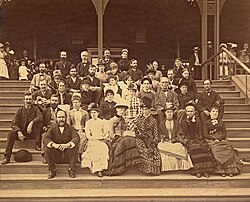
The turning point came through the influence of Mary H. Plunkett, a fellow student who sought to establish a rival movement. As Plunkett swayed Hopkins away from Eddy, the tension culminated in Hopkins' removal from her editorial position and her resignation from the Christian Science Association on November 4, 1884. Hopkins cited ideological and financial disagreements as the primary reasons for the break.
Establishing a Metaphysical Empire in Chicago
By 1886, Hopkins and Plunkett relocated to Chicago to launch their own educational venture. After a brief stint editing the Mind Cure Journal for A. J. Swarts, the duo founded the Emma Curtis Hopkins College of Christian Science. With Hopkins as the teacher and Plunkett as the business administrator, the college quickly gained traction.
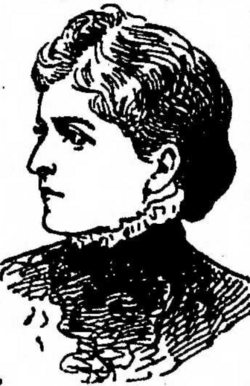
The college's first graduating class in June 1886 included influential figures such as Mabel McCoy and Kate Bingham, who would later help found Divine Science. Hopkins' reach expanded rapidly; she lectured in major cities including San Francisco and New York, sometimes attracting thousands of students. By 1887, twenty-one Hopkins Associations existed across the United States.
Hopkins consciously aligned her movement with the burgeoning women's rights movement in Chicago. Seeking to avoid the male dominance characteristic of the medical profession, she fostered a predominantly female environment for her students and patients.
The Transition to the Theological Seminary
The partnership between Hopkins and Plunkett collapsed around 1888. Plunkett left for New York, taking the organization's mailing lists and renaming their magazine the International Magazine of Christian Science. A subsequent public scandal involving Plunkett and a bigamist named Arthur Bentley Worthington led Hopkins to sever all ties with her former ally.
In the wake of this split, Hopkins reorganized her institution into the Christian Science Theological Seminary. Adopting a Protestant seminary model, she assumed the role of bishop and began ordaining her students. This was a landmark event in religious history, as Hopkins became the first woman in modern times to ordain others as ministers.
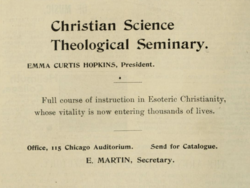
The seminary became a catalyst for the New Thought movement. By 1893, it had trained over 350 students, with more than 100 ordained. To further distance herself from Mary Baker Eddy, Hopkins eventually dropped the term "Christian Science," renaming her publication the Universal Truth magazine and her association the "Truth Students Association."
Key Facts
- First Female Ordainer: Emma Curtis Hopkins is recognized as the first woman in modern times to ordain other ministers.
- Educational Impact: Her seminary trained over 350 students and ordained more than 100 by 1893.
- New Thought Influence: Her teachings served as the seed organizations from which the broader New Thought movement emerged.
- Rapid Growth: At her peak, she had associations in 21 different locations across America.
- Gender Advocacy: She intentionally aligned her metaphysical work with the women's suffrage and rights movements.
| Period | Primary Role | Key Organization | Key Associate |
|---|---|---|---|
| 1883–1884 | Practitioner / Editor | Massachusetts Metaphysical College | Mary Baker Eddy |
| 1886–1888 | Teacher / Founder | Emma Curtis Hopkins College of Christian Science | Mary H. Plunkett |
| 1888–1895 | Bishop / President | Christian Science Theological Seminary | Various students |
| 1895–1928 | Lecturer / Mentor | Private Practice (NYC) | Ernest Holmes |
Later Life and Legacy
In 1895, Hopkins closed her seminary and moved to New York City. While she largely retired from formal teaching, she continued to mentor a select few, including Ernest Holmes. She also provided metaphysical treatment to prominent socialites and artists, such as Mabel Dodge Luhan. In 1918, she was named the honorary president of the International New Thought Alliance.
Hopkins spent her final years in her childhood home of Killingly, Connecticut, where she passed away in 1928 at the age of seventy-five. Her legacy was preserved through her sister, Estelle Carpenter, and the establishment of "Joy Farm," a facility dedicated to perpetuating her teachings.
Frequently Asked Questions
What was the main cause of the split between Emma Curtis Hopkins and Mary Baker Eddy?
The split was driven by ideological and financial grounds, as well as the influence of Mary H. Plunkett, who encouraged Hopkins to establish a rival movement. Additionally, Hopkins' interest in eclecticism—incorporating non-Christian spiritual sources—diverged from Eddy's strict teachings.
How did Hopkins contribute to the rights of women in religion?
Hopkins became the first woman in modern times to ordain other ministers. She intentionally structured her seminary to empower women, attracting suffragists and ensuring that women held significant roles in the ministry and leadership of her movement.
What is the relationship between Hopkins and the New Thought movement?
Hopkins' college and seminary are considered the "seed organizations" of New Thought. By modifying the theology of Christian Science and moving toward a more universalist approach, she provided the foundation for many subsequent New Thought practitioners and organizations.
Who were some of Hopkins' most notable students?
Notable students included Ernest Holmes, as well as Mabel McCoy and Kate Bingham, who influenced the founding of Divine Science. She also provided metaphysical treatment to figures like Mabel Dodge Luhan and various New York artists.
Did Hopkins continue to use the term "Christian Science" throughout her career?
No. While she began her career within that framework, by the 1890s she began dispensing with the term to differentiate her work from Mary Baker Eddy's. She renamed her magazine Universal Truth and her association the "Truth Students Association."