
EPFL Campus: A Hub of Innovation and Sustainability in Lausanne
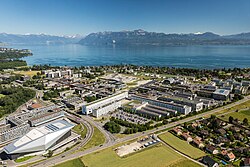
The École Polytechnique Fédérale de Lausanne (EPFL) is more than just an academic institution; it is a sprawling center of scientific excellence located on the shores of Lake Geneva. While its origins trace back to the École d'ingénieurs de l'Université de Lausanne in the center of Lausanne, the modern campus at Dorigny in Écublens began construction in 1974. Since the inauguration of its first buildings in 1978, the site has evolved into a world-class environment for research and learning.
Together with the University of Lausanne (UNIL), EPFL forms a massive academic complex that supports approximately 20,000 students combined, creating a vibrant intellectual ecosystem in Western Switzerland.
Key Facts
- Campus Size: Approximately 65 buildings across 55 hectares (136 acres).
- Population: 14,000 people, including 9,300 students and 4,700 staff and entrepreneurs.
- Diversity: Over 125 nationalities represented, with 48% of students being foreign nationals.
- Sustainability: Powered by 100% certified hydroelectric electricity since 2012.
- Recognition: First campus to receive the International Sustainable Campus Excellence Award.
Campus Evolution and Architecture
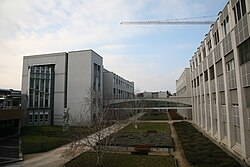
The EPFL campus has grown in distinct phases, reflecting the evolution of architectural styles and the expanding needs of the institution. The initial development stages were completed in 1984 and 1990, focusing on modular buildings that now house the Schools of Basic Sciences, Architecture, Civil and Environmental Engineering, and Mechanical and Electrical Engineering.
The late 1990s and early 2000s saw a shift toward specialized facilities. The Microtechnology building (BM) was completed in 1998, followed by the architecture building (SG) in 2000. By 2002, the department of architecture moved to the Écublens site, successfully uniting all EPFL departments on a single campus.
Modern Landmarks
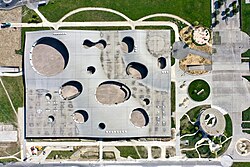
In recent years, the campus has added iconic structures that blend utility with avant-garde design. The Rolex Learning Center, completed in February 2010, serves as the central library and a multipurpose hub for work, leisure, and services.
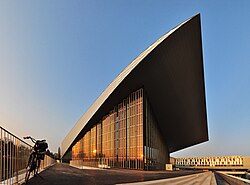
Further expansion included the SwissTech Convention Center, inaugurated in March 2014, and the "Quartier Nord," which provides student accommodation and retail shops. Additionally, the EPFL-Pavilions, designed by Kengo Kuma and opened in 2016, hosts the Montreux Jazz Festival archives, museum experimentations, and the DataSquare—an exhibition on Big data featuring the Human Brain Project and the Venice Time Machine.
Infrastructure and Regional Reach
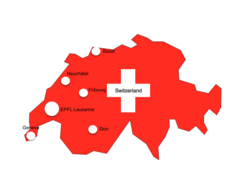
The campus is designed for accessibility and environmental responsibility. It is served by the Lausanne Metro Line M1 and features an electric bicycle sharing system. Beyond the main site, EPFL maintains a strategic network of associated campuses across Western Switzerland to foster collaboration with hospitals and other academic institutions:
- Geneva: Campus Biotech (including the Wyss Center for Bio- and Neuro-engineering).
- Neuchâtel: Microcity.
- Sion: Pôle EPFL Valais.
- Fribourg: Smart Living Lab.
Student Life and Support
EPFL emphasizes a multicultural environment through its Language Centre, which provides modules in French, German, Italian, and English (CEFR levels A1 to C2). To encourage peer-to-peer learning, the university participates in a Tandem Program with the University of Lausanne, where individuals of different native languages meet to teach one another.
For physical well-being, EPFL and the University of Lausanne share an active sports center located 1,250 meters from the main EPFL site, accessible within a five-minute drive.
Campus Summary
| Category | Details |
|---|---|
| Total Area | 55 hectares (136 acres) |
| Number of Buildings | Approximately 65 |
| Student Population | ~9,300 (Bachelor, Master, Doctoral) |
| Staff & Entrepreneurs | ~4,700 |
| Energy Source | 100% Certified Hydroelectric |
| Key Facilities | Rolex Learning Center, SwissTech Convention Center, Science Park |
Frequently Asked Questions
How sustainable is the EPFL campus?
EPFL is highly sustainable; since 2012, it has used only certified hydroelectric electricity to power the campus. It was also the first campus to be honored with the International Sustainable Campus Excellence Award by the International Sustainable Campus Network.
What is the Rolex Learning Center?
Completed in 2010, the Rolex Learning Center is the main library of the campus. It is located at the center of the site and provides integrated spaces for study, leisure, and various services.
Does EPFL have locations outside of Lausanne?
Yes, EPFL operates several associated campuses in Western Switzerland, including Campus Biotech in Geneva, Microcity in Neuchâtel, Pôle EPFL Valais in Sion, and the Smart Living Lab in Fribourg.
What language support is available for students?
The Language Centre offers communication modules in English, French, German, and Italian ranging from CEFR levels A1 to C2. Students can also participate in the Tandem Program to practice languages with partners from the University of Lausanne.
Who has access to the sports facilities?
EPFL and the University of Lausanne share a joint active sports center located on the shores of Lake Geneva, approximately 1.25 km from the EPFL campus.